

On this page
What happens when you cut a lens in half depends on which way you cut. NCERT's Class 10 science chapter on light asks a close cousin of this question, whether a convex lens with one half covered in black paper still makes a complete image (NCERT Class 10 Science, Light – Reflection and Refraction, exercise 9).
What decides the focal length of a lens?
The lens maker's formula, 1/f = (n − 1)(1/R1 − 1/R2), gives a thin lens's focal length from its refractive index n and the radii of curvature R1 and R2 of its two surfaces (NCERT Class 12 Physics, Ray Optics, Eq. 9.21). Notice what is missing: the lens's width, and how much of it light passes through. Focal length changes only if a surface or the material changes.
What happens to focal length when a lens is cut in half?
Cut along the principal axis
Slice through a diameter, so the cut plane contains the principal axis. Each half keeps both curved surfaces, so R1, R2 and n are unchanged and the focal length stays f. Each half forms the image at the same distance, just with less light.
Cut across the principal axis
Now slice an equiconvex lens through its thickness, perpendicular to the axis. Each piece is plano-convex: one surface keeps radius R, the other is flat, so R = ∞ for that face. By the lens maker's formula, the whole lens has 1/f = (n − 1)(2/R) and each half has 1/f′ = (n − 1)(1/R). So f′ = 2f, and each half has half the power.
You can check this with the rule for thin lenses in contact: their powers add, P = P1 + P2 + … (NCERT Class 12 Physics, Eq. 9.32). Put the halves back together and P/2 + P/2 gives back P. With unequal radii, the halves have focal lengths R1/(n − 1) and R2/(n − 1) in size.
Does covering half a lens cut off half the image?
No. NCERT explains why: each point on an object gives out an infinite number of rays, and all of them pass through the same image point after refraction (NCERT Class 12 Physics, Ray Optics). Block the lower half and rays through the upper half still reach every image point: the complete image, same position, same size.
What changes is brightness. The light a lens or mirror collects depends on the area of its opening; OpenStax's astronomy textbook notes that a 4-metre mirror can collect 16 times as much light as a 1-metre one, because area grows with the square of the diameter (OpenStax Astronomy 2e, Telescopes). Cover half the area and roughly half the light reaches an image of the same size, so it looks about half as bright.
A worked example: one lens, four cases
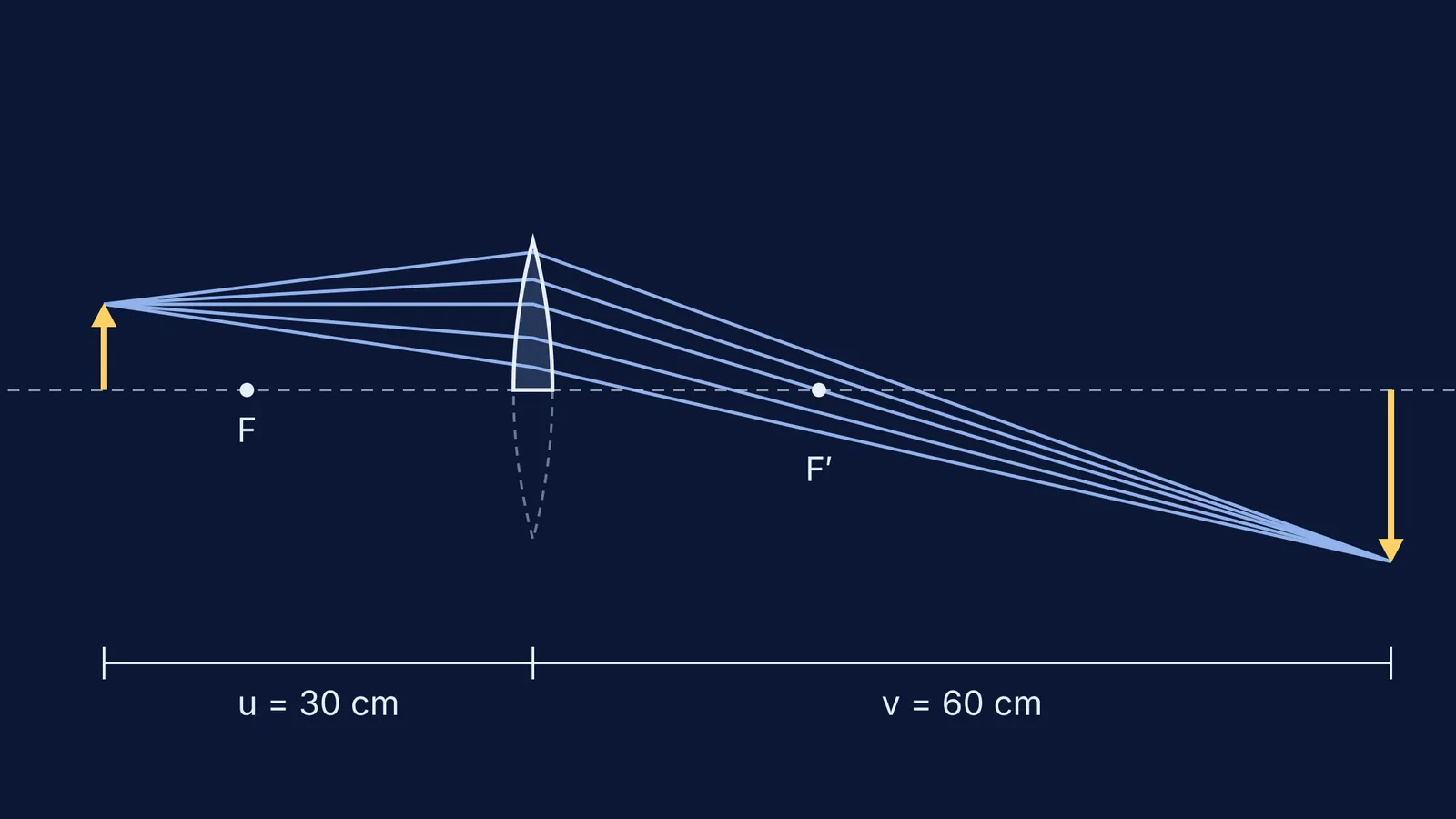
Take an equiconvex glass lens with n = 1.5 and R = 20 cm, and an object 30 cm in front of it. The lens maker's formula gives 1/f = 0.5 × (1/20 + 1/20), so f = 20 cm, a power of +5 D. Then use the lens formula 1/v − 1/u = 1/f with u = −30 cm (NCERT Class 10 Science, Eq. 9.8), as in our Class 10 guide to reflection, refraction and the lens formula.
Whole lens: 1/v = 1/20 − 1/30 = 1/60, so v = +60 cm and m = v/u = −2. Real, inverted, twice the size.
Lower half covered: f, v and m unchanged; the full image forms at 60 cm, about half as bright.
Cut along the axis, one half used: same as case 2.
Cut across the axis, one plano-convex half used: f′ = 40 cm (+2.5 D). Now 1/v = 1/40 − 1/30 = −1/120, so v = −120 cm and m = +4. The image is virtual, erect and four times the size.
How do you check any cut or covered lens question?
Ask, in order:
Did either curved surface change? If not, f is the same. If a face became flat, put R = ∞ in the lens maker's formula.
Did the area that light passes through change? Then brightness changes in proportion; image size and position do not.
Did the optical centre move? Pull apart two halves cut along the axis and each carries its own optical centre, so each forms its own image.
If signs trip you up, see common sign-convention mistakes with the mirror and lens formulas; for lenses joined together, see lens maker's formula and lens combinations, with worked examples.
The Fermi Problem Library has worked problems with a step-by-step solver that explains the reasoning rather than printing an answer. If the lens maker's formula itself feels shaky, the Fermi Concept Library gives each physics concept its own lesson.
Next time a question says cut or covered, sketch the two surfaces first.


