

On this page
A moving coil galvanometer is the heart of both the ammeter and the voltmeter. But before you can convert a galvanometer into either device, you need to know how sensitive it is.
Students often assume that a high current sensitivity guarantees a high voltage sensitivity, a common trap in board exams.
Here is how the current and voltage sensitivity of a galvanometer are defined, the formulas you need, and why more turns in the coil do not always give you a better voltage response.
What is the current sensitivity of a galvanometer?
Current sensitivity is the deflection produced in the galvanometer per unit of current flowing through it. If a small current causes a large twist in the coil, the current sensitivity is high.
The formula for current sensitivity (I_s) is:
I_s = NAB / k
Where:
N is the number of turns in the coil.
A is the area of the coil.
B is the strength of the magnetic field.
k is the restoring torque per unit twist (the torsional constant of the suspension spring).
The SI unit is radians per ampere (rad/A). To increase current sensitivity, you can add turns, use a larger area, apply a stronger magnetic field, or choose a suspension wire with a lower torsional constant.
What is the voltage sensitivity of a galvanometer?
Voltage sensitivity is the deflection produced in the galvanometer per unit of potential difference applied across its ends.
Since the voltage V across the coil equals the current I multiplied by the electrical resistance R (V = IR), the voltage sensitivity (V_s) is the current sensitivity divided by the resistance:
V_s = I_s / R = NAB / kR
The SI unit is radians per volt (rad/V) or divisions per volt.
Why does increasing current sensitivity not increase voltage sensitivity?
This is the classic "turns paradox" that appears in almost every physics textbook.
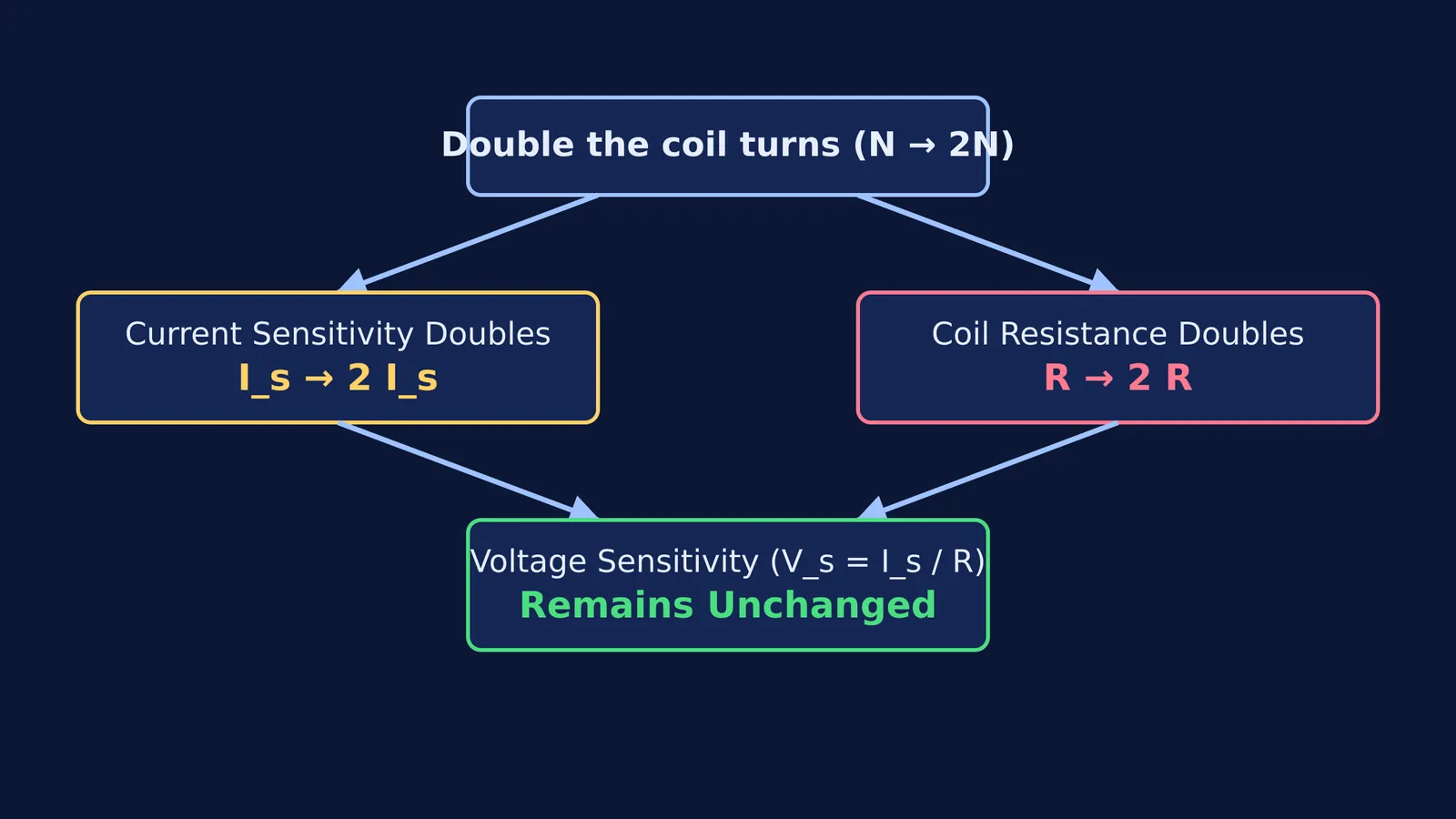
If you want to double the current sensitivity of your galvanometer, the easiest way is to double the number of turns in the coil (from N to 2N). Looking at the formula I_s = NAB / k, the current sensitivity clearly doubles.
As noted by AskFilo, doubling the turns means using twice as much wire. Assuming the wire thickness is identical, doubling its length directly doubles the electrical resistance of the coil (from R to 2R).
When you put these new values into the voltage sensitivity formula:
V_s = (2N)AB / k(2R)
The factors of 2 cancel out. The voltage sensitivity remains exactly the same (NAB / kR), even though the current sensitivity doubled. Therefore, increasing current sensitivity by adding more turns does not increase voltage sensitivity.
Worked example: comparing two galvanometers
Let us put these formulas to the test with a practical comparison of two moving coil galvanometers, M1 and M2, which have the following properties:
Galvanometer M1:
Number of turns, N1 = 30
Area, A1 = 3.6 × 10⁻³ m²
Magnetic field, B1 = 0.25 T
Resistance, R1 = 10 Ω
Galvanometer M2:
Number of turns, N2 = 42
Area, A2 = 1.8 × 10⁻³ m²
Magnetic field, B2 = 0.50 T
Resistance, R2 = 14 Ω
Assume the restoring torque per unit twist (k) is identical for both springs.
Step 1: Compare their current sensitivities Using I_s = NAB / k, we find the ratio of their current sensitivities (I_s2 / I_s1): I_s2 / I_s1 = (42 × 1.8 × 10⁻³ × 0.50) / (30 × 3.6 × 10⁻³ × 0.25) = 1.4
So, M2 is 1.4 times (or 40%) more current-sensitive than M1.
Step 2: Compare their voltage sensitivities Using V_s = I_s / R, we find the ratio of their voltage sensitivities (V_s2 / V_s1): V_s2 / V_s1 = 1.4 × (10 / 14) = 1
Though M2 has a higher current sensitivity, its increased resistance perfectly cancels out the gain, leaving the voltage sensitivity unchanged.
How to master galvanometer problems
If you are struggling to picture how the coil twists in the magnetic field, the Fermi Concept Library holds lessons on every concept in physics, placing each idea in a clear map so you can trace it back to basics.
When you are ready to tackle numericals on sensitivity, try the Fermi Problem Library. Instead of giving you the final answer, Fermi's AI tutor works through the problem with you step by step, explaining the reasoning and checking your understanding as it goes.
For more practice on how charges and fields interact, you can read our guide on the helical path of a charge in a magnetic field or review Faraday's law and the circulating E inside a solenoid.


