

On this page
If your Class XI chemistry practical includes crystallisation, copper sulphate is a common choice. CBSE's 2026-27 Class XI chemistry curriculum lists "Crystallization of impure sample of any one of the following: Alum, Copper Sulphate, Benzoic Acid" under Characterization and Purification of Chemical Substances (CBSE Chemistry curriculum 2026-27). Here is NCERT's method, the stop-heating check and the viva questions.
Why does crystallisation purify copper sulphate?
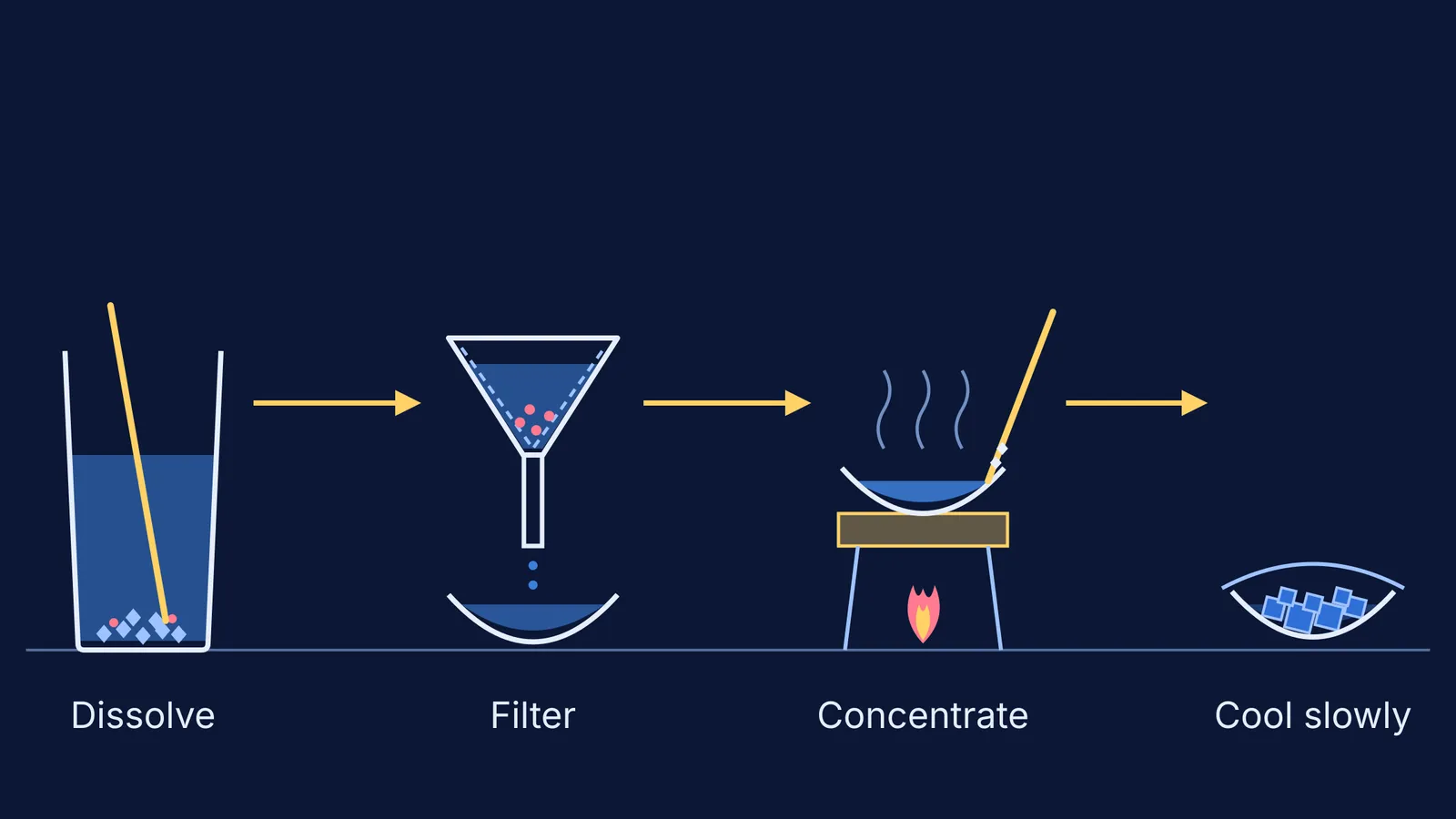
NCERT's Class XI chemistry laboratory manual sets out the idea: make a saturated solution, filter off insoluble impurities, concentrate it, then cool it slowly so the solute crystallises out, "leaving the greater part of impurities in the solution".
Mother liquor is the liquid left behind after crystallisation, and it holds the greater part of the soluble impurities (NCERT lab manual).
Colour is your first purity check: the manual notes that impurities change the colour of crystals. The usual form is copper sulphate pentahydrate, CuSO4·5H2O, a bright blue crystal, while the anhydrous salt is white (copper(II) sulfate reference_sulfate)).
How do you crystallise copper sulphate from an impure sample?
You need a 250 mL beaker, a glass funnel, a tripod stand, a porcelain dish, a glass rod and a sand bath, as listed in the NCERT lab manual. The procedure, in the manual's order:
Dissolve: take 30-50 mL of distilled water in the beaker and add the impure copper sulphate a little at a time, stirring, until no more dissolves at room temperature.
Filter: pour this saturated solution through filter paper and collect the filtrate in the porcelain dish. Insoluble dirt stays on the paper.
Concentrate: heat the dish on a sand bath until nearly three-quarters of the water has evaporated, then test for the crystallisation point.
Cool: cover the dish with a watch glass and leave it undisturbed.
Separate: when crystals have formed, pour off the mother liquor (decantation).
Wash: rinse the crystals with a very small amount of alcohol containing a little cold water, then with alcohol, in 3-4 small portions rather than one.
Dry: press the crystals between folds of filter paper and store them somewhere dry.
How do you know you have reached the crystallisation point?
The crystallisation point is when the hot solution is concentrated enough for a cooled sample to crystallise. NCERT's test is to dip a glass rod into the solution, take it out and dry it by blowing on it; if a solid film forms on the rod, stop heating (NCERT lab manual). The Royal Society of Chemistry describes the same check: put a drop of the hot solution on a glass rod and let it cool, and "if the drop crystallises on cooling, the solution is ready" (RSC Education).
Strong heating also strips the water of crystallisation. Copper sulphate pentahydrate loses two water molecules at 63 °C, two more at 109 °C and the last at 200 °C, ending up as the white anhydrous salt (copper(II) sulfate reference_sulfate)).
Why cool slowly, and what if no crystals appear?
NCERT warns that rapid cooling gives small or disfigured crystals, and its second precaution is not to disturb the solution while it cools (NCERT lab manual).
If crystals are slow to start, NCERT notes that a minute quantity of the pure substance is sometimes added during cooling. This is called seeding: the added tiny crystal acts as a nucleus on which new crystals grow (NCERT lab manual). The RSC's copper sulfate method suggests placing a splint in the liquid if crystals do not form straight away (RSC practical videos).
What viva questions come up in the copper sulphate practical?
CBSE's Class XI practical exam is worth 30 marks, of which the content-based experiment carries 6 and class record and viva another 4 (CBSE Chemistry curriculum 2026-27). NCERT's discussion questions make a good viva drill:
What is mother liquor? The liquid left after the crystals form; it holds the soluble impurities.
What is a saturated solution? One in which no more solute will dissolve at that temperature.
What is water of crystallisation? Water built into the crystal: five molecules per formula unit in CuSO4·5H2O.
What happens on strong heating? The crystals lose that water and turn into white anhydrous copper sulphate.
Which processes are involved? Dissolving, filtration, concentration, cooling, decantation, washing and drying.
Know the safety points too. The NCERT manual puts hazard symbols beside copper sulphate, whose GHS hazard statements include harmful if swallowed, causes serious eye damage and very toxic to aquatic life with long-lasting effects (copper(II) sulfate reference_sulfate)). Wear eye protection, as the RSC method requires, and follow your lab's rule for disposing of the mother liquor.
If an answer falls apart when you explain it, look the idea up in the Fermi Concept Library, where every concept in chemistry has its own lesson and its place in the map.
Where does this fit with your other chemistry practicals?
The same routine returns in Class XII when you make a double salt: see preparing Mohr's salt and potash alum in the chemistry practical. For the bigger practical mark, read salt analysis in the chemistry practical.


