

On this page
Most roots exist to anchor a plant and drink from the soil. But when soils are poor in nitrogen or phosphorus, standard roots are not enough. Gymnosperms like cycads and pines have solved this by outsourcing the work to microbes.
If you are studying gymnosperms and their life cycles, the distinction between the root systems of *Cycas* and *Pinus* is a frequent exam topic. One partners with bacteria, the other with fungi. One grows up, the other grows down.
What are the coralloid roots of Cycas?
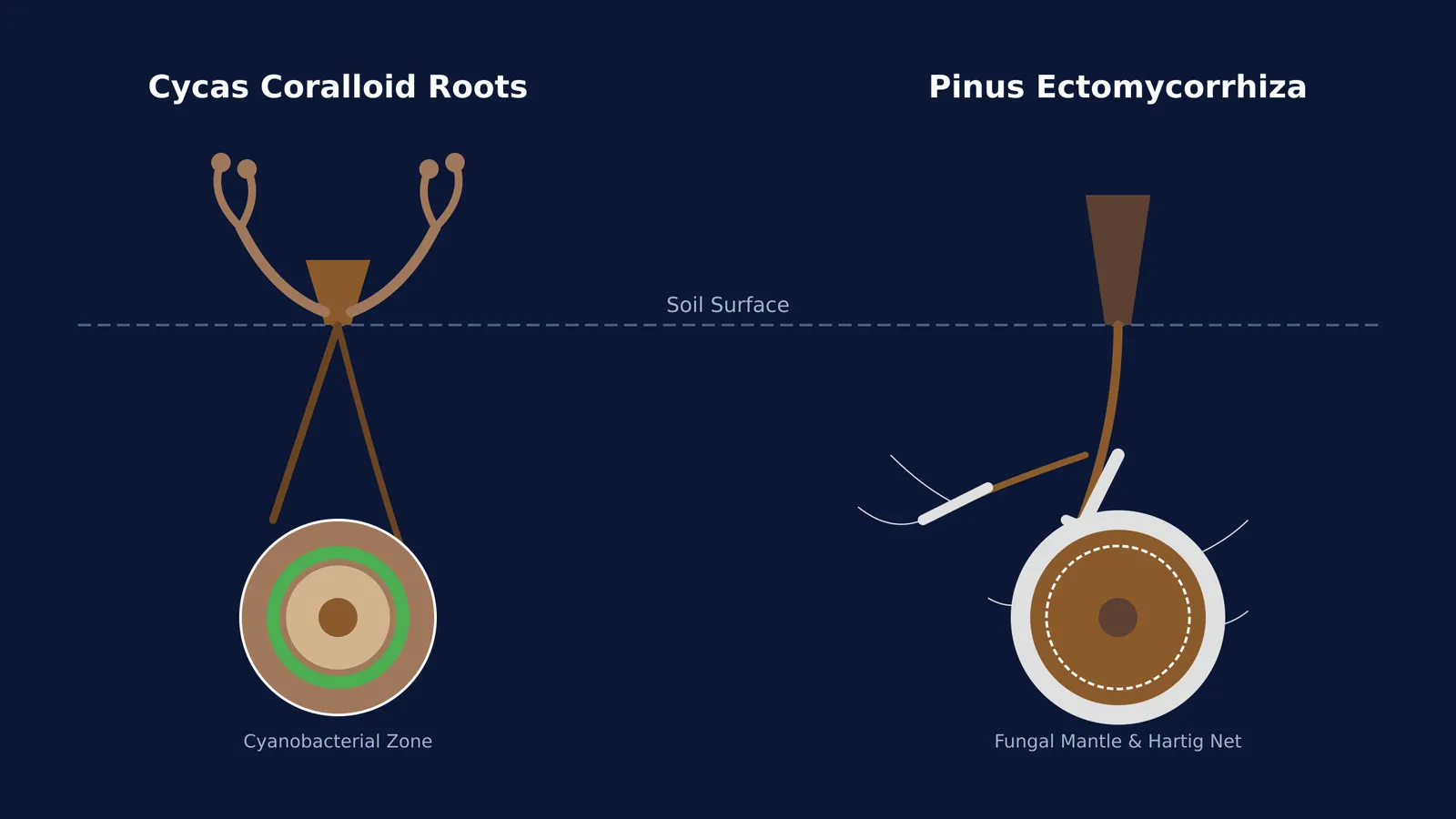
If you examine a *Cycas* plant, you will find normal roots growing downward into the soil to provide stability and gather water. However, near the soil surface, you will also see specialized secondary roots that grow upwards, a phenomenon known as apogeotropic growth. Because they branch dichotomously into knobby, clustered structures, they look remarkably like miniature coral, earning them the name "coralloid roots" (Wikipedia).
These coralloid roots exist specifically to host nitrogen-fixing cyanobacteria, primarily from the genera *Nostoc* and *Anabaena*. If you cut a coralloid root in half, you can clearly see a distinct green ring located in the root cortex—this is the cyanobacterial zone where the symbiosis takes place.
Within this protected zone, the plant provides a safe environment and supplies the bacteria with carbohydrates generated through photosynthesis. In return, the cyanobacteria pull nitrogen gas directly from the air and convert it into ammonia, a form the plant can easily use for growth. A 2019 study published in *Frontiers in Microbiology* confirmed that the cycad uses chemical signals to selectively recruit these specific bacteria from the surrounding soil, creating a highly specialized niche essential for the plant's survival in nutrient-poor environments (Frontiers).
How does mycorrhiza function in Pinus?
While cycads partner with bacteria, pine trees (*Pinus*) form a symbiotic relationship with fungi. This specific type of association is called an ectomycorrhiza, meaning the fungus lives on the outside of the root cells rather than penetrating them (Wikipedia).
Instead of fixing nitrogen from the air, the fungal partner acts as a master scavenger within the soil. The fungus wraps itself tightly around the pine's fine root tips, forming a dense white sheath called a fungal mantle. From this mantle, it weaves a complex network of hyphae—known as the Hartig net—between the epidermal and cortical cells of the plant root.
The fungal hyphae also extend far out into the surrounding soil matrix, massively increasing the overall surface area available for absorbing water and dissolved minerals. They are particularly efficient at extracting phosphorus, a vital nutrient that is often locked up in the soil. To sustain this vast underground network, the pine tree repays the fungus with energy-rich sugars made in its needles.
This mutualistic relationship is not just beneficial; it is an obligate association. Pine seeds often fail to germinate or establish themselves successfully if the specific fungal partner is completely missing from the soil. Knowing the four classes of fungi helps in understanding how basidiomycetes, such as the edible *Boletus pinophilus*, are able to form these vital, life-sustaining networks with pine species across the globe.
How do you tell Cycas and Pinus roots apart?
When you need to recall the key differences for a biology test or exam, it helps to build a mental table comparing the defining traits of the two partnerships.
The Partner: *Cycas* exclusively partners with cyanobacteria (blue-green algae); *Pinus* exclusively partners with higher fungi.
The Function: The primary role of coralloid roots is to fix atmospheric nitrogen; mycorrhizae primarily absorb phosphorus and water from the soil.
The Growth Direction: Coralloid roots are apogeotropic, meaning they grow upwards to break the soil surface; pine roots are positively geotropic, growing downwards into the earth.
The Anatomy: *Cycas* roots contain an internal green cyanobacterial zone within the cortex; *Pinus* roots are wrapped in an external fungal mantle with an internal Hartig net.
If you are struggling to picture how these intricate structures fit into the broader biology of plants, the Fermi Concept Library can help you trace the exact anatomical differences between gymnosperm families. Drawing the cross-sections yourself, carefully noting the green algal zone in *Cycas* and the white fungal mantle in *Pinus*, is the fastest way to lock the concept into your long-term memory.


