

On this page
In short
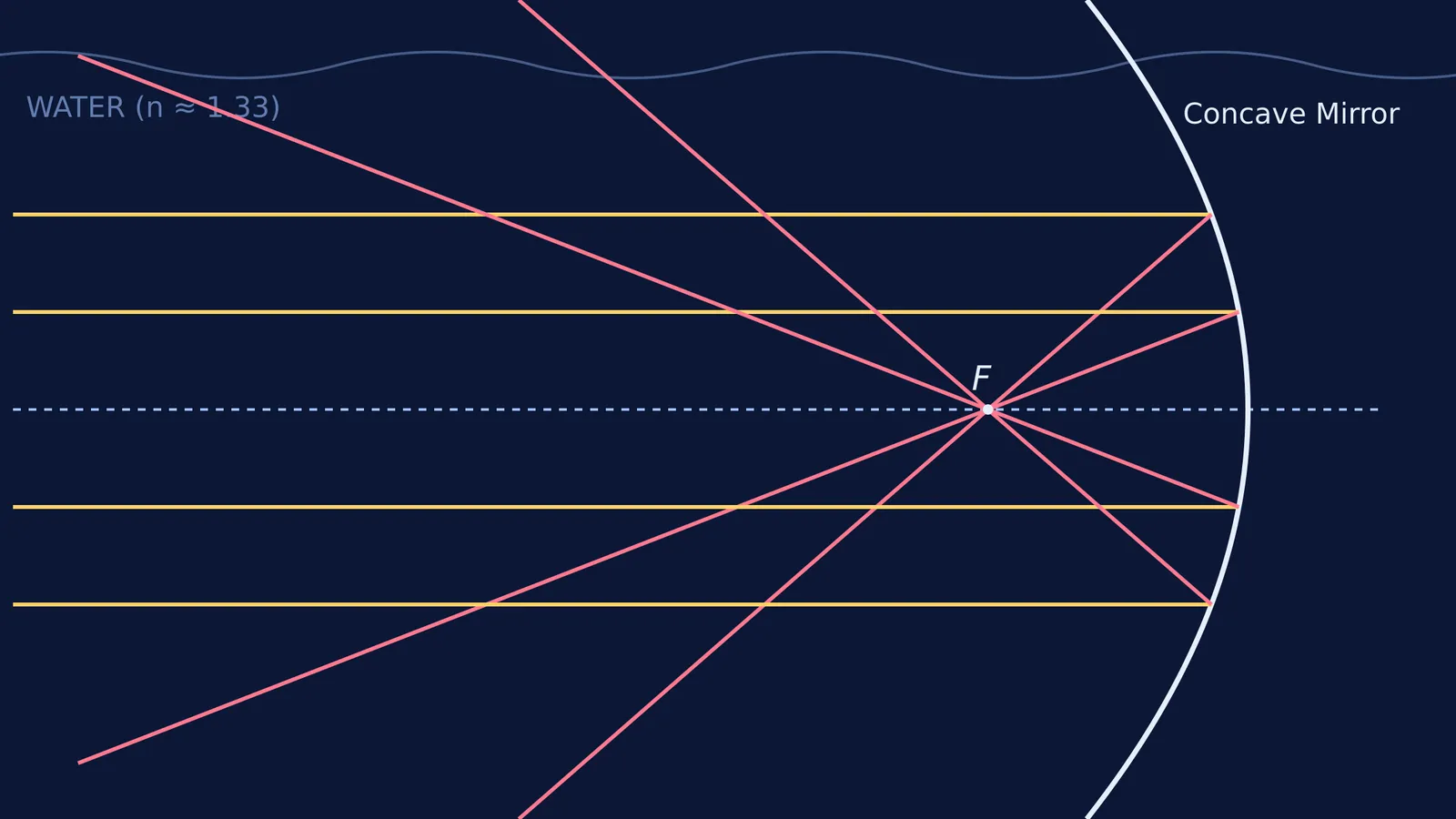
No, the focal length of a concave mirror does not change when it is placed in water. A mirror relies entirely on reflection, meaning its focal length is fixed by its physical radius of curvature (f = R/2), which stays the same in any medium.
If you have ever tried opening your eyes underwater, you know that your vision blurs because the water changes how light bends. It is easy to assume that optical instruments like mirrors and lenses would also behave differently when submerged.
While lenses are drastically affected by water, mirrors ignore it completely. Understanding why this happens will save you from common traps in physics exams and practicals.
Why doesn't the focal length of a mirror change in water?
The focal length of a spherically curved mirror is determined entirely by its shape. As established in geometric optics, the magnitude of a mirror's focal length is equal to its radius of curvature divided by two (f = R/2).
Because a mirror works by reflection, the light bounces off the silvered surface according to the law of reflection, where the angle of incidence always equals the angle of reflection. This law does not care what transparent medium the light is travelling through. Whether you place your mirror in air, vacuum, or water, its physical curvature R does not warp or shrink. Therefore, the focal length remains exactly the same.
If you are setting up a concave mirror practical to measure image distances, pouring water into the apparatus will not shift where the image forms.
Does a convex lens change its focal length in water?
Yes, the focal length of a lens changes significantly in water. Unlike mirrors, lenses work by refraction—the bending of light as it crosses the boundary between two different materials.
The amount of bending depends on the difference in the refractive index between the lens glass and the surrounding liquid. Water has a refractive index of approximately 1.33, which is much closer to glass (around 1.5) than air is (1.0). When you submerge a lens, the light bends less at the glass-water boundary than it does at a glass-air boundary.
Because the light is bent less sharply, it takes a longer distance for the rays to converge. This means the focal length of a convex lens increases when you drop it in water.
How do you calculate the shift for a lens?
Here is a worked example to show just how large this effect is. Suppose you have a standard convex glass lens with a refractive index of 1.5, and its focal length in air is 10 cm.
In air: The relative refractive index is 1.5 ÷ 1.0 = 1.5. The bending power is proportional to (1.5 − 1) = 0.5.
In water: The relative refractive index is 1.5 ÷ 1.33 = 1.125. The bending power is proportional to (1.125 − 1) = 0.125.
The ratio: The bending power in air (0.5) is exactly four times greater than the bending power in water (0.125).
Because the bending power is four times weaker, the focal length becomes four times longer. A lens that focuses light at 10 cm in air will focus light at 40 cm in water.
If you want to trace how light paths shift across different media, the Fermi Concept Library contains every concept in physics, chemistry, biology, mathematics and computing, each with its own lesson and its place in the map.
How can you avoid ray optics mistakes?
Exam papers frequently use the "submerged optics" scenario as a trap. When you read a problem involving a liquid, use this checklist before writing any equations:
Identify the component: Is it a mirror or a lens? If it is a pure mirror, ignore the liquid's refractive index entirely and use f = R/2.
Check for silvered lenses: If a problem features a glass lens with one silvered side, it acts as a combination of a lens and a mirror. You will need to calculate the new focal length of the lens part using water's refractive index, but the mirror part's focal length stays fixed. You can learn more about solving these in our guide to silvered lens problems.
Watch your signs: Remember that concave mirrors have negative focal lengths and convex mirrors have positive focal lengths in the standard Cartesian convention. Keep your signs straight to avoid the most common ray optics mistakes.
If you keep getting stuck on whether to use the lens formula or the mirror equation in complex setups, the Fermi Problem Library has worked problems with a step-by-step solver that explains the reasoning rather than printing an answer.


