

On this page
Look into a shiny steel spoon, then turn it over. The NCERT Class 10 science chapter on light starts its look at curved mirrors with this activity, because a spoon is two mirrors in one: the hollow side acts like a concave mirror, the bulging side like a convex one. Once you know which image each makes, the mirrors in a torch, a bathroom, a dental clinic and on a scooter become choices you can explain.
What is the difference between a concave and a convex mirror?
A concave mirror's reflecting surface curves inwards, towards the centre of the sphere, and a convex mirror's reflecting surface curves outwards, according to NCERT's Class 10 textbook. For mirrors of small aperture, the radius of curvature is twice the focal length (R = 2f), so the focus F sits midway between the mirror and its centre of curvature.
A concave mirror's image depends on where the object is: real and inverted, or, with the object between the mirror and F, virtual, upright and enlarged. A convex mirror's image is always virtual, upright and smaller.
Why are concave mirrors used in torches and headlights?
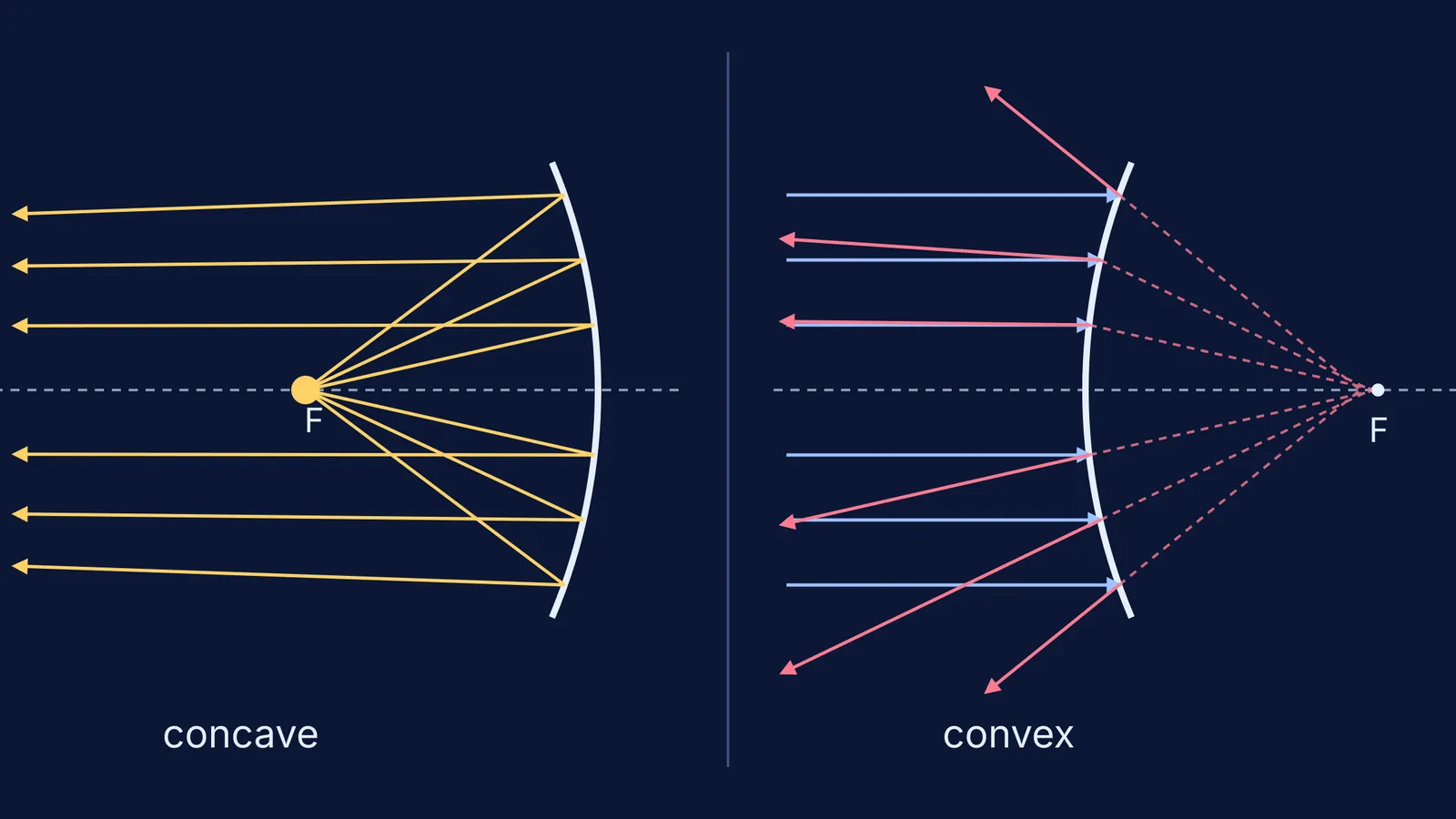
Put a bulb at the focus of a concave mirror and the light leaves as a nearly parallel beam; NCERT's Table 9.1 puts the image of an object at F at infinity. That is why, as the textbook says, torches, search-lights and vehicle headlights use concave mirrors to get powerful parallel beams of light. Run the arrows backwards and you get a solar furnace, where large concave mirrors concentrate sunlight to produce heat.
In the diagram at the top, the outermost rays tilt slightly inwards: a spherical mirror only behaves perfectly near its axis, which is why NCERT limits its rules to small-aperture mirrors.
Why is a shaving mirror concave?
Because your face sits inside the focal length. Here is a worked example using the mirror formula, 1/v + 1/u = 1/f, and the New Cartesian sign convention from the NCERT chapter.
Take a concave shaving mirror with f = -20 cm and hold your face at u = -15 cm.
1/v = 1/f - 1/u = -1/20 + 1/15 = 1/60, so v = +60 cm. The plus sign puts the image behind the mirror, so it is virtual.
Magnification m = -v/u = -(60)/(-15) = +4. The image is upright and four times larger.
Now step back to u = -30 cm, beyond F. 1/v = -1/20 + 1/30 = -1/60, so v = -60 cm and m = -2. The image is now real and upside down.
Try it with a make-up mirror: walk slowly backwards and your face grows, blurs, then flips once you pass F.
Which mirror does a dentist use?
The NCERT textbook says dentists use concave mirrors to see large images of teeth; as with the shaving mirror, the tooth sits inside F. Not every mouth mirror magnifies: a Danish dental instrument company's mouth mirror guide says concave ones give 1.5 times magnification for detail work.
Why are convex mirrors used as rear-view mirrors in vehicles?
Convex mirrors always give an upright, smaller image and have a wider field of view, so a driver sees a much larger area than a plane mirror would show, says NCERT. The book even mentions one in a wall of Agra Fort that shows the full Taj Mahal.
The catch is distance. In the US, the federal mirror standard 49 CFR 571.111 requires a passenger car's driver-side outside mirror to be flat (unit magnification), allows a convex mirror on the passenger side with an average radius of curvature between 889 mm and 1,651 mm, and requires that mirror to carry the words "Objects in Mirror Are Closer Than They Appear".
Worked example: take R = +1.2 m, inside that range, so f = +0.6 m, and a car 10 m behind you (u = -10 m).
1/v = 1/0.6 - 1/(-10) = 1.667 + 0.100 = 1.767, so v is about +0.57 m: behind the mirror, virtual.
m = -v/u = -0.57/(-10), about +0.057. The car appears upright and roughly one-eighteenth of its true size.
Your brain reads a small image as a distant car, so look over your shoulder before changing lanes.
How do you choose the right mirror in an exam answer?
Ask what the job needs:
A strong parallel beam, or light gathered onto one spot: concave, with the bulb or target at F.
An enlarged, upright view of something close: concave, with the object between the mirror and F.
A wide, upright view of a large area: convex.
A true-size view: plane.
In numericals, remember that f is negative for a concave mirror and positive for a convex one. If your signs keep going wrong, the Fermi Problem Library has worked problems with a step-by-step solver that explains the reasoning rather than printing an answer. If the sign convention itself feels shaky, the Fermi Concept Library gives each physics concept its own lesson.
Tonight, grab a steel spoon and check the shaving-mirror steps against your own face.


