

On this page
The genetic code is how a cell translates a string of nucleotides into a fully functional protein. It relies on a three-letter matching system between the mRNA (messenger RNA) that carries the genetic blueprint from the nucleus, and the tRNA (transfer RNA) that brings the amino acid building blocks to the ribosome.
In this system, a codon is the three-nucleotide sequence on the mRNA, while an anticodon is the complementary sequence on the tRNA. Understanding how these two structures pair is central to molecular biology, from basic transcription up to advanced RNA processing.
What is a codon vs anticodon?
The easiest way to tell them apart is by their location, their function, and how many there are in a single molecule. According to standard reference texts, the primary differences are:
Function: A codon acts as an instruction, specifying which amino acid comes next or signalling the ribosome to stop. An anticodon acts as a key, binding to that codon so the tRNA can drop off the correct amino acid.
Quantity: A single mRNA transcript contains hundreds or thousands of codons. Each individual tRNA molecule carries exactly one anticodon.
Because they are made of RNA, both structures use the bases adenine (A), uracil (U), cytosine (C), and guanine (G) instead of the thymine (T) found in DNA. If you need a refresher on the chemistry of these bases, you can review the difference between nucleosides and nucleotides.
How to write an anticodon from a codon?
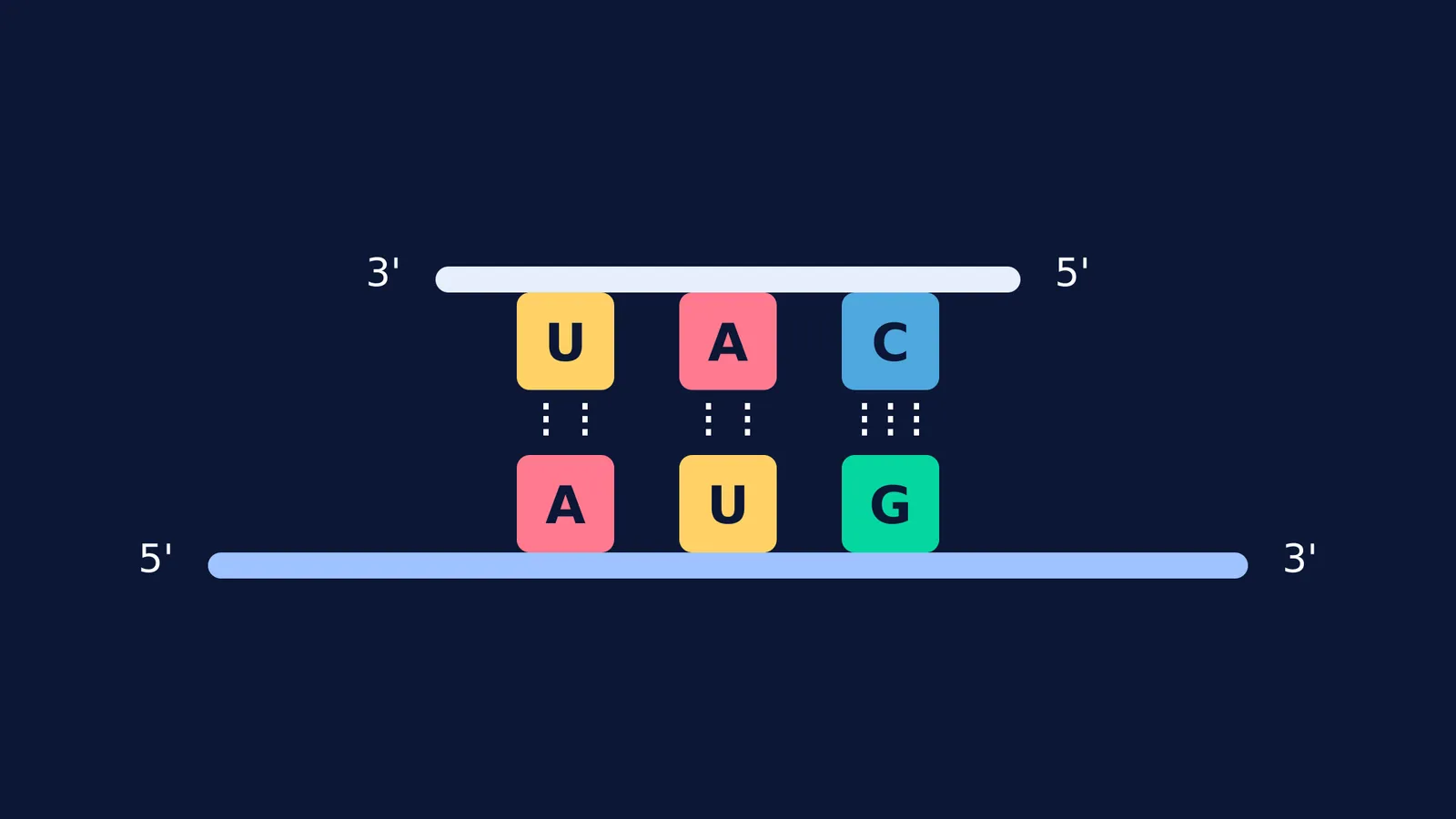
Writing an anticodon from a given codon is an exercise in complementary base pairing and directionality. Because the two RNA strands bind antiparallel to each other, a tRNA anticodon runs in the 3′ to 5′ direction when paired with an mRNA codon running 5′ to 3′.
Find the complements: Pair A with U, and C with G.
Account for direction: Write the result from 3′ to 5′, and then reverse it if the answer must be presented in standard 5′ to 3′ notation.
Worked example: The start codon
The universal start codon for methionine is 5′–AUG–3′.
Its complement is UAC.
Because the mRNA runs 5′ to 3′, the tRNA pairs with it as 3′–UAC–5′.
If an exam question asks for the anticodon in standard 5′ to 3′ notation, you must flip it to 5′–CAU–3′.
If you struggle to remember the direction rules for these problems, the Fermi Concept Library can walk you through the geometry of nucleic acids and show you exactly why the strands run opposite to each other.
How many anticodons are there?
You might assume that because the genetic code contains 64 total codons—with 61 sense codons that code for an amino acid rather than one of the three stop signals—a cell must manufacture 61 unique anticodons to read them. Stop codons (UAA, UAG, and UGA) do not have matching tRNA anticodons; instead, proteins called release factors bind to them to terminate translation.
In reality, human cells get by with just 48 distinct tRNA anticodons to decode the 61 sense codons. This reduction is possible because of a phenomenon known as "wobble" base pairing, which allows a single tRNA to do the work of several.
The wobble hypothesis explains that the first position of the anticodon (which pairs with the third position of the codon) does not always follow strict Watson–Crick rules. For example, a single tRNA with the modified base inosine (I) in its wobble position can comfortably pair with U, C, or A on the mRNA. This flexibility allows one tRNA to recognize multiple synonymous codons, significantly reducing the number of unique anticodons required for translation. Because multiple codons can specify the same amino acid, this degenerate nature of the genetic code protects cells against harmful mutations.


