

On this page
Phylum Cnidaria marks an evolutionary milestone in the animal kingdom, introducing tissue-level organisation and radial symmetry. For students preparing for NEET-UG and Class 11 biology, three interconnected concepts recur on every exam: the firing biomechanics of cnidoblasts, the morphological distinction between polyps and medusae, and the metagenesis life cycle in Obelia. Understanding how cellular adaptations power whole-organism physiology turns a memorisation chore into a clear diagnostic model.
How do cnidoblasts fire at nanosecond speeds?
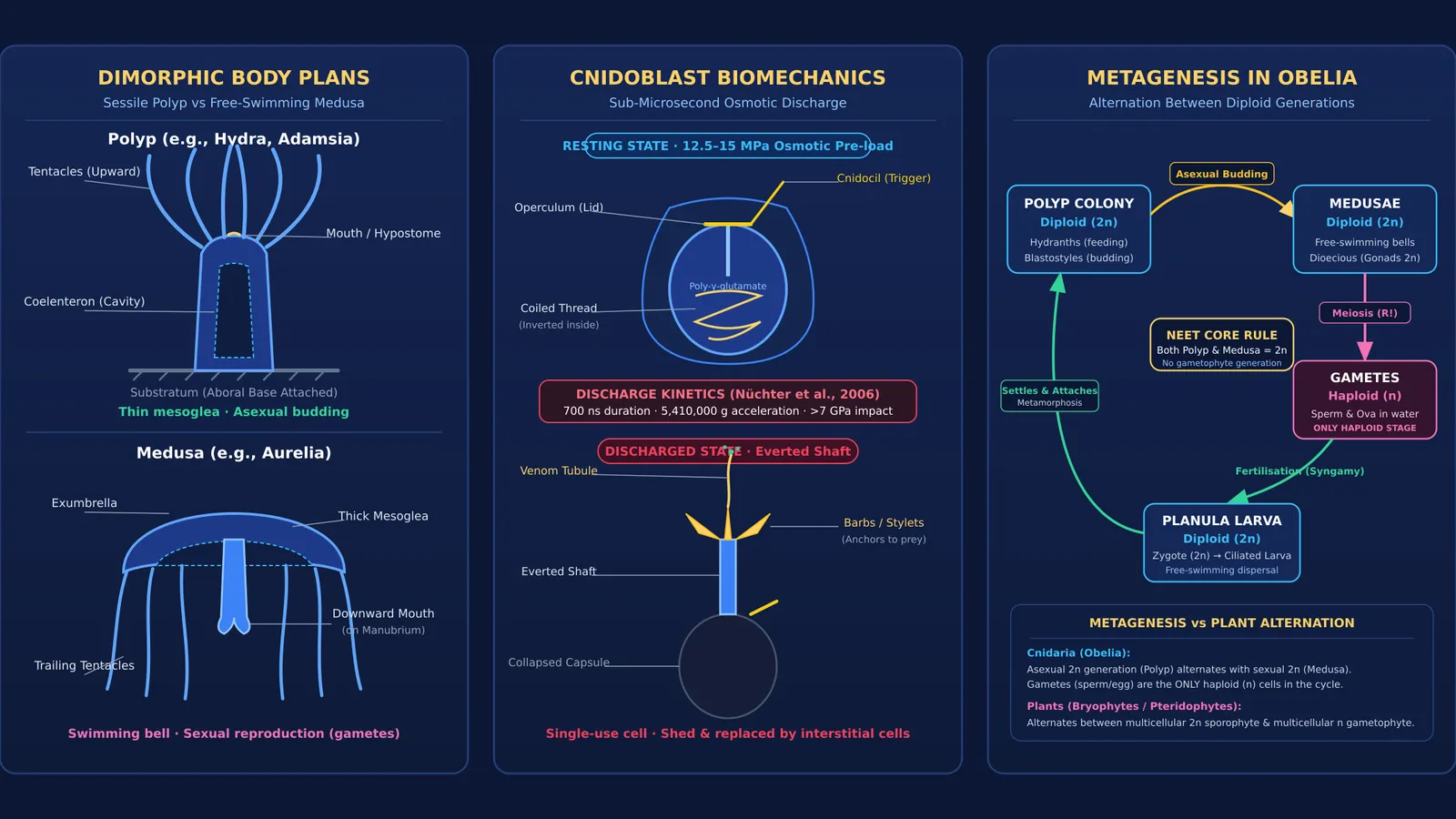
Cnidarians derive their name from cnidoblasts (cnidocytes)—specialised stinging cells on their tentacles and body wall. Each cell houses a nematocyst capsule with an inverted tubule and a hair-like sensory trigger, the cnidocil. As outlined in the official NCERT Class 11 biology curriculum, cnidoblasts serve three roles: anchorage, defense, and prey capture.
The discharge mechanism is one of the fastest in nature. Research by Jakob Weber (1989) revealed that resting nematocysts maintain an internal osmotic pressure of 12.5 to 15 MPa (125 to 150 bar), driven by densely packed poly-gamma-glutamate. When a stimulus touches the cnidocil, water floods into the capsule. High-speed recordings by Nüchter et al. (2006) demonstrated that the barbed shaft ejects in just 700 nanoseconds with an acceleration of 5,410,000 g, producing an impact pressure exceeding 7 GPa that pierces crustacean shells. Because the discharge completely inverts the organelle, a spent cnidoblast cannot reload; it is shed and replaced from totipotent interstitial cells.
What is the difference between a polyp and a medusa?
Cnidarians exhibit dimorphism, alternating between two distinct architectural body forms:
Polyp: A sessile, cylindrical form attached to a substrate at its aboral base. Its mouth and tentacles point upwards into the water column. Polyps have thin mesoglea and reproduce asexually by budding, as seen in *Hydra* and the sea anemone *Adamsia*.
Medusa: A motile, umbrella-shaped form that swims by bell contractions. Its mouth sits on a downward-pointing central tube (the manubrium) surrounded by trailing tentacles. Medusae have thick, gelatinous mesoglea for buoyancy and reproduce sexually by releasing gametes, as in the jellyfish *Aurelia*.
Classifying these body plans correctly is fundamental when placing organisms in our animal kingdom classification guide for NEET.
How does metagenesis work in the life cycle of Obelia?
Unlike *Hydra* (polyp only) or *Aurelia* (medusa dominant), the marine hydrozoan *Obelia* exhibits both body plans in a cycle termed metagenesis. An *Obelia* colony is polymorphic, bearing feeding polyps (hydranths) and reproductive polyps (blastostyles). The life cycle runs through six distinct stages:
The sessile diploid colony produces umbrella-shaped medusa buds asexually by budding on blastostyles.
Free-swimming medusae mature and release haploid gametes (sperm and ova) through meiosis.
External fertilisation in seawater forms a diploid zygote.
The zygote develops into a ciliated, free-swimming planula larva that disperses across distances.
The planula larva settles onto a hard surface, attaches, and metamorphoses into a young polyp.
The new polyp buds repeatedly to establish a branched diploid colony.
Why is cnidarian metagenesis different from plant alternation of generations?
Students often confuse *Obelia*'s life cycle with alternation of generations in plants. In bryophytes and pteridophytes, the cycle alternates between two multicellular generations of different ploidy: a haploid gametophyte (n) and a diploid sporophyte (2n).
In *Obelia*, there is no multicellular haploid phase. Both the polyp colony and the medusa are diploid (2n). Meiosis occurs only during gametogenesis in the medusa's gonads, making sperm and eggs the sole haploid stages. Thus, metagenesis is an alternation between an asexual diploid generation and a sexual diploid generation. Reading textbook definitions with this precision is central to mastering NCERT lines for NEET biology.
What are the most common NEET traps on Cnidaria?
NEET assertion-reason and statement questions regularly test four specific distinctions:
Ploidy trap: Both polyps and medusae are diploid (2n). Only the unicellular gametes are haploid (n).
Reproduction direction: Polyps produce medusae asexually; medusae produce polyps sexually via the planula larva.
Reusability trap: Cnidoblasts fire only once. They never reload and must be replaced by interstitial cells.
Taxon confusion: *Hydra* lacks a medusa; *Aurelia* has a reduced polyp; *Obelia* displays both in metagenesis.
Drawing these stages from memory strengthens structural recall, as shown in our NCERT biology diagrams guide.
To trace how body symmetry and tissue layers evolve across animal phyla, the Fermi Concept Library covers every concept in biology, each with its own lesson and its place in the map. When practicing complex exam questions, the Fermi Problem Library provides worked problems with a step-by-step solver that explains the reasoning rather than printing an answer. If you get stuck distinguishing larval stages or ploidy levels across life cycles, Fermi's AI tutor notices where you are stuck, draws the figure on a board, and checks understanding as it goes.


