

On this page
In qualitative analysis, detecting an acid radical often involves looking for characteristic gases and precipitates. Similar to how the carbylamine test identifies primary amines by a distinct smell, the chromyl chloride test relies on striking colour changes to detect the chloride ion (Cl⁻).
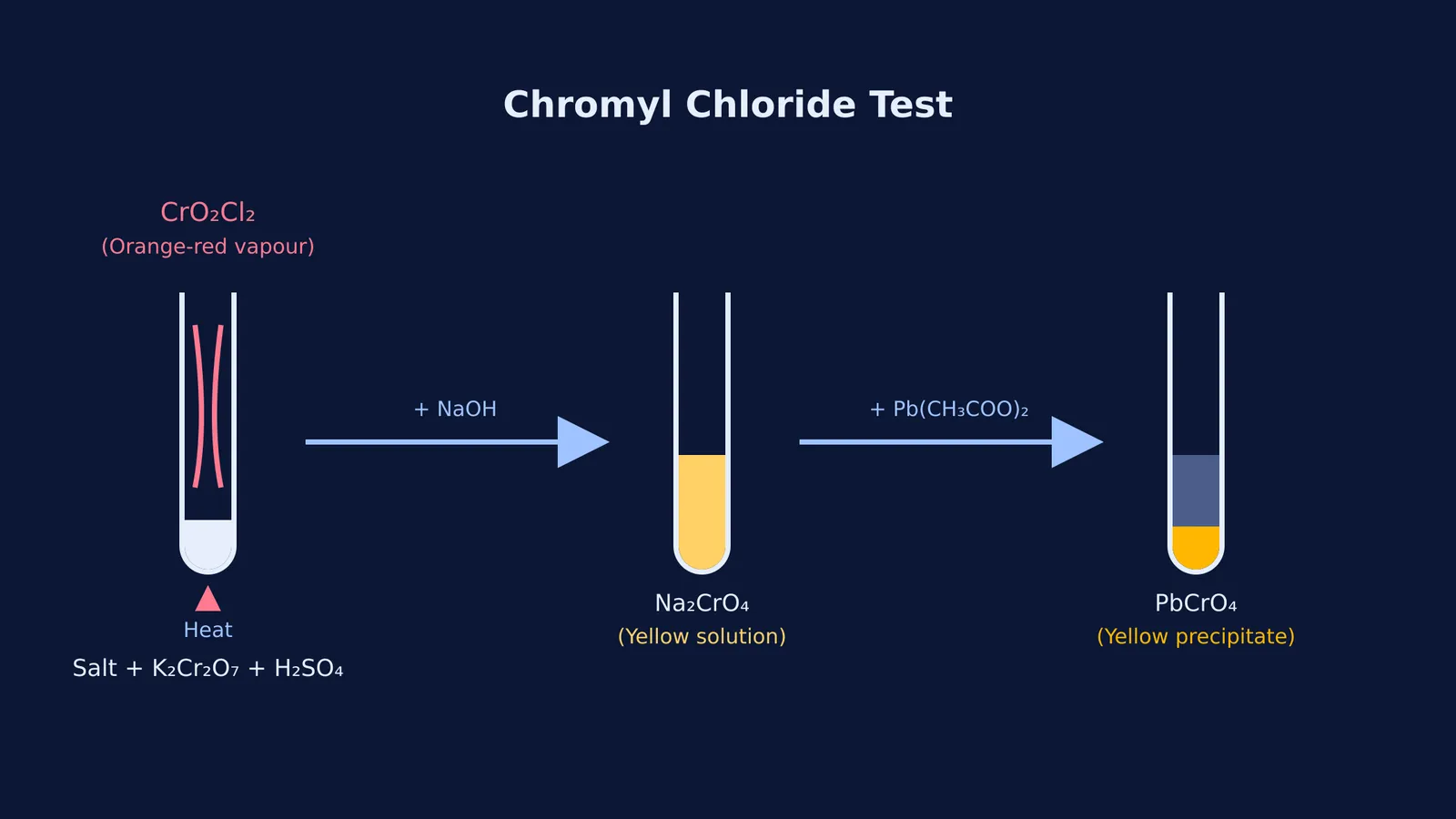
When working through chemical analysis in the Fermi Concept Library, you can trace how these specific reactions distinguish one halide from another. The test takes a chloride salt through two distinct colour phases: an orange-red gas and a bright yellow solid.
What is the chromyl chloride test?
The chromyl chloride test is a definitive chemical procedure used to confirm the presence of the chloride radical in an inorganic salt. The test exploits the fact that chlorides react with potassium dichromate (K₂Cr₂O₇) in a highly acidic medium to form a volatile, deep orange-red compound called chromyl chloride (CrO₂Cl₂), which has a boiling point of 118.5 °C.
Because other common halides like bromides and iodides do not form similar chromyl compounds, this reaction acts as a highly specific filter for chlorides.
How do you perform the test?
The procedure requires a solid-state reaction to ensure the acid is concentrated enough to drive the process. You start by taking a small amount of the unknown salt in a completely dry test tube and mixing it intimately with an equal amount of solid, powdered potassium dichromate.
Next, you add a few drops of concentrated sulfuric acid (H₂SO₄) and heat the mixture gently. The sulfuric acid acts as both a strong acidifying agent and a dehydrating agent. As the heat is applied, the mixture bubbles and releases dense, orange-red vapours of chromyl chloride.
The chemical equation for this first step is: K₂Cr₂O₇ + 4NaCl + 6H₂SO₄ → 2KHSO₄ + 4NaHSO₄ + 2CrO₂Cl₂ + 3H₂O
If you find balancing complex overall reactions difficult, Fermi's AI tutor can teach you through it — writing out the oxidation states on a board and checking your understanding as it goes.
How does lead acetate confirm the chloride radical?
Seeing the orange-red vapour alone is not enough to declare the test a success. Bromine gas (Br₂) is also reddish-brown and can be released if the salt happens to contain a bromide instead of a chloride.
To confirm that the gas is indeed chromyl chloride, you must pass the vapours into a second test tube containing a dilute solution of sodium hydroxide (NaOH). The chromyl chloride vapour reacts immediately with the base to form sodium chromate (Na₂CrO₄), turning the clear liquid distinctly yellow.
CrO₂Cl₂ + 4NaOH → Na₂CrO₄ + 2NaCl + 2H₂O
Finally, you acidify this yellow solution by adding acetic acid (CH₃COOH) and then introduce a few drops of lead acetate solution. A bright yellow, opaque precipitate of lead(II) chromate (PbCrO₄) falls to the bottom of the tube.
Na₂CrO₄ + (CH₃COO)₂Pb → PbCrO₄ + 2CH₃COONa
Identifying this final yellow solid is a definitive marker, much like looking for the yellow precipitate in the iodoform test. Acetic acid is used for acidification instead of a stronger acid like hydrochloric acid because lead chromate is soluble in strong mineral acids, which would destroy the precipitate.
What should you check before starting the test?
A successful chromyl chloride test relies on strict laboratory conditions. If you are preparing for a practical exam, keep this checklist in mind:
Dry glassware: Even a few drops of water in the reaction tube will cause the chromyl chloride to hydrolyse back into chromic acid and hydrochloric acid before it ever leaves the tube.
Solid reagents: You must use the solid salt and solid potassium dichromate. If you use a salt solution, the concentrated sulfuric acid will be diluted, and the reaction will fail.
Gentle heating: Boiling the mixture too vigorously can cause the sulfuric acid to vaporise or splash into the delivery tube, contaminating the sodium hydroxide trap.
Why do some chlorides fail this test?
Not all chlorides release the Cl⁻ ion easily enough for this reaction to work. Covalent chlorides hold onto their chlorine atoms tightly and do not readily exchange them.
Heavy metal chlorides such as silver chloride (AgCl), lead(II) chloride (PbCl₂), mercury(I) chloride (Hg₂Cl₂) and antimony trichloride (SbCl₃) are predominantly covalent or have extremely low solubility in the acid mixture. They will not yield chromyl chloride vapours when heated with dichromate and sulfuric acid, leading to a false negative.
If your unknown salt is a bromide or an iodide, adding concentrated sulfuric acid and dichromate will release free bromine (Br₂) or iodine (I₂) gas. While bromine vapour looks very similar to chromyl chloride, passing it through sodium hydroxide will form sodium hypobromite and sodium bromide, which is a colourless solution. It will not produce the yellow chromate solution, stopping the test in its tracks and ruling out the chloride radical.


