

On this page
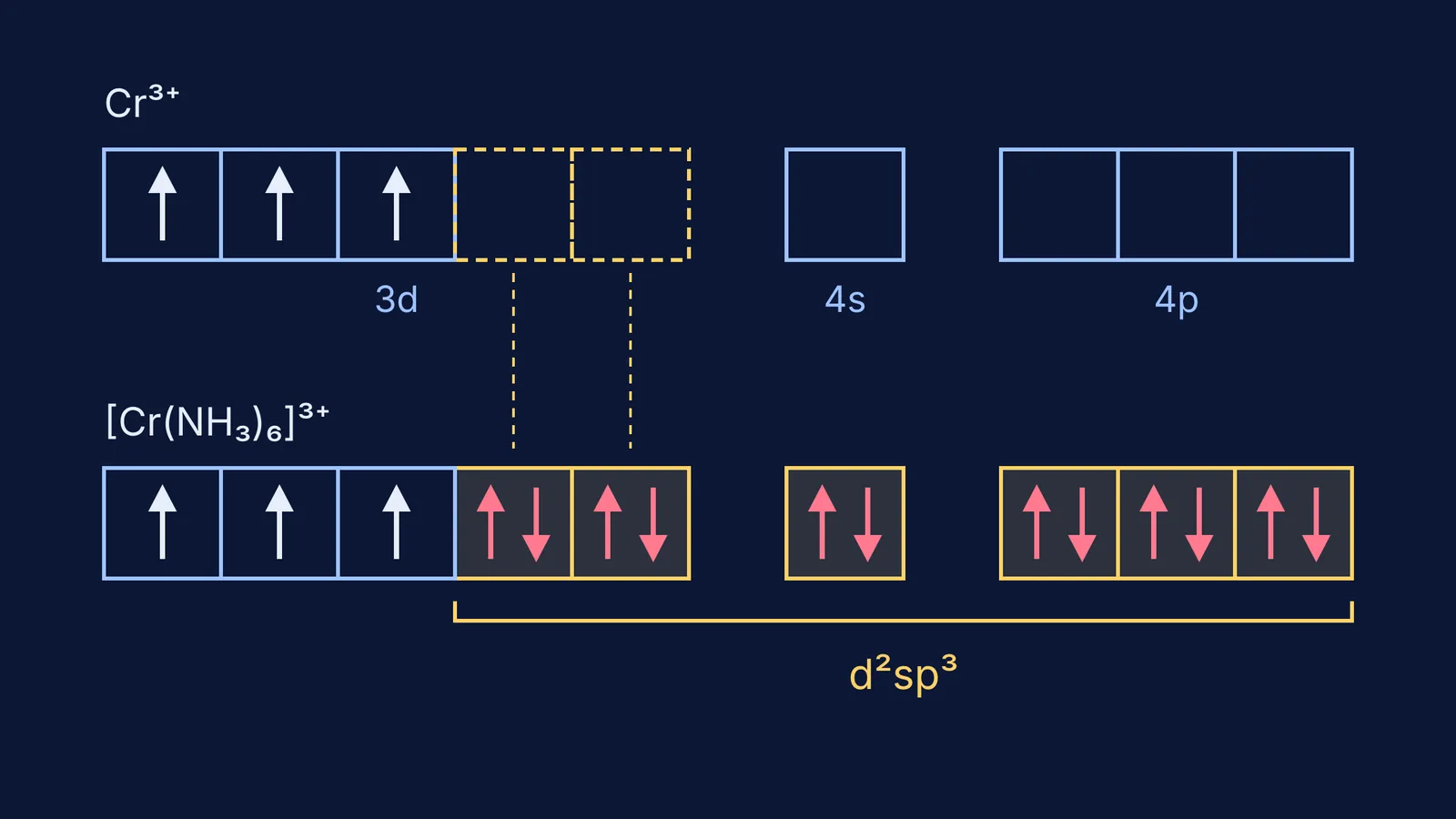
If you have learnt that strong ligands like CN⁻ give inner orbital complexes and weak ligands like F⁻ give outer orbital ones, chromium(III) looks like a rule-breaker. Whatever ligand you attach to Cr³⁺, valence bond theory gives d²sp³ hybridisation and three unpaired electrons. The reason is not a special property of chromium. It is simple counting: three electrons cannot fill five orbitals.
What is the electron configuration of Cr³⁺?
Neutral chromium (Z = 24) has the configuration 3d⁵4s¹, not 3d⁴4s², because the 3d and 4s energies are close and a half-filled d set is relatively stable, as the NCERT Class 12 chapter on the d- and f-block elements explains in section 4.2.
To make Cr³⁺, remove three electrons: the single 4s electron first, then two 3d electrons. That leaves 3d³, and the same NCERT chapter lists Cr³⁺ as a 3d³ ion in its table of aquated ion colours.
Why are chromium(III) complexes always inner orbital?
An octahedral complex needs six empty hybrid orbitals to accept six lone pairs from the ligands. In d²sp³ hybridisation those six come from two inner 3d orbitals, one 4s and three 4p orbitals. In sp³d², the outer orbital option, the two d orbitals come from the 4d level instead.
The NCERT Class 12 chapter on coordination compounds states the key point in section 5.5.2: for metal ions with up to three d electrons, such as Ti³⁺ (d¹), V³⁺ (d²) and Cr³⁺ (d³), two vacant d orbitals are available for octahedral hybridisation with 4s and 4p orbitals.
By Hund's rule, the three electrons of Cr³⁺ occupy three separate 3d orbitals with parallel spins. Two 3d orbitals are already empty. Nothing has to pair up to make room, so the ligand has nothing to decide.
Compare cobalt(III), which is 3d⁶. The same NCERT chapter shows that in [Co(NH₃)₆]³⁺ the electrons pair up to free two 3d orbitals (d²sp³, diamagnetic), while in [CoF₆]³⁻ they do not, so the complex uses 4d orbitals (sp³d², paramagnetic). The chapter notes that for d⁴, d⁵ and d⁶ ions a vacant pair of 3d orbitals appears only if 3d electrons pair. That is where the ligand matters, and Cr³⁺ never reaches it.
How do you write the hybridisation of [Cr(NH₃)₆]³⁺ step by step?
Use this sequence for any octahedral complex in valence bond questions.
Find the oxidation state. NH₃ is neutral and the complex charge is +3, so chromium is +3.
Write the ion's configuration. Cr³⁺ is 3d³ 4s⁰ 4p⁰.
Fill the 3d boxes by Hund's rule: three single up-arrows, two empty boxes.
Count empty inner orbitals. Two empty 3d plus one 4s plus three 4p gives six orbitals, which is exactly what an octahedral complex needs.
Name the hybridisation: d²sp³, inner orbital, octahedral.
Count unpaired electrons: three. The spin-only formula μ = √(n(n+2)) BM, given in the NCERT d- and f-block chapter, gives √15, about 3.87 BM, which matches that chapter's calculated value for a 3d³ ion.
Now repeat it for [CrF₆]³⁻ or [Cr(H₂O)₆]³⁺. Only the charge arithmetic in step 1 changes; every step still ends at d²sp³ with three unpaired electrons, because no step asked how strong the ligand was. That is the whole point. If you are unsure of any step, such as Hund's rule or oxidation states, the Fermi Concept Library has a lesson for each concept in chemistry and shows where it sits in the map, so you can fill the gap before returning to the question.
Which other ions are always inner orbital in octahedral complexes?
By the same counting, any d¹, d² or d³ ion behaves like Cr³⁺. NCERT names Ti³⁺ and V³⁺ alongside it. Before you trust the rule in an exam, run this quick check:
Is the complex octahedral (six ligand donor atoms)? The rule is about d²sp³ versus sp³d².
Is the metal ion d¹, d² or d³ after you remove electrons? Then answer d²sp³ without looking at the ligand.
Is it d⁴, d⁵ or d⁶? Then the ligand matters: check the spectrochemical series and decide whether electrons pair.
Did the question give a magnetic moment? Use √(n(n+2)) to find n and confirm your box diagram.
Keep the model's limits in mind too. The NCERT coordination chapter itself notes that hybrid orbitals do not actually exist and that valence bond theory does not distinguish between weak and strong ligands. Crystal field theory tells the same story differently: in d³ complexes the electrons occupy the t₂g orbitals singly, so the question of pairing only arises from the fourth electron onwards.
To practise the six steps on more complexes, try mixed questions in the Fermi Problem Library, where a step-by-step solver explains the reasoning rather than printing an answer. Pick a d³ ion, a d⁶ ion and a d⁸ ion, and see how the answer changes.


