

On this page
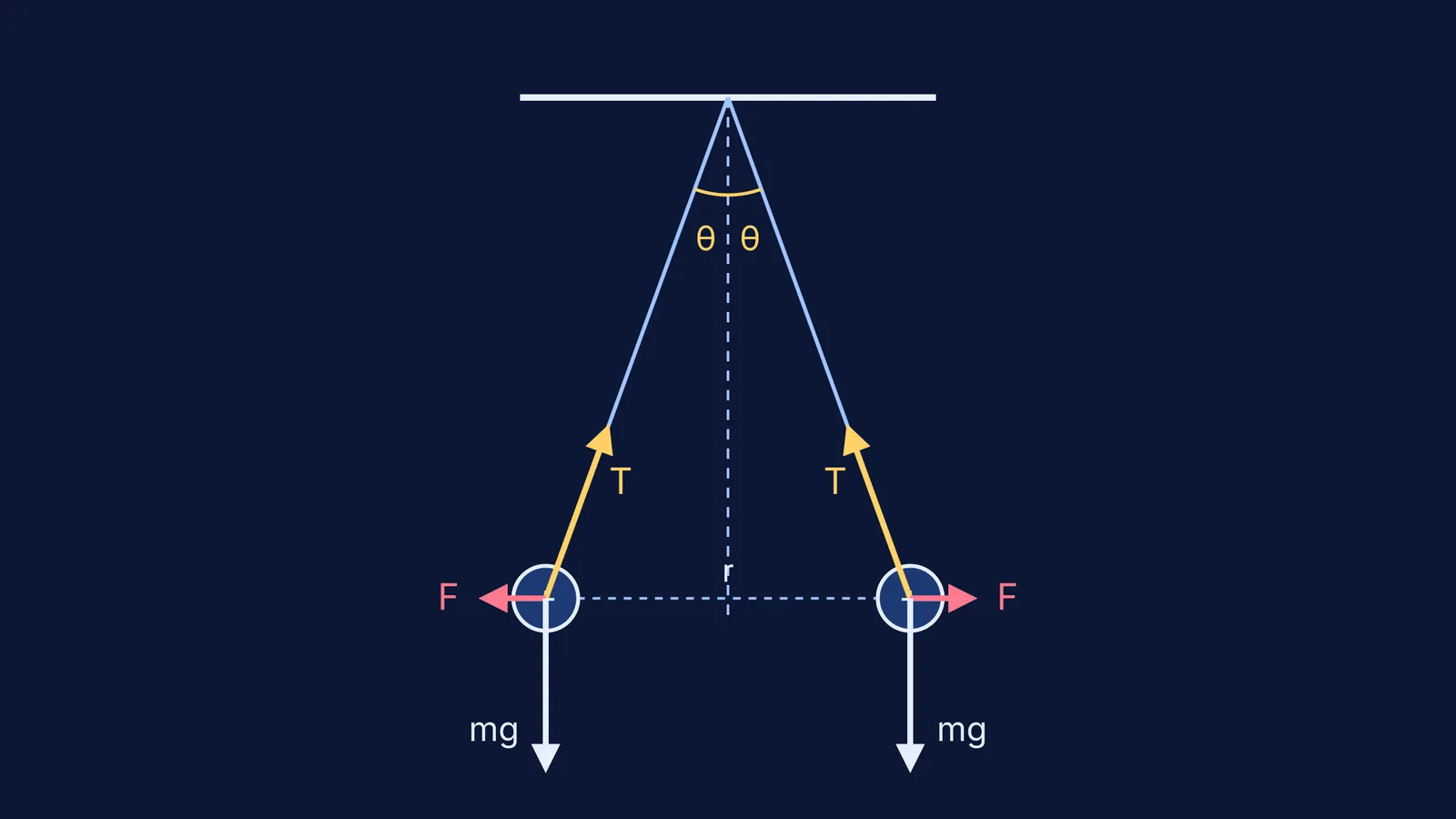
Two identical balls, each with charge q and mass m, hang from threads of length L tied to the same point, and push apart until they settle. The problem tests Coulomb's law and force balance together.
What forces act on each hanging ball?
Each ball feels three forces: its weight mg straight down, the tension T along the thread, and the electric repulsion F along the line joining the two balls. Because the balls are identical and the threads are equal and share a support, that line is horizontal.
Coulomb's law gives F = kq²/r², where r is the distance between the balls and k is about 9 × 10⁹ N m²/C² in SI units, as the NCERT Class 12 Physics textbook, Chapter 1 states.
Three forces on one point in equilibrium is the same situation as a knot held by three strings, which we work through in Lami's theorem for strings and knots. Resolve along the vertical and the horizontal:
Vertical: T cos θ = mg
Horizontal: T sin θ = F
Divide: tan θ = F/mg
Square and add: T = √((mg)² + F²)
What is the angle between two charged balls hanging from threads?
The angle each thread makes with the vertical is θ, so the angle between the two threads is 2θ.
The geometry links θ to the separation: r = 2L sin θ. Putting that into Coulomb's law gives tan θ = kq²/(4L² sin²θ · mg). This equation has no neat exact solution, which is why examiners almost always add "assume θ is small".
How does the small-angle approximation give the separation?
For a small angle, tan θ ≈ sin θ ≈ x/2L, where x is the separation. Then x/2L = kq²/(x² mg), which rearranges to x³ = 2kq²L/mg, or x = (q²L/2πε₀mg)^(1/3).
Separation grows as q^(2/3) and L^(1/3), and shrinks as m^(-1/3).
Worked example
Take m = 2 g, L = 50 cm, q = 20 nC on each ball and g = 9.8 m/s².
Weight: mg = 0.002 × 9.8 = 0.0196 N.
Separation: x³ = 2 × (9 × 10⁹) × (2 × 10⁻⁸)² × 0.5 / 0.0196 = 1.84 × 10⁻⁴ m³, so x ≈ 0.057 m, about 5.7 cm.
Angle: sin θ = x/2L ≈ 0.057, so θ ≈ 3.3° and the angle between the threads is about 6.5°.
Check: F = (9 × 10⁹)(2 × 10⁻⁸)²/(0.0569)² ≈ 1.11 × 10⁻³ N, and F/mg ≈ 0.057, which matches tan 3.3°. The small-angle step was safe.
Tension: T = √(0.0196² + 0.00111²) ≈ 0.0196 N, almost the weight.
What changes when the balls are dipped in a liquid?
Two things change, and the trap is to change only one.
First, the electric force weakens. In a medium, Coulomb's law keeps its form but the constant is altered, and the relative permittivity εr (the dielectric constant K) is a pure number, as Oxford's chemistry teaching notes on Coulomb's law explain. So F becomes F/K.
Second, the balls get lighter. Buoyancy cuts the weight from mg to mg(1 − σ/ρ), where ρ is the density of the balls and σ the density of the liquid.
Divide one by the other: tan θ′ = F / [K mg(1 − σ/ρ)]. The angle stays the same only if K(1 − σ/ρ) = 1, that is K = ρ/(ρ − σ). Balls of density 1.6 g/cm³ in a liquid of density 0.8 g/cm³ need K = 2 to keep the same angle. For small angles, the new separation is x′ = x [ρ / (K(ρ − σ))]^(1/3).
For scale, water's dielectric constant is 80.4 at 20 °C, according to the HyperPhysics table of dielectric constants. Ignoring buoyancy, that alone would shrink the separation by 80.4^(1/3), roughly 4.3 times.
That effective-g thinking is the core of our post on the pendulum with a charged bob in an electric field. To revise Coulomb's law, dielectrics and buoyancy as linked ideas, the Fermi Concept Library gives each concept its own lesson and its place in the map.
Which mistakes cost marks on this problem?
Reporting θ when the question asks for the angle between the threads, 2θ.
Using L instead of 2L sin θ as the distance in Coulomb's law.
Dividing the weight by K, or forgetting buoyancy altogether.
Assuming unequal charges give unequal angles. The two forces are equal and opposite, since Coulomb's law agrees with Newton's third law, as the NCERT chapter notes. With equal masses, the angles stay equal.
Forgetting that unequal masses do change the angles: m₁ sin θ₁ = m₂ sin θ₂, so for small angles tan θ₁/tan θ₂ ≈ m₂/m₁.
For another case where you balance Coulomb forces to find a position, see where to place a third charge for equilibrium. If your answer comes out wrong and you cannot see why, the Fermi Problem Library has worked problems with a step-by-step solver that explains the reasoning rather than printing an answer.


