

On this page
When a charge moves near a current-carrying wire, it experiences a magnetic force that depends on its direction of motion. To find this force, we have to combine two rules: the field created by the wire, and the Lorentz force on the moving charge.
What is the magnetic field of the wire?
A straight wire carrying a steady current creates a magnetic field in the space around it. The magnetic field (B) produced by an infinitely long, thin, straight wire carrying a current (I) at a distance (r) is B = μ₀I / 2πr (OpenStax University Physics). The constant μ₀ is the permeability of free space, which equals 4π × 10⁻⁷ T·m/A.
To find the direction of this field, use the Right-Hand Grip Rule. Point your right thumb in the direction of the current, and your fingers will curl in the direction of the circular magnetic field lines. If the current flows straight up the page, the magnetic field points into the page on the right side of the wire, and out of the page on the left side.
How does the moving charge react?
Once we know the field, we can calculate the force. The Lorentz force is the total force exerted on a charged particle by electric and magnetic fields (Wikipedia). Because there is no electric field outside a steady current wire, the charge only feels the magnetic component.
The magnetic force magnitude is F = qvB sin θ, where q is the charge, v is its speed, B is the magnetic field, and θ is the angle between the velocity and the field.
For the direction, we use the Right-Hand Rule for cross products. If you point your index finger in the direction of velocity and your middle finger in the direction of the magnetic field, your thumb points in the direction of the force on a positive charge. If keeping track of cross products in 3D gets confusing, the Fermi Concept Library breaks down the vectors step by step so you can see exactly how the rules line up.
Which way does the force point?
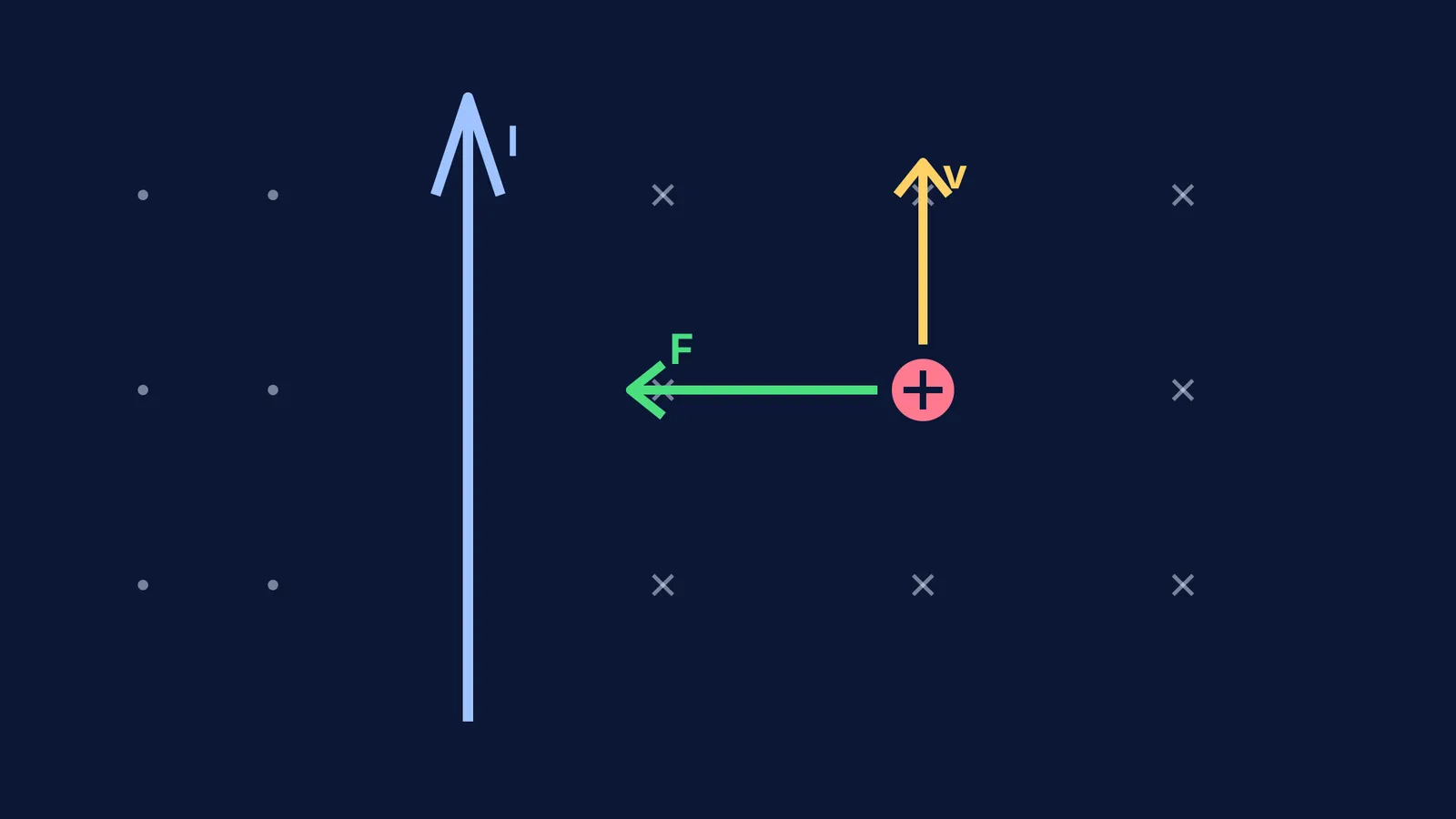
Let us put the two rules together to find the force on a moving charge near a current carrying wire. Assume we have a wire with current flowing upwards, and a positive charge on the right side of the wire. The magnetic field on the right side points straight into the page.
Moving parallel (same direction): If the positive charge moves upwards, parallel to the current, its velocity is up and the field is into the page. Applying the right-hand rule, the force points to the left. The charge is pulled toward the wire.
Moving antiparallel (opposite direction): If the positive charge moves downwards, opposite to the current, the velocity is down and the field is still into the page. The force points to the right. The charge is pushed away from the wire.
This leads to a simple rule of thumb for parallel currents and charges: like currents attract, and opposite currents repel. A positive charge moving parallel to a current acts like a parallel current, so it feels an attractive force.
When a charge moves perpendicular to the wire, it is a different story. If it heads straight for the wire, the force will deflect it parallel to the current. Similar deflection rules dictate the helical path of a charge in a magnetic field when the angle is not exactly 90 degrees, or what happens to a charge crossing into a B-field region.
How do you calculate the exact force?
Imagine an alpha particle (charge q = 3.2 × 10⁻¹⁹ C) moving upwards at 10⁴ m/s, exactly 2 cm (0.02 m) to the right of a wire carrying a 5 A upward current. Here is a framework to solve it:
Calculate the field: Using B = μ₀I / 2πr from the wire, where μ₀ = 4π × 10⁻⁷ T·m/A. B = (4π × 10⁻⁷ × 5) / (2π × 0.02) = 5 × 10⁻⁵ T. Because it is on the right side of an upward current, B points into the page.
Calculate the force: The velocity is up and the field is into the page, so they are perpendicular (θ = 90°, sin 90° = 1). F = qvB = (3.2 × 10⁻¹⁹) × (10⁴) × (5 × 10⁻⁵) = 1.6 × 10⁻¹⁹ N.
Determine the direction: Velocity (up) crossed with Field (into page) gives a force pointing left, toward the wire.
Whether you are plotting an electron beam in a cathode tube or solving a JEE Main physics problem, always find the magnetic field first, and then apply the Lorentz force.


