

On this page
When trying to place an arthropod into the right branch of the animal kingdom, the simplest visual test is looking at its legs. Centipedes and millipedes both belong to the subphylum Myriapoda (meaning "many legs"), but they are in completely different classes: Chilopoda and Diplopoda.
The Myriapoda family tree
Before looking at their differences, it helps to know what they share. Both centipedes and millipedes belong to a group of arthropods characterised by elongated bodies and many legs Wikipedia. Like insects and crustaceans, myriapods have a hard exoskeleton, jointed appendages, and a pair of antennae. However, unlike insects which have a distinct head, thorax, and abdomen, a myriapod's body is divided simply into a head and a long, segmented trunk.
Because they lack a waxy, moisture-retaining cuticle on their exoskeleton, both centipedes and millipedes are prone to drying out. This shared biological constraint explains why you will almost always find both of them in similar habitats: dark, damp environments such as under rotting logs, beneath damp rocks, or buried deep in leaf litter.
How many legs per segment do they have?
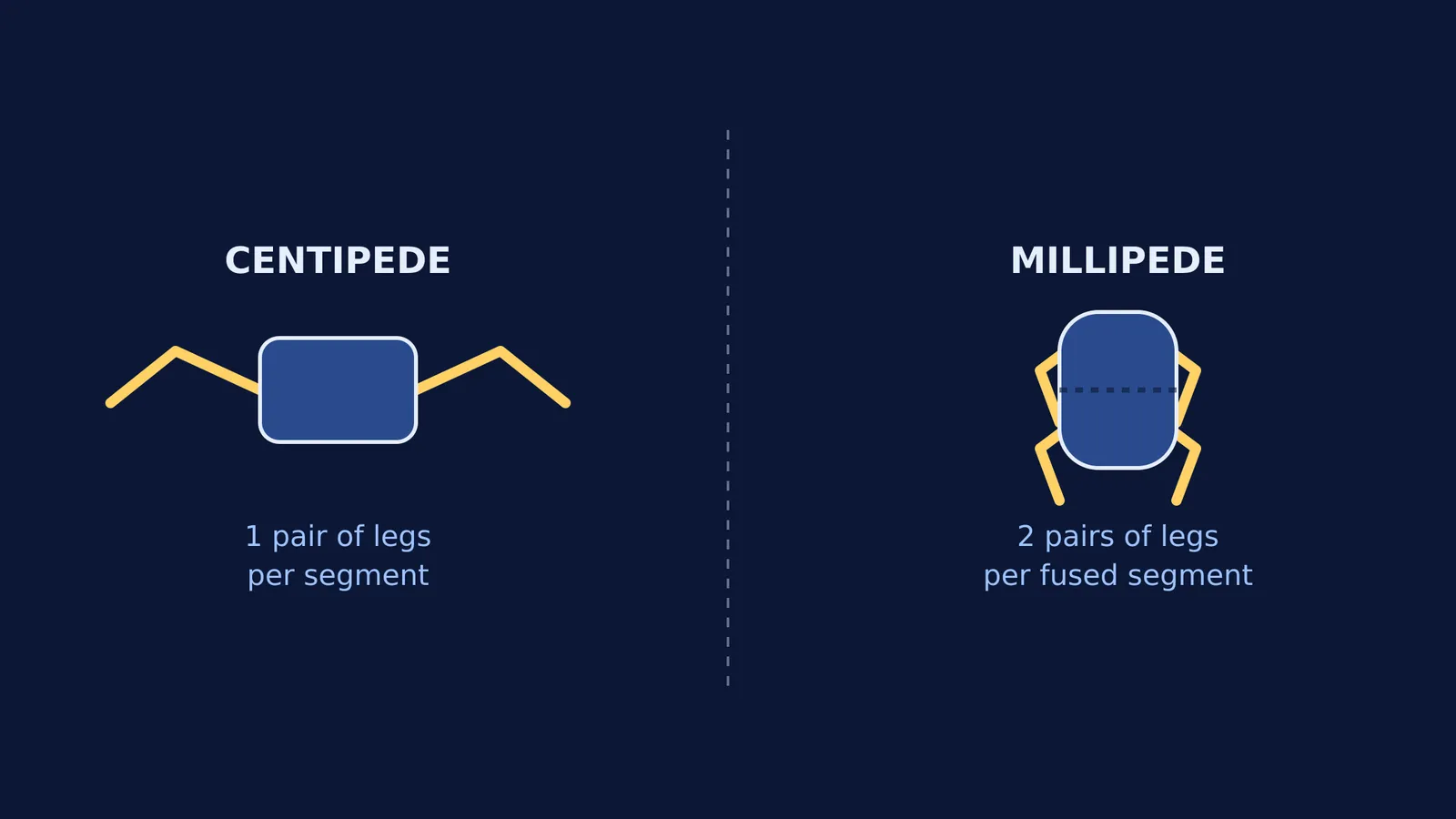
The defining difference between a centipede and a millipede is the number of legs attached to each segment of their body.
Centipedes (Chilopoda): Have exactly one pair of legs per body segment Wikipedia. Their legs are typically long and jut out visibly from the sides of their flattened bodies.
Millipedes (Diplopoda): Have two pairs of legs per body segment, except for the first few segments behind the head Wikipedia. This happens because two adjacent embryonic segments fuse into a single "diplosegment" during development. Their legs are shorter and tucked underneath their rounded, cylindrical bodies.
Are they fast predators or slow detritivores?
You can also tell them apart by watching how they move and what they eat.
Centipedes: These are fast, agile, carnivorous predators. They actively hunt insects, spiders, and earthworms. To catch their prey, centipedes use modified front legs near their head—called forcipules—to inject venom. When threatened, a centipede's first instinct is usually to run away quickly.
Millipedes: These are slow-moving scavengers, or detritivores. They feed on decaying organic matter like dead leaves and rotting wood, acting as vital recyclers in the ecosystem. Because they cannot outrun predators, their main defence is to coil tightly into a spiral to protect their soft undersides. Many species also secrete foul-smelling or toxic chemicals to deter attackers.
How can you remember the difference for exams?
Questions on classifying these animals often appear in biology exams like NEET-UG. A simple way to remember their traits is to connect their names to their nature:
Centipede starts with C: Carnivorous, Chilopoda, Claws (venomous), and they are flat like a Coin.
Millipede has double Ls: Diplopoda (double-footed), two pairs of legs per segment, and they eat Mulch and dead Matter.
Here is a summary of the differences for quick recall:
Legs per segment: Centipede has one pair; millipede has two pairs.
Leg position: Centipede legs extend sideways; millipede legs are tucked underneath.
Body shape: Centipedes are flattened; millipedes are cylindrical.
Diet: Centipedes are carnivorous predators; millipedes are detritivores.
Defence: Centipedes bite and run; millipedes coil into a ball and release chemicals.
If you are revising biological classification and need to brush up on where Myriapoda fits alongside insects and crustaceans, explore the Fermi Concept Library. Fermi's AI tutor can work out what you already know and teach through the branches of Arthropoda, checking understanding as it goes.
For more on classifying animals, read about the Animal kingdom for NEET: place any phylum with six questions or see how grouping starts early in Diversity in the living world in Class 6: grouping plants and animals.


