

On this page
Placing a celery stalk in a jar of dyed water is a memorable way to see how plants transport water. The experiment makes hydration visible, turning pale leaves bright red or blue and highlighting the internal plumbing system.
This low-cost practical lays the groundwork for advanced biology. By tracing the dye, you see firsthand the anatomical structures that keep a plant alive.
How does the celery in coloured water experiment show xylem?
The setup is simple: you cut the bottom off a fresh celery stalk and place it in a jar containing water and food colouring. According to the educational resource Little Bins for Little Hands, you should use at least 15 to 20 drops of dye to ensure the colour shows up clearly against the green tissue.
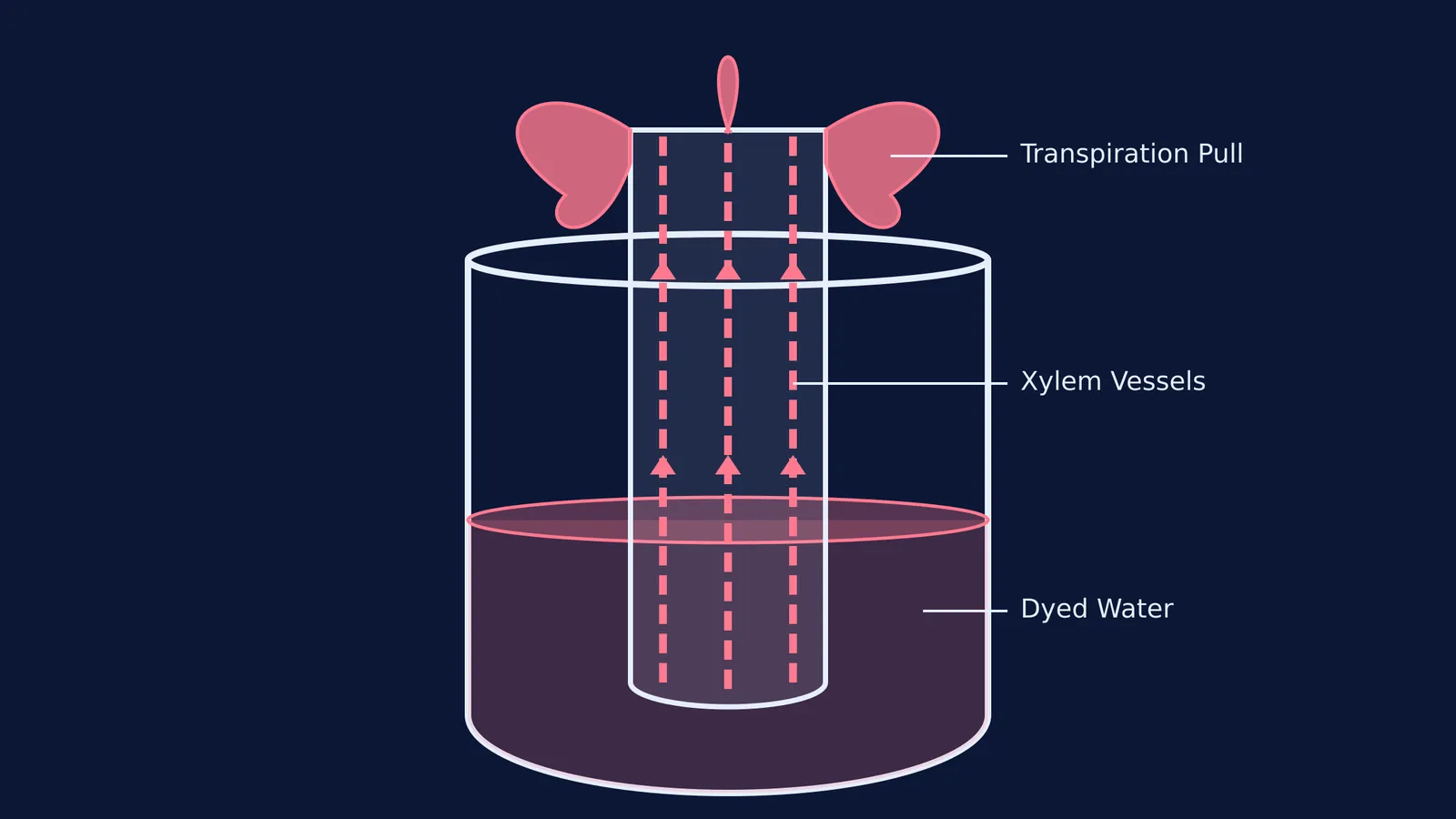
Over the next 2 to 24 hours, the dye slowly creeps up the stalk. Because celery stalks have long, straight parallel "veins," the colour stands out sharply. The dye eventually reaches the top, staining the leaf edges. This movement happens entirely through the plant's vascular tissue, specifically the xylem.
How do capillary action and the transpiration stream work?
Plants do not have a heart to pump fluids around their bodies. Instead, they rely on a combination of physical forces. Water enters the roots and moves upward through tiny, tube-like structures called xylem.
This upward movement is driven by two main processes:
Capillary action: Water molecules are naturally attracted to each other (cohesion) and to the rigid walls of the xylem tubes (adhesion). This allows the water column to climb the narrow tubes against the pull of gravity.
The transpiration stream: As described on Wikipedia, this is the continuous flow of water and solutes from the roots to the leaves via the xylem. When water evaporates from tiny pores in the leaves (called stomata) during transpiration, it creates a pressure deficit. This tension pulls more water up from below, much like drinking from a straw.
If you are a student working through plant physiology and struggling to picture these invisible forces at play, the Fermi Concept Library has a lesson on xylem, phloem, and the physics of the transpiration pull, each with its place in the map.
Why do leaves speed up the process?
If you try the experiment with two stalks—one with a full head of leaves and one with the leaves cut off—you will notice a significant difference in speed. The leafy stalk will draw the dyed water up much faster.
This happens because the leaves are the primary engine of the transpiration stream. Without leaves, there are no stomata for the water to evaporate from, which means there is no pressure deficit to pull the water column upward. The stalk without leaves will still draw up a little water due to capillary action, but it will travel much slower and stall out sooner. (You can explore more about how plants respond to light and their environment in our overview of tropic movements.)
What do the coloured dots mean?
The most revealing part of the celery experiment happens when you take the stalk out of the water and slice it cleanly across the middle with a knife.
Looking at the cross-section, you will see a row of bright red or blue dots arranged in a crescent near the outer edge of the stalk. These dots are the vascular bundles. They contain the xylem vessels that absorbed and transported the dye. Because the food colouring molecules are large, they are left behind in the xylem as the water evaporates from the leaves, marking the exact path the water took. (You can read more about variations in plant structures in our guide to stem modifications.)
If you peel a "string" down the length of the celery stalk starting from one of these dots, you will see a continuous coloured tube. The strings of the celery (the collenchyma tissue) sit just outside these vascular bundles and provide the structural support that keeps the stalk upright.
A worked plan for your kitchen lab
Here is how to set up the experiment for the clearest results:
Prepare the jar: Fill a clear glass or jar halfway with room-temperature water. Add 20 drops of dark food colouring (red or blue contrast best with green celery).
Trim the stalk: Take a leafy, crisp celery stalk and cut about an inch off the bottom at a slight angle. Doing this underwater prevents air bubbles from entering and blocking the xylem tubes.
Wait and watch: Place the stalk in the dyed water. Check it after 2 hours to see the dye moving halfway up the stem, and leave it for a full 24 hours to see the leaves change colour.
Dissect and inspect: Cut the stalk horizontally every few inches to find the coloured vascular bundles, comparing the colour intensity at the base to the top.
Understanding how water moves through a plant is a foundational step in biology, connecting simple physical principles like adhesion and evaporation to complex living systems.


