

On this page
Lab activities are manageable marks if you do them yourself and can explain what you found. CBSE's Class 10 mathematics curriculum for 2026-27 gives internal assessment 20 marks: 10 for pen-paper tests and multiple assessment, 5 for the portfolio and 5 for the lab practical. The split is the same for Mathematics Standard (041) and Basic (241).
The same document says lab activities are "to be done from the prescribed books". Two of those books are CBSE's Guidelines for Mathematics Laboratory in Schools, Class X and NCERT's Laboratory Manual for the secondary stage. The kit manual used below is a separate NCERT book that is not on that list, so check with your teacher which activities your school uses.
How should you record a maths lab activity?
NCERT's Manual for Secondary Stage Mathematics Kit (Grades 9 and 10) sets out each activity under the same headings: Objective, Material required, How to proceed and Inference, and many activities add a table of readings. Use that structure in your lab file, with a figure and precautions added:
Objective: the result stated in full.
Material required: what you actually used.
Procedure: numbered steps in the past tense.
Figure: a neat, labelled pencil drawing.
Observation table: three rows where you can, since the manual's triangle activities ask you to repeat with different triangles.
Inference: one or two sentences answering the objective.
Precautions: what could throw readings off, such as thick cutting lines.
How do you verify Pythagoras theorem with paper cut-outs?
Activity 18 in the NCERT kit manual uses a right-angled triangle with sides a, b and hypotenuse c, and a cut-out square on each side. Put the squares on a and b side by side, mark two copies of the triangle on them, and cut along those lines to get five pieces. Rearrange the five pieces on the square of side c. They cover it exactly, so a² + b² = c².
A worked row for your table: with a = 3 cm, b = 4 cm and c = 5 cm, the two small squares give 9 + 16 = 25 cm², which matches c² = 25 cm².
How does the area of a circle activity work?
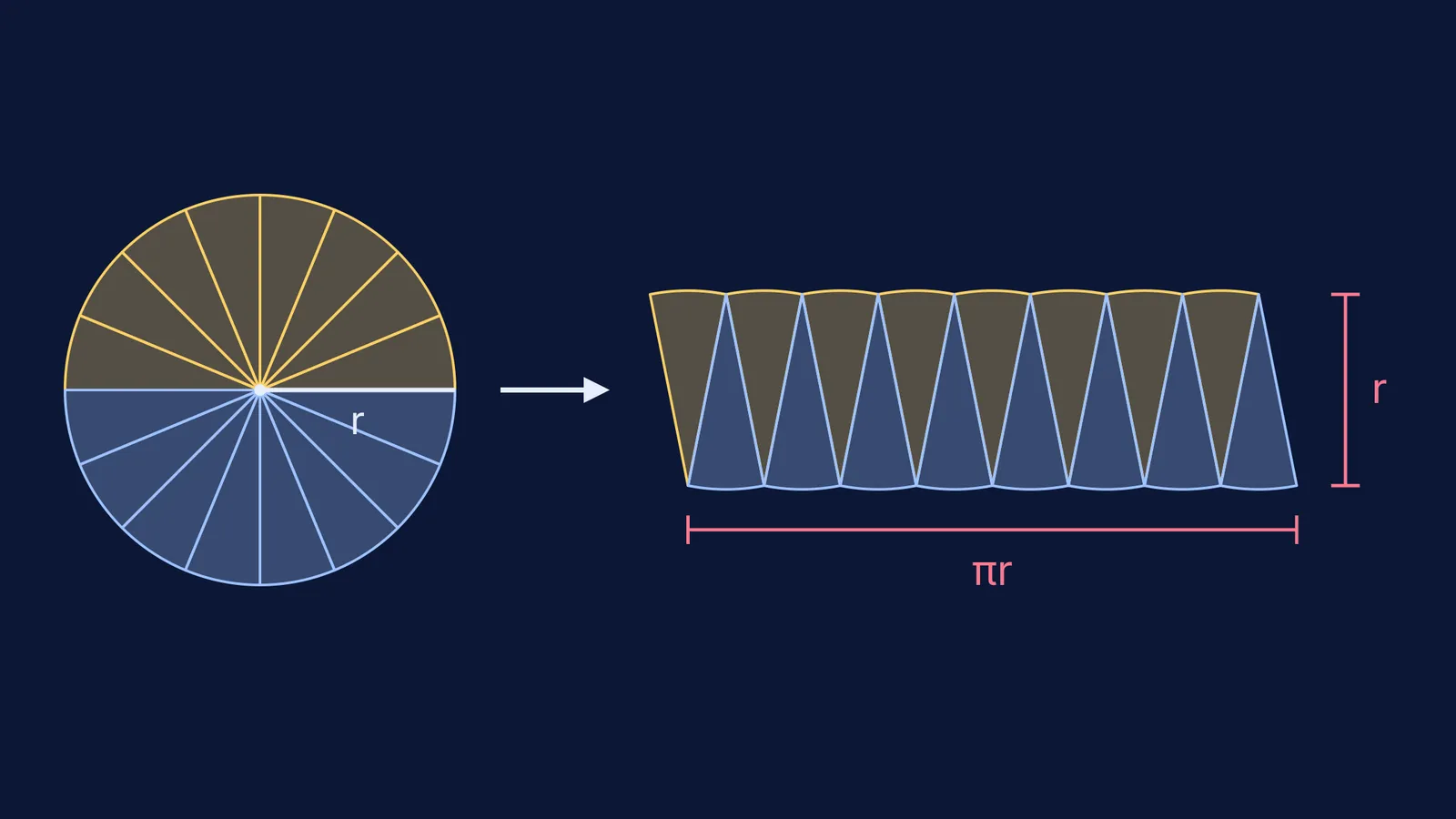
In Activity 22 of the NCERT kit manual, you cut identical circles into 4, 6, 8, 12 and 16 equal sectors. Each time you lay half the sectors point-up and half point-down, head to tail. The more sectors you use, the more the shape looks like a parallelogram whose base is half the circumference (πr) and whose height is the radius (r). So the area of the circle is πr × r = πr². The manual suggests extending the activity to 32 or 64 sectors.
In your table, record the number of sectors and describe the shape each time. For problems that use this formula, see our guide to areas of sectors and segments in Class 10.
How do you verify BPT in the lab?
Activity 6 in the kit manual builds triangle ABC from plastic strips, with a half protractor at B. A fourth strip is fixed at a point D on AB and turned until the angle at D equals the angle at B. Equal corresponding angles mean DE is parallel to BC. You then measure AD, DB, AE and EC and check whether AD:DB = AE:EC.
On paper, draw DE with a set square sliding along a ruler. Sample readings (yours will differ): AD = 3.0 cm, DB = 2.0 cm, so AD:DB = 1.5; AE = 4.2 cm, EC = 2.8 cm, so AE:EC = 1.5. The curriculum also asks you to prove BPT, so revise the proof in our post on the Class 10 maths theorems you must be able to prove and the worked examples on similar triangles and BPT. For BPT numericals, the Fermi Problem Library has worked problems with a step-by-step solver that explains the reasoning rather than just printing an answer.
What viva questions are asked in maths lab?
The curriculum does not list viva questions, so expect questions about your own activity. Practise these out loud:
What is the hypotenuse, and how did you identify it?
Would your Pythagoras cut-outs fit for a triangle that is not right-angled?
Why does the circle's shape look more like a parallelogram as you add sectors?
In BPT, how did you make sure DE was parallel to BC?
What is the converse of BPT?
Why might your two ratios differ slightly?
A simple script for opening your viva: "I verified that [result]. I measured [quantities] for three triangles, and the values agreed within [a small amount], because [one source of error]."
If a why question stumps you, the gap is usually the concept, not the activity. The Fermi Concept Library has a lesson for every concept in mathematics and shows where it fits in the map.
Do one activity this week, write it up under the seven headings and practise the viva answers out loud with a parent or a friend.


