

On this page
Reach for the Cauchy–Schwarz inequality in JEE maths when a question gives you a sum of squares and asks for the largest or smallest value of something else. Here are the two forms you need, three worked problems and the equality check.
What does the Cauchy–Schwarz inequality say?
For real numbers, (a₁b₁ + a₂b₂ + … + aₙbₙ)² ≤ (a₁² + … + aₙ²)(b₁² + … + bₙ²), as stated on Wolfram MathWorld. Equality holds when the two lists are proportional, that is aₖ = c·bₖ for every k (same source).
In vector language, |a · b| ≤ |a||b|, and the two sides are equal if and only if the vectors are linearly dependent, as the Wikipedia article on the inequality states. If you know a · b = |a||b| cos θ from vector algebra for JEE, this is just |cos θ| ≤ 1. Equality means θ = 0° or 180°.
How do you use the vector form in JEE problems?
The pattern: a linear expression plus a condition on a sum of squares. Pair the coefficients with the variables.
Worked example 1. If x² + y² + z² = 9, find the maximum of 2x + y − 2z.
Write it as a dot product: (2, 1, −2) · (x, y, z).
Apply Cauchy–Schwarz: (2x + y − 2z)² ≤ (4 + 1 + 4)(x² + y² + z²) = 9 × 9 = 81.
So −9 ≤ 2x + y − 2z ≤ 9.
Equality needs (x, y, z) = t(2, 1, −2). Then 9t² = 9, so t = 1. Check: 4 + 1 + 4 = 9. The maximum is 9.
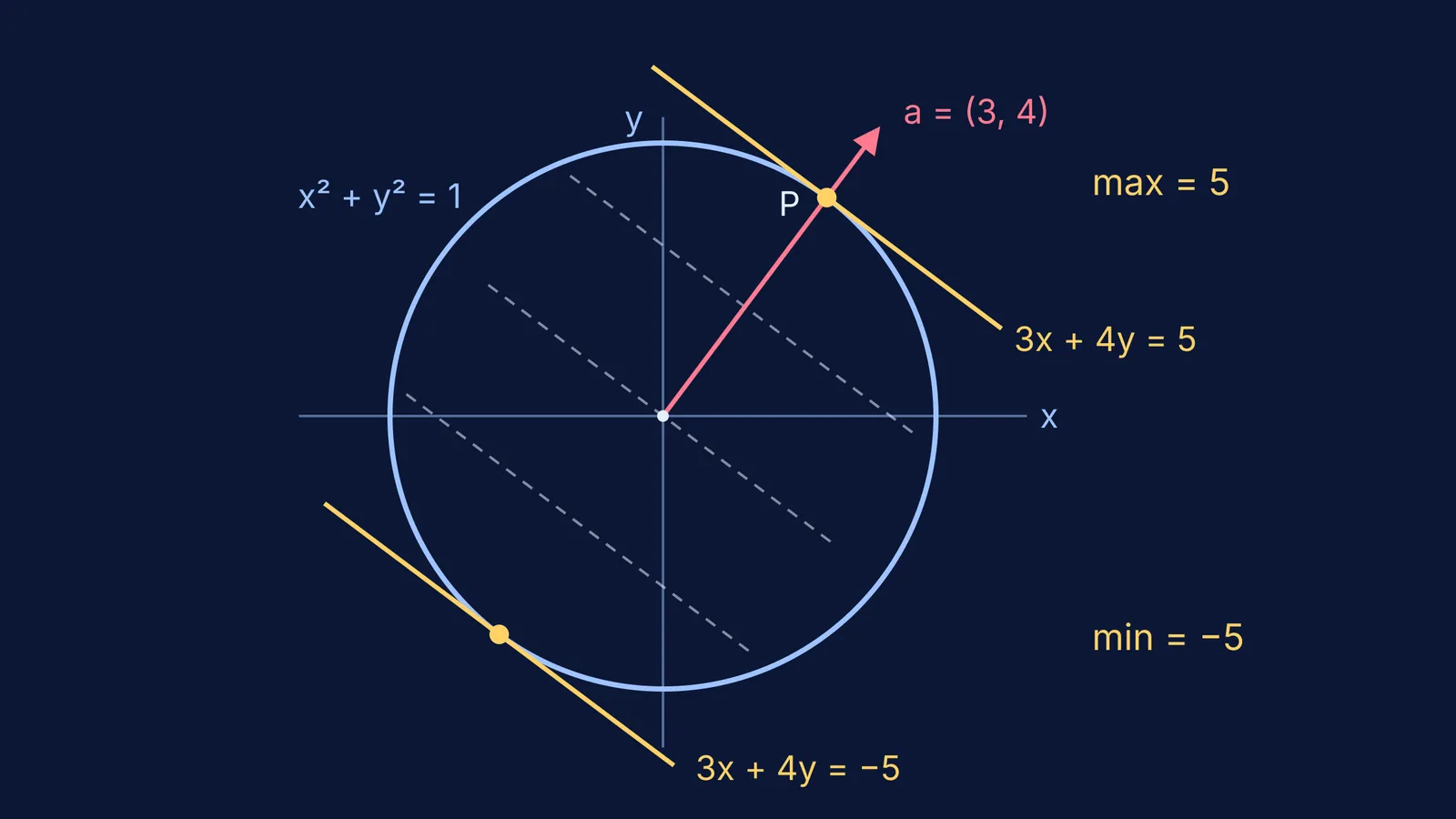
The same idea gives the range of 3 sin x + 4 cos x: (3, 4) · (sin x, cos x) is at most 5 × 1 = 5, as in our post on the range of a sin x + b cos x. The diagram at the top shows it: the line 3x + 4y = 5 just touches the unit circle at P(3/5, 4/5), where (x, y) points along (3, 4).
Worked example 2. If 2x + 3y + 6z = 14, find the least value of x² + y² + z².
14² = (2x + 3y + 6z)² ≤ (4 + 9 + 36)(x² + y² + z²) = 49(x² + y² + z²).
So x² + y² + z² ≥ 196/49 = 4.
Equality needs (x, y, z) = t(2, 3, 6), so 49t = 14 and t = 2/7, giving (4/7, 6/7, 12/7). The least value is 4.
What is the Engel form, and when does it beat AM-GM?
For real a₁, …, aₙ and positive b₁, …, bₙ, a₁²/b₁ + … + aₙ²/bₙ ≥ (a₁ + … + aₙ)²/(b₁ + … + bₙ), as the Wikipedia article on Titu's lemma states. It is also called Bergström's inequality, Engel's form and Sedrakyan's inequality; Arthur Engel included it in Problem-Solving Strategies in 1998 (same source). It follows from Cauchy–Schwarz, so equality holds when a₁/b₁ = … = aₙ/bₙ.
Use it when fractions have squares on top and the denominators have a known sum.
Worked example 3. If a, b, c > 0 and a + b + c = 1, find the minimum of 1/a + 4/b + 9/c.
Write the numerators as squares: 1²/a + 2²/b + 3²/c.
Engel form: the sum is at least (1 + 2 + 3)²/(a + b + c) = 36.
Equality needs 1/a = 2/b = 3/c, so a : b : c = 1 : 2 : 3, giving a = 1/6, b = 1/3, c = 1/2. Check: 6 + 12 + 18 = 36. The minimum is 36.
Now try AM-GM, as in our guide to the AM-GM inequality in JEE. It gives 1/a + 4/b + 9/c ≥ 3(36/abc)^(1/3), and abc ≤ 1/27, so the sum is at least 3 × 972^(1/3), about 29.7. That bound is true but not the answer: it needs a = b = c and 1/a = 4/b = 9/c at once, which is impossible.
Which inequality should you try first?
Linear expression, condition on a sum of squares: Cauchy–Schwarz, vector form.
Sum of squares to minimise, linear condition: Cauchy–Schwarz, or the distance from the origin to a plane.
Sum of fractions with a fixed sum of denominators: Engel form.
Positive terms with a fixed product or a fixed sum: AM-GM.
Then write three lines: the pairing, the bound, and the equality point substituted back into the condition.
How do you practise it?
Take five max-min questions from your notes and solve each with both methods. Note which one reaches a point where equality holds. If the pairing step is where you stall, the Fermi Problem Library has worked problems with a step-by-step solver that explains the reasoning rather than printing an answer. If dot products still feel shaky, the lesson on them is in the Fermi Concept Library.
Start with worked example 3 tonight: cover the solution and see if you spot the squares on top.


