

On this page
A perfectly executed "bank shot" on a carrom board feels like pure intuition, but it is entirely dictated by classical mechanics. Every time the heavy acrylic striker collides with a lighter wooden coin or the board's hardwood edge, it obeys strict rules of momentum and energy transfer.
For students preparing for competitive exams, the carrom board is more than just a game—it is a perfect, real-world laboratory for visualising 2D oblique collisions, friction, and the conservation of momentum.
How do angles decide the striker's path?
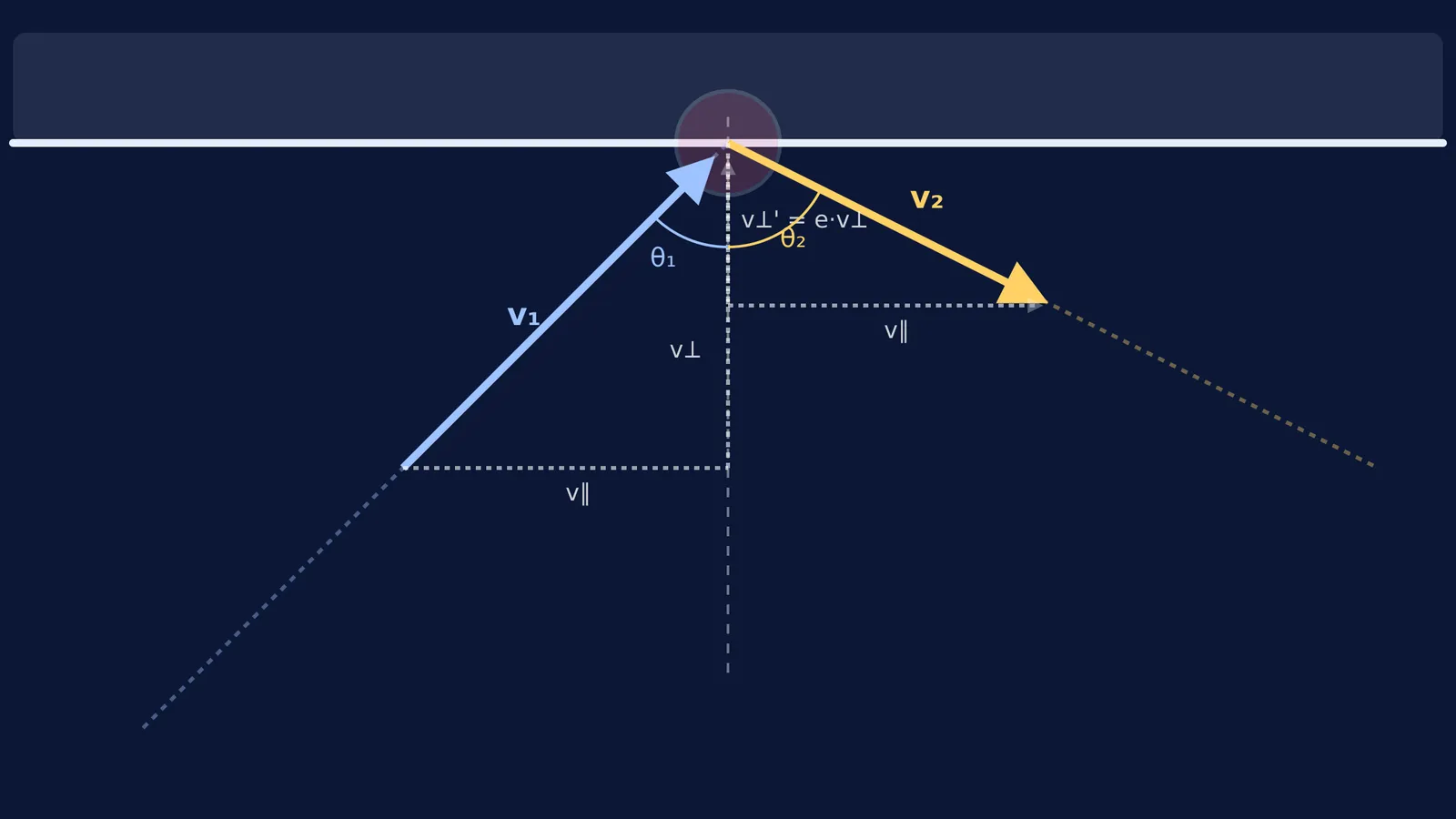
In introductory geometry and optics, the law of reflection states that the angle of incidence equals the angle of reflection (θ₁ = θ₂). If carrom collisions were perfectly elastic, you could aim at a point on the frame exactly halfway between the striker and the target pocket, and the striker would bounce perfectly into the hole.
However, real carrom boards are made of solid hardwood, which absorbs a fraction of the striker's kinetic energy upon impact. This energy loss is characterised by the coefficient of restitution (e).
In mechanics, the coefficient of restitution is defined as the ratio of the relative velocity of separation to the relative velocity of approach along the line of impact (Wikipedia).
When the striker hits the edge at an oblique angle, only the perpendicular component of its velocity is reduced by this energy loss. The velocity component running parallel to the edge remains unchanged (assuming the board is well-powdered). Because the perpendicular speed drops while the forward speed is maintained, the striker's path flattens out. This means the angle of reflection on a carrom board is always slightly larger than the angle of incidence.
Worked example: calculating a rebound shot
You can calculate the exact energy loss of your board's frame using the rebound angles: e = tan(θ₁) / tan(θ₂). Let us see how this alters a shot:
Suppose you aim a striker at the frame with an angle of incidence of 45° (θ₁ = 45°).
Assume the hardwood frame has a coefficient of restitution of 0.7 (e = 0.7).
Using the tangent of 45° (which is 1), the equation becomes: 0.7 = 1 / tan(θ₂).
Rearranging this gives tan(θ₂) ≈ 1.43.
The resulting angle of reflection (θ₂) is approximately 55°.
The striker bounces back 10 degrees wider than it approached. If you had relied on perfect symmetry, the shot would have missed the pocket by a wide margin.
What happens when the striker hits a coin?
When the striker hits a coin on the open board, the impact is a classic 2D oblique collision.
In an ideal scenario, when a moving disc strikes an identical stationary disc off-centre, the two objects will separate at exactly a 90-degree angle, provided the collision is perfectly elastic (HyperPhysics).
However, the 90-degree rule assumes equal masses. In carrom, the masses are deliberately mismatched. According to the Indian Carrom Federation, a standard striker can weigh up to 15.00 grams, while the wooden coins weigh only 5.25 to 5.50 grams (Indian Carrom Federation).
Why does the mass of the striker matter?
Because the striker is nearly three times as heavy as the coin, the conservation of linear momentum works heavily in the attacker's favour.
Momentum retention: The heavier striker retains a significant portion of its forward momentum even after transferring enough kinetic energy to send the coin into a pocket. This mass disparity is what makes follow-through or double-pocket shots possible.
The line of impact: The coin will always travel along the exact line connecting the centres of the two discs at the moment of impact. The striker, meanwhile, is deflected based on the impact parameter (how thick or thin the cut was).
How does friction change the sliding path?
Unlike billiards, where balls eventually begin to roll, carrom involves sliding friction throughout the entire motion. Boric powder is used to lower the coefficient of kinetic friction (μ) between the discs and the board.
Without powder, the frictional force (F = μmg) would cause rapid deceleration. This deceleration would not only stop the striker prematurely but could also cause it to curve slightly at low speeds as it catches the wood grain. By minimising friction, the striker acts more like an ideal physics particle gliding through a vacuum.
To practice aiming using the line of impact and the varying angles of restitution, try visualising the vectors using the Fermi Simulation Lab. Seeing how altering the mass ratio and the coefficient of friction changes the trajectory makes the underlying maths much easier to grasp.
For a deeper mathematical dive into how these angles behave, read about oblique elastic collisions of equal masses. If you are curious about how friction forces are calculated on different surfaces, check out how the angle of repose and angle of friction relate to kinetic movement.


