

On this page
Have you ever noticed that blades of grass on a lawn fold or roll up tightly during a hot, dry afternoon? This curling is not passive wilting in defeat. Instead, it represents a reversible, active defence mechanism against rapid water loss, driven by specialized cellular hinges known as bulliform cells.
Bulliform cells—also termed motor cells—are prominent morphological adaptations found throughout monocotyledonous plants, particularly members of the grass family (Poaceae). By translating changes in cellular water content directly into mechanical curling, these cells allow grasses to maintain physiological function across erratic cycles of drought and hydration.
What are bulliform cells?
In most grasses, including cereal crops such as maize, wheat, and rice, certain epidermal cells along the adaxial (upper) leaf surface undergo distinct structural differentiation. Rather than remaining compact pavement cells, they enlarge into prominent, bubble-shaped structures that arrange in longitudinal strips parallel to the leaf veins.
Under a microscope, bulliform cells stand out because they are noticeably larger than ordinary epidermal cells. They possess thin primary cell walls, contain large central vacuoles designed for water storage, and lack chloroplasts, leaving them largely colourless.
Their cell walls and external barriers are uniquely adapted for environmental sensing. Research on maize leaves indicates that bulliform cells possess a specialized cuticle with distinct cutin monomer composition, making them significantly more permeable to water than surrounding epidermal pavement cells (source). Because their cuticular conductance is higher, bulliform cells lose water and shrink far more rapidly than adjacent cells when evaporative demand escalates.
What is the function of bulliform cells in a grass leaf?
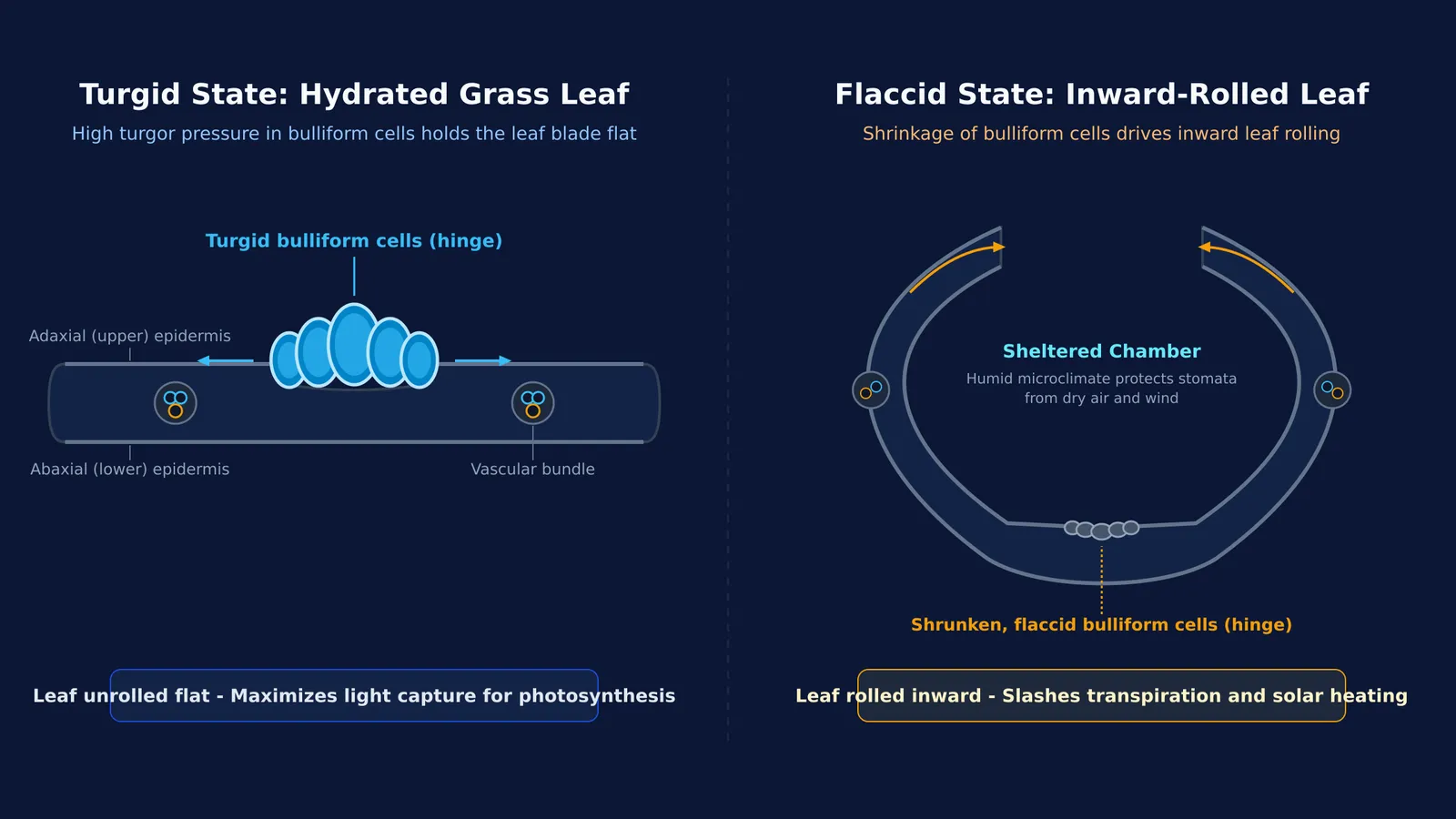
The primary function of bulliform cells in a grass leaf is to control the folding and unfolding of the leaf blade in response to changing water availability. They function as hydraulic hinges embedded within the leaf surface.
When water is plentiful in the soil and root uptake keeps pace with atmospheric transpiration:
The vacuoles of bulliform cells fill with water, generating high turgor pressure.
The swollen cells expand laterally against one another, exerting outward mechanical pressure on the leaf blade.
This turgid expansion forces the leaf to flatten and unroll, exposing its broad adaxial surface to incoming sunlight for photosynthesis and gas exchange.
When water becomes scarce during periods of drought or dry winds, this hydraulic balance shifts:
Bulliform cells lose water rapidly across their permeable cuticles, reducing internal turgor pressure.
As turgor drops, the cells become flaccid and shrink substantially in volume.
Because these cells are situated on the adaxial surface, their contraction generates asymmetrical auto-stresses across the leaf thickness, forcing the blade to roll inward toward the midrib (source).
This inward rolling creates an enclosed, cylindrical microclimate on the upper leaf surface where stomata are sheltered from direct solar radiation and wind currents. By reducing exposed surface area and humidifying the trapped boundary layer, the plant cuts evaporative water loss and cools its internal tissues. Once rainfall or irrigation restores soil moisture, the flaccid bulliform cells absorb water, swell again, and unroll the leaf blade.
Why does leaf rolling matter for crops?
While leaf rolling is essential for wild grasses surviving arid environments, it also serves as a crucial agronomic trait in cereal crops. In agricultural settings, the geometry of crop leaves directly dictates how efficiently sunlight penetrates the field canopy.
Moderate leaf rolling keeps the upper canopy leaves upright and erect rather than floppy. Erect leaves reduce mutual shading, allowing solar radiation to reach lower leaf tiers and boosting total canopy photosynthesis. In rice (*Oryza sativa*), researchers identified the *SEMI-ROLLED LEAF1* (*SRL1*) gene, which modulates leaf rolling by regulating the formation and number of bulliform cells; moderate leaf rolling improves overall photosynthetic efficiency and grain yield (source). Plant breeders therefore select for lines with optimal rolling indices to combine drought resistance with maximum yield potential.
How do cellular water changes connect to plant movements?
The folding of grass leaves illustrates how microscopic changes in cellular turgor translate directly into whole-organ movements. Unlike directional growth responses such as phototropism, geotropism and other tropic movements, bulliform-mediated leaf rolling is a reversible nastic movement governed purely by physics and cell geometry.
Studying these tissue systems connects directly to broader topics in the anatomy of flowering plants, where specialized cell groups serve distinct mechanical and physiological roles.
If you are exploring plant anatomy and need help visualizing internal structures, the Fermi Concept Library maps every concept across biology, physics, and chemistry. When you work through demanding topics—from the zones of apical, intercalary and lateral meristems to the biophysics of water transport—Fermi's AI tutor teaches rather than simply answering questions. It holds a line of reasoning across a whole session, notices where you are stuck, and decides whether to explain or show you a diagram to clarify complex plant biology.


