

On this page
You see Brewster's law at work whenever polarised sunglasses cut the glare off a lake. In a Class 12 or JEE Main paper it shows up as tan i = n, usually tied to Snell's law, so one slip can cost the whole question. Here is where the formula comes from, why the 90° condition matters, and five worked problems.
What is Brewster's law?
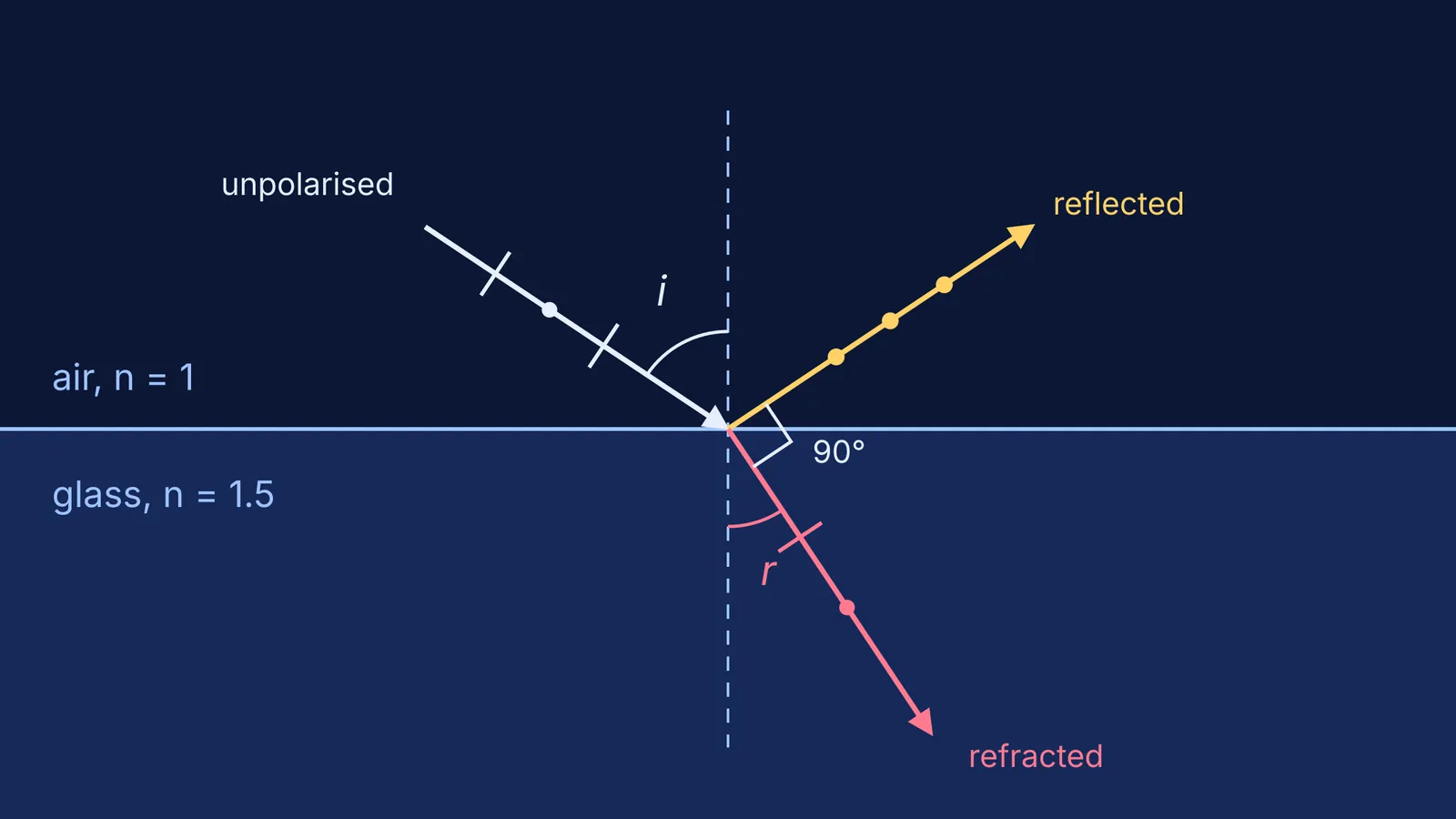
Light reflected from glass or water is usually only partly polarised. At one angle, called the polarising angle or Brewster angle, the reflected light is completely linearly polarised, with its electric field perpendicular to the plane of incidence (HyperPhysics, Georgia State University).
Brewster's law: tan i = n₂/n₁, where i is the Brewster angle and the light travels from medium 1 into medium 2 (OpenStax College Physics 2e, section 27.8). When the light comes from air, n₁ = 1 and the law becomes the textbook form tan i = n.
OpenStax gives the Brewster angle as 53.1° for light reflected from water and 56.7° for crown glass. It notes that because the two angles are similar, polarising sunglasses work equally well on glare from either.
David Brewster published the rule in 1815 in the Philosophical Transactions of the Royal Society; read the story in David Brewster and the angle of perfect polarisation.
Why are the reflected and refracted rays at 90 degrees?
The Fresnel equations show that the reflection of light polarised in the plane of incidence drops to zero exactly when the angles of incidence and refraction add up to 90° (HyperPhysics). Once you have that, Snell's law gives you Brewster's law in three lines:
The reflected ray makes angle i with the normal and the refracted ray makes angle r. If they are perpendicular, i + 90° + r = 180°, so r = 90° − i.
Snell's law gives n₁ sin i = n₂ sin r = n₂ sin(90° − i) = n₂ cos i.
Divide both sides by cos i: tan i = n₂/n₁.
Brewster's law is Snell's law with r = 90° − i. For Snell's own story, see Willebrord Snell and the sine law of refraction.
How do you solve Brewster angle problems step by step?
Write n₁ for the medium the light starts in and n₂ for the one it enters.
Write tan i = n₂/n₁ and find i.
Write r = 90° − i.
For a critical angle, use sin C = n(rarer)/n(denser); it exists only for light going from denser to rarer.
Check your answer: put i and r into n₁ sin i = n₂ sin r. Both sides must match.
Worked problems mixing Brewster's law and Snell's law
Problem 1, the angle of refraction. Light in air falls on glass with n = √3, and the reflected light is completely polarised. Find the angle of refraction.
tan i = √3, so i = 60°. The rays are perpendicular, so r = 90° − 60° = 30°. Check: sin 60° = √3 × sin 30°, and both sides equal √3/2.
Problem 2, from polarising angle to critical angle. A medium has a polarising angle of 60°. Find its critical angle for light going from the medium into air.
n = tan 60° = √3. Then sin C = 1/√3 ≈ 0.577, so C ≈ 35.3°.
Problem 3, glass under water. A glass plate (n = 1.5) lies under water (n = 1.33). At what angle of incidence is the reflected light completely polarised?
tan i = 1.5/1.33 ≈ 1.128, so i ≈ 48.4°. The common wrong answer, 56.3° from tan i = 1.5, assumes the light comes from air.
Problem 4, the Sun above a lake. Using OpenStax's 53.1° for water, how high is the Sun when glare off a calm lake is completely polarised?
Incidence is measured from the vertical normal, so the elevation is 90° − 53.1° = 36.9°.
Problem 5, Brewster angle from inside glass. Light inside glass (n = 1.5) meets air. Compare the Brewster and critical angles.
tan i = 1/1.5, so i ≈ 33.7°. The critical angle is given by sin C = 1/1.5, so C ≈ 41.8°. Here tan i and sin C equal the same number, and tan x > sin x for acute angles, so the Brewster angle is always smaller than the critical angle.
Which mistakes cost marks in polarisation questions?
Using sin i = n instead of tan i = n.
Flipping n₂/n₁ when the light starts in water or glass.
Measuring the angle from the surface instead of from the normal.
Saying the refracted light is completely polarised. Only part of the light polarised perpendicular to the plane of incidence is reflected, so the refracted beam still carries both polarisations and is only partly polarised.
If you set problems up wrong under time pressure, the Fermi Problem Library has worked problems with a step-by-step solver that explains the reasoning rather than printing an answer.
Next, apply the same habits to transmitted light in single-slit diffraction and Malus's law: problems and common errors.


