

On this page
If you are studying finance or taking an advanced mathematics course, calculating the price of a bond is often one of the first times you see the time value of money in action. A bond is simply a loan: you pay a certain amount today, and in exchange, you receive regular interest payments (coupons) plus the return of your initial loan (face value) when the bond matures.
To figure out exactly what that bond is worth today, you calculate its present value.
What is the present value of a bond formula?
The fair price of a bond is the sum of the present values of all its expected future cash flows, discounted at the market interest rate. To find this, you discount both the coupons and the final principal amount using the current market yield to maturity.
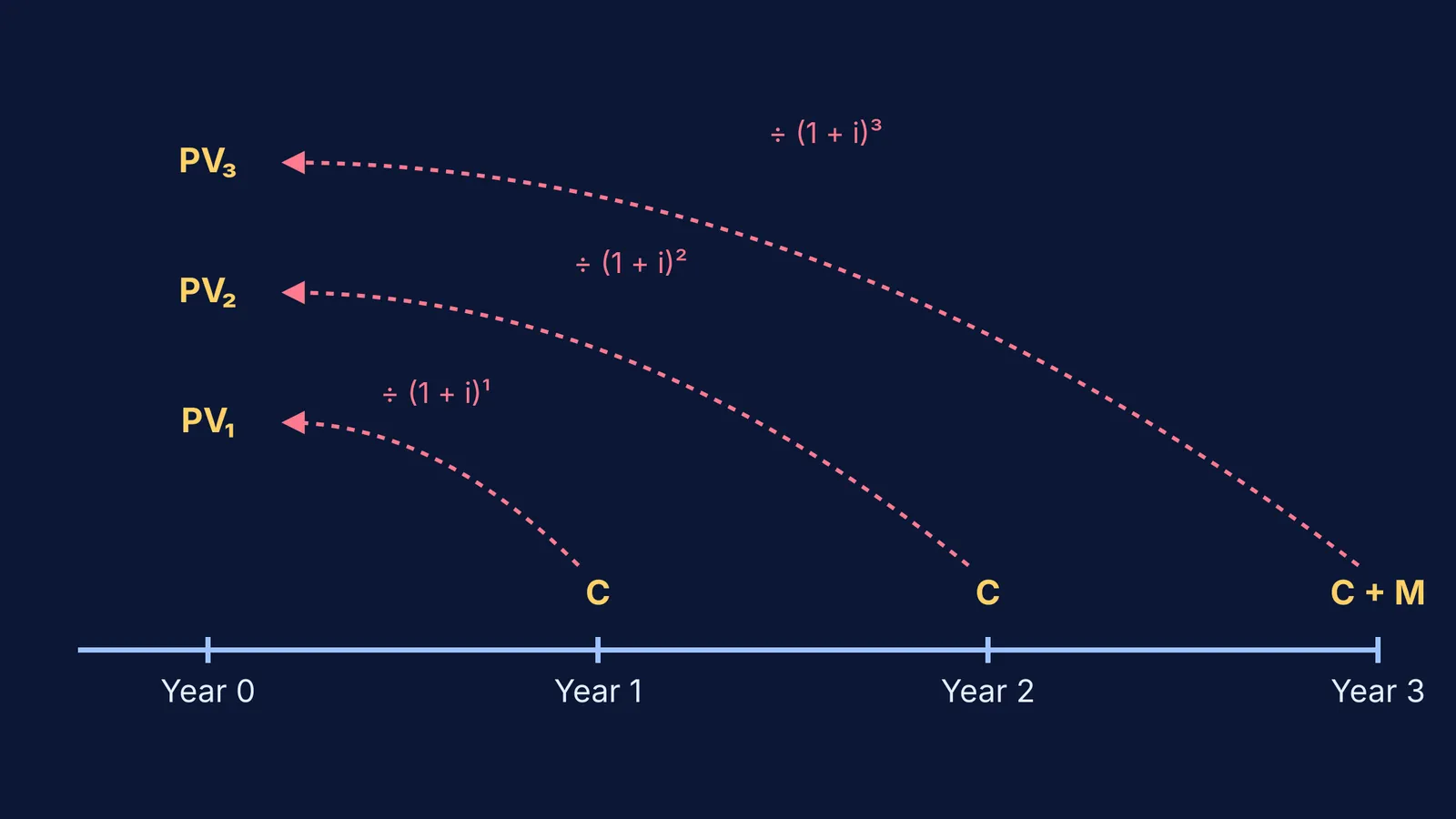
According to Wikipedia, the general formula for a bond's price (P) is the sum of its cash flows divided by (1 + i)^n, where i is the market interest rate and n is the period:
P = Σ [ C / (1 + i)^n ] + M / (1 + i)^N
Here, C represents the regular coupon payment, M is the final maturity amount (face value), and N is the total number of periods until maturity.
The coupon payments form a steady stream, so their present value can be grouped into an annuity formula. The face value is a single lump sum paid at the very end. When these two pieces are combined, they tell you exactly what the bond is worth right now. If grasping the concept of summing geometric progressions feels abstract, you can explore the underlying ideas in the Fermi Concept Library.
How do you find the present value of a bond?
To see how this works using the formula from Wikipedia, let's look at a worked example. Suppose you are evaluating a 3-year bond with a face value of ₹1,000 and an annual coupon of 5% (meaning you receive ₹50 each year). If the current market interest rate is 4%, here is how you find its present value step by step:
Step 1: Discount the coupons You will receive ₹50 in Year 1, ₹50 in Year 2, and a final ₹50 in Year 3.
Year 1 present value: 50 / (1 + 0.04)¹ = 48.08
Year 2 present value: 50 / (1 + 0.04)² = 46.23
Year 3 present value: 50 / (1 + 0.04)³ = 44.45
The total present value of the coupons is ₹138.76.
Step 2: Discount the face value You will also get your ₹1,000 back at the end of Year 3.
Year 3 face value present value: 1000 / (1 + 0.04)³ = 889.00
Step 3: Add them together P = 138.76 + 889.00 = 1027.76
The present value of the bond is ₹1,027.76. Because the bond's coupon rate is higher than the current market rate, it trades at a "premium" above its face value. Working through multi-step calculations like this is a great way to build your skills; if you get stuck on the arithmetic, you can step through similar examples in the Fermi Problem Library, which explains the reasoning behind each line rather than just printing an answer.
*(For other mathematical patterns that rely on summing terms, see our guide on sums like 9 + 99 + 999 and other geometric progressions.)*
The annuity shortcut for coupon payments
Calculating the present value of a 3-year bond term by term is straightforward, but what if you are evaluating a 10-year or 30-year bond? Writing out thirty separate present value calculations is tedious and error-prone.
Because the coupon payments are identical each year, they form what mathematicians call an annuity. According to Wikipedia, the present value of all remaining coupon payments can be simplified using the annuity formula:
PV_coupons = C × [ 1 − (1 + i)^−N ] / i
Using our previous example of a ₹1,000 bond with a ₹50 annual coupon (C) and a 4% market interest rate (i) over 3 years (N), we can calculate the coupon portion in one step: PV_coupons = 50 × [ 1 − (1 + 0.04)⁻³ ] / 0.04 = 50 × 2.7751 = 138.75
This matches our step-by-step addition (with a tiny rounding difference of a penny), saving considerable time on exams. Mastering shortcuts like this is helpful whether you are tackling finance algorithms or exponential models of growth and decay.
Why do bond prices fall when interest rates rise?
There is a strict inverse relationship between bond prices and market interest rates. When interest rates rise, bond prices fall, and when rates fall, bond prices rise.
This happens for two key reasons:
The mathematical effect: Look back at the formula. The interest rate (i) is in the denominator. As Wikipedia notes, a higher interest rate increases the denominator, meaning the present value of fixed future cash flows decreases, leading to a lower bond price.
The opportunity cost: When market rates go up, newly issued bonds start paying higher coupon rates. The older bonds with lower fixed payments suddenly look less attractive to buyers. The only way those older bonds can find a buyer is if their price drops until their effective yield matches the new, higher market rate.
How sensitive is the bond to interest rate changes?
We know that as interest rates rise, bond prices fall, but they do not all fall by the same amount. The degree to which a bond's price changes in response to interest rate shifts is measured by a metric called duration Wikipedia.
A higher duration indicates that a bond's price will be more sensitive to changes in interest rates. Generally, bonds with longer maturity periods (meaning you have to wait longer to receive your face value) have higher durations. Their prices will drop more sharply if market rates suddenly increase, because those distant cash flows are discounted more heavily.
If you struggle to picture how changing one variable (like duration or interest rates) shifts an entire outcome, Fermi's AI tutor can work out what you already know and build a plan for the session, so you sit down to a clear next step.


