

On this page
When a force pulls the bottom block in a stacked system, how do you find the acceleration of both blocks?
Many students hit a wall when friction acts not just between the blocks, but also between the bottom block and the floor. A 2021 review in *Physical Review Physics Education Research* found that the most common misconception is assuming friction always points opposite to the direction of motion, rather than opposing relative motion between surfaces.
In a stacked system, static friction is actually the force that pulls the top block forward. Here is a step-by-step method to write the equations for two stacked blocks with friction at both surfaces, and how to check which surfaces slip.
What are the friction forces on two stacked blocks?
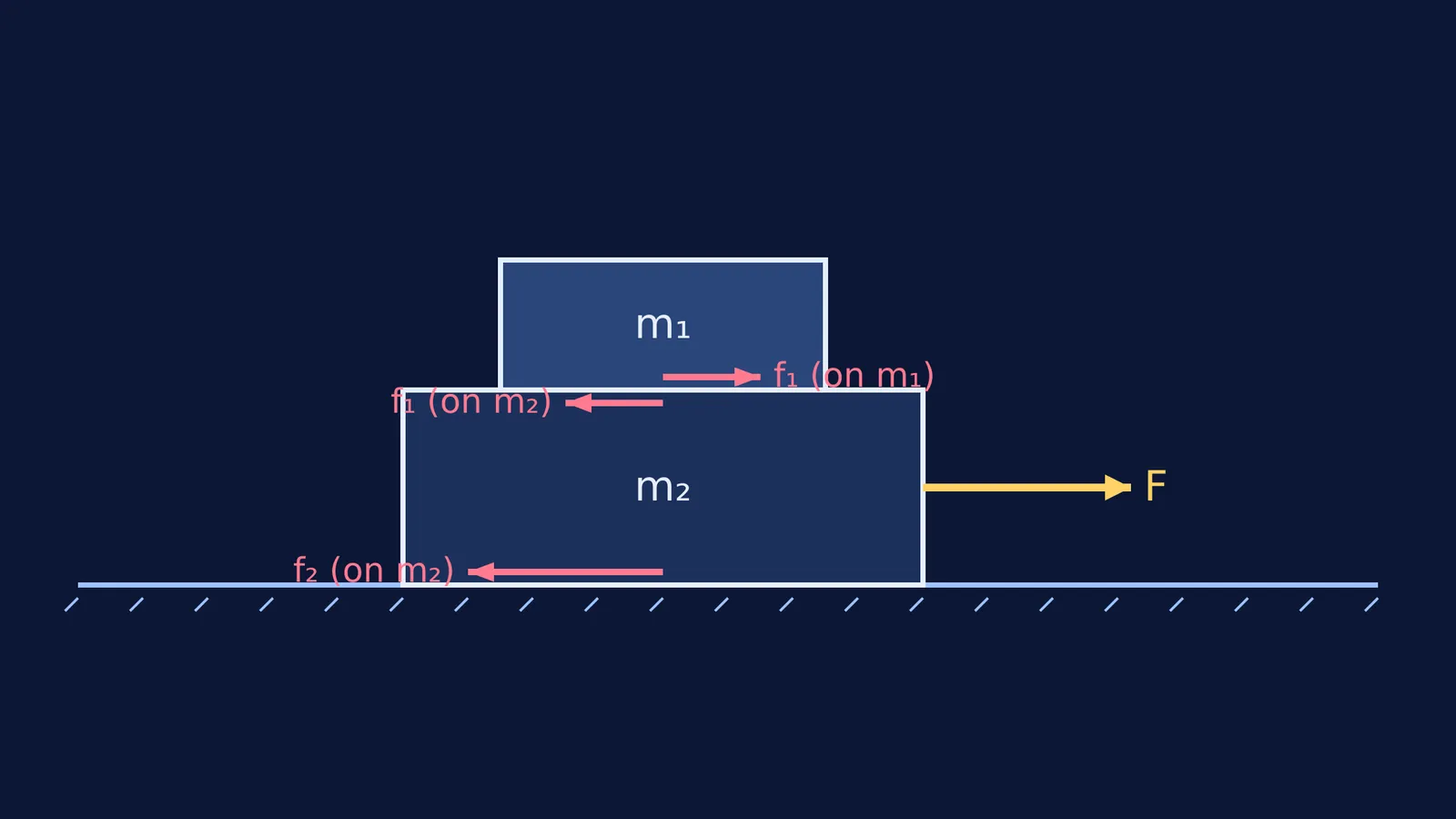
Before writing any equations of motion, you need to know the maximum static friction available at both surfaces. Let m₁ be the mass of the top block and m₂ be the mass of the bottom block.
For the top block, the normal force from the bottom block is simply its own weight: N₁ = m₁g. The maximum static friction that can act between the two blocks is f_s1(max) = μ_s1 N₁.
For the bottom block, the floor must support the weight of both blocks. Therefore, the normal force on the bottom block is N₂ = (m₁ + m₂)g. The maximum static friction at the floor is f_s2(max) = μ_s2 N₂.
How do you check if the blocks slip?
When you do not know whether the blocks will slip against each other, always start by assuming they stick together and share the same acceleration, a. Treat the two blocks as a single system of mass (m₁ + m₂).
If an external force F pulls the bottom block to the right, the only horizontal forces on the combined system are F to the right and the floor's kinetic friction f_k2 = μ_k2 (m₁ + m₂)g to the left. (If F is less than f_s2(max), nothing moves at all).
The equation of motion for the system is: F − f_k2 = (m₁ + m₂)a
From this, you can calculate the assumed acceleration a.
Now that you have the acceleration a, you must check if your assumption was correct. Look at the top block on its own. The only horizontal force acting on it is the static friction f₁ from the bottom block.
To give the top block an acceleration a, the required friction is: f₁ = m₁a
Compare this required friction f₁ to the maximum available static friction f_s1(max):
If f₁ ≤ f_s1(max): Your assumption holds. The friction is strong enough to keep the blocks stuck together. They both accelerate at a, and the static friction acting on the top block is exactly m₁a.
If f₁ > f_s1(max): The required friction exceeds the physical limit. The blocks slip against each other.
If the blocks slip, the assumption that they move together is wrong. You must recalculate the accelerations using kinetic friction.
What are the equations when the surfaces slip?
When the top block slips on the bottom block, the friction between them reaches its maximum kinetic value: f_k1 = μ_k1 m₁g. Because they are slipping, they have different accelerations, a₁ and a₂.
Write a separate Newton's second law equation for each block.
For the top block, kinetic friction pushes it to the right: f_k1 = m₁a₁
For the bottom block, the pulling force F acts to the right. The floor's kinetic friction f_k2 pulls to the left. Crucially, by Newton's third law, the kinetic friction f_k1 from the top block also pulls the bottom block to the left: F − f_k1 − f_k2 = m₂a₂
Solve these two equations to find a₁ and a₂. The top block's acceleration a₁ will be smaller than the bottom block's acceleration a₂.
How can a step-by-step solver tool help?
Checking for the slip condition is a common trap in JEE and school physics exams, leading students to guess whether to use static or kinetic friction. If you find yourself stuck at the slip-check step, the Fermi Problem Library has a step-by-step solver that explains the reasoning rather than just printing an answer. It breaks down the forces on each surface so you understand why a block moves, not just how. For a broader review of where forces come from, the Fermi Concept Library can help map out Newton's laws.
For more practice on connected bodies, see Atwood machine problems: tension, acceleration and three variations or how to spot Rotational motion: five common JEE mistakes and their fixes.


