

On this page
Most reactions you learn for benzene keep the ring aromatic. The Birch reduction breaks that rule, but only halfway: it adds two hydrogens to benzene and then stops, leaving a ring with two double bonds that are not next to each other. Learn why it stops there and you can predict the product for any substituted ring.
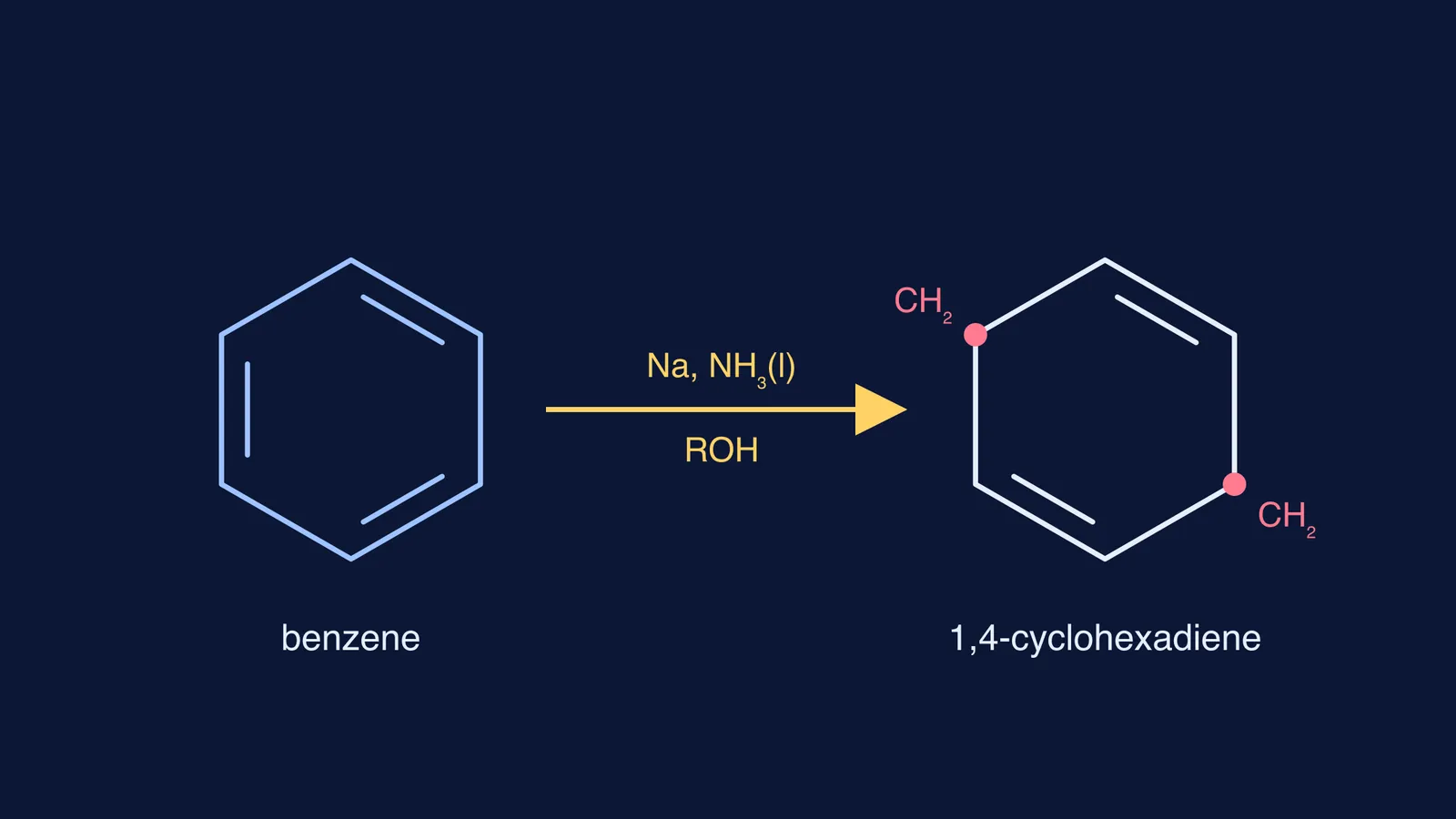
What is the product of the Birch reduction of benzene?
The product is 1,4-cyclohexadiene, C₆H₈: a six-membered ring with double bonds at C1=C2 and C4=C5, and a CH₂ group at C3 and at C6 (Organic Chemistry Portal; Wikipedia: Birch reduction).
The reagents are an alkali metal, usually lithium or sodium, dissolved in liquid ammonia, which refluxes at –33 °C, plus an alcohol (William Reusch, Virtual Textbook of Organic Chemistry). A solution of sodium in liquid ammonia is intensely blue and contains solvated electrons, which do the reducing; the alcohol is the proton source, and Birch's original procedure used sodium and ethanol (Wikipedia: Birch reduction).
The reaction is named after the Australian chemist Arthur J. Birch, who developed it in the 1940s. His series "Reduction by dissolving metals" began with Part I in the Journal of the Chemical Society in 1944 (Crossref record, DOI 10.1039/JR9440000430).
Why does the Birch reduction give a non-conjugated diene?
Follow the electrons and protons in turn. Two electrons are added one at a time, and each is followed by a protonation (Reusch; Wikipedia):
A sodium atom gives one electron to the ring, making a radical anion.
The radical anion takes a proton from the alcohol, giving a cyclohexadienyl radical.
A second electron arrives, turning the radical into a cyclohexadienyl anion.
The anion takes a second proton from the alcohol.
The key is step 4. The cyclohexadienyl anion spreads its negative charge over three carbons, and it is protonated on the central one, which sits directly opposite the carbon protonated in step 2 (Reusch). Two CH₂ groups opposite each other leave two isolated double bonds. The Organic Chemistry Portal gives one way to picture it: repulsion between electrons in the radical anion keeps the nonbonding electrons as far apart as possible, in a 1,4 relationship (Organic Chemistry Portal).
Why does it stop at the diene instead of going on to cyclohexane? The residual double bonds do not stabilise further radical additions, so they are left alone; only alkenes conjugated with the ring tend to be reduced (Wikipedia; Organic Chemistry Portal).
If the idea of an isolated versus a conjugated diene is shaky, our post on heat of hydrogenation and alkene stability is a good refresher first.
Where do substituents end up in a Birch reduction?
The substituent decides where the first proton goes, and the second proton goes para to the first (Reusch).
Electron-donating groups (–OCH₃, –CH₃, other alkyl groups) favour protonation ortho to the substituent, so the group stays on a double-bond carbon (Reusch). The result is the diene with the more substituted double bond (Organic Chemistry Portal).
Electron-withdrawing groups (–COOH) favour para protonation, so the carbon carrying the group itself becomes saturated, sp³ (Reusch).
Do not mix this up with electrophilic substitution of anisole, where –OCH₃ directs incoming groups ortho and para. In Birch, you are placing hydrogens, not new groups, and what matters is which carbons end up sp³.
Worked example: three rings, one method
Number the ring with the substituent at C1, then ask one question: does C1 keep its double bond or lose it?
Toluene (–CH₃, donating). C1 keeps its double bond. Hydrogens add at C3 and C6. Product: 1-methylcyclohexa-1,4-diene, with the methyl group on a double bond.
Anisole (–OCH₃, donating). Same pattern. Product: 1-methoxycyclohexa-1,4-diene. One of its double bonds is an enol ether, which is readily hydrolysed to a ketone, so the sequence becomes a route to a cyclohexenone (Reusch).
Benzoic acid (–COOH, withdrawing). C1 loses its double bond. Hydrogens add at C1 and C4. Product: cyclohexa-2,5-diene-1-carboxylic acid, with the –COOH on an sp³ carbon (Organic Chemistry Portal).
How do you check a Birch reduction answer in an exam?
Run this checklist before you mark an option:
Are there exactly two new hydrogens, one at each of two para carbons?
Are the two remaining double bonds non-conjugated (1,4, not 1,3)?
Is a donating group on a double-bond carbon?
Is a withdrawing group on an sp³ carbon?
If the ring had –OCH₃ and the question adds aqueous acid, did you convert the enol ether into a ketone?
If an option fails any line, cross it out. For more practice of this kind, the Fermi Problem Library has worked problems with a step-by-step solver that explains the reasoning rather than printing an answer. If the gap is further back, say resonance or what makes a group donating, the Fermi Concept Library gives each concept its own lesson.
Next time you see sodium and liquid ammonia over a benzene ring, draw the CH₂ groups opposite each other first, then place the substituent.


