

On this page
In chemistry, the words "base" and "alkali" are often used as if they mean the same thing, but they do not. While every alkali is a base, not every base is an alkali. The difference comes down to one property: whether or not the substance dissolves in water.
What is the difference between a base and an alkali?
A base is a broad category of substances that can neutralise an acid. According to Wikipedia's summary of chemical bases), they react with hydrogen ions from acids to form a salt and water. This definition includes metal oxides and metal hydroxides.
An alkali is a specific type of base that is soluble in water. The word itself comes from the Arabic *al-qalīy*, which means "the calcined ashes", referring to the plant ashes from which early chemists extracted potassium carbonate, according to Wikipedia's entry on alkalis. When you dissolve an alkali in water, it releases hydroxide ions (OH⁻), giving the solution a pH greater than 7.
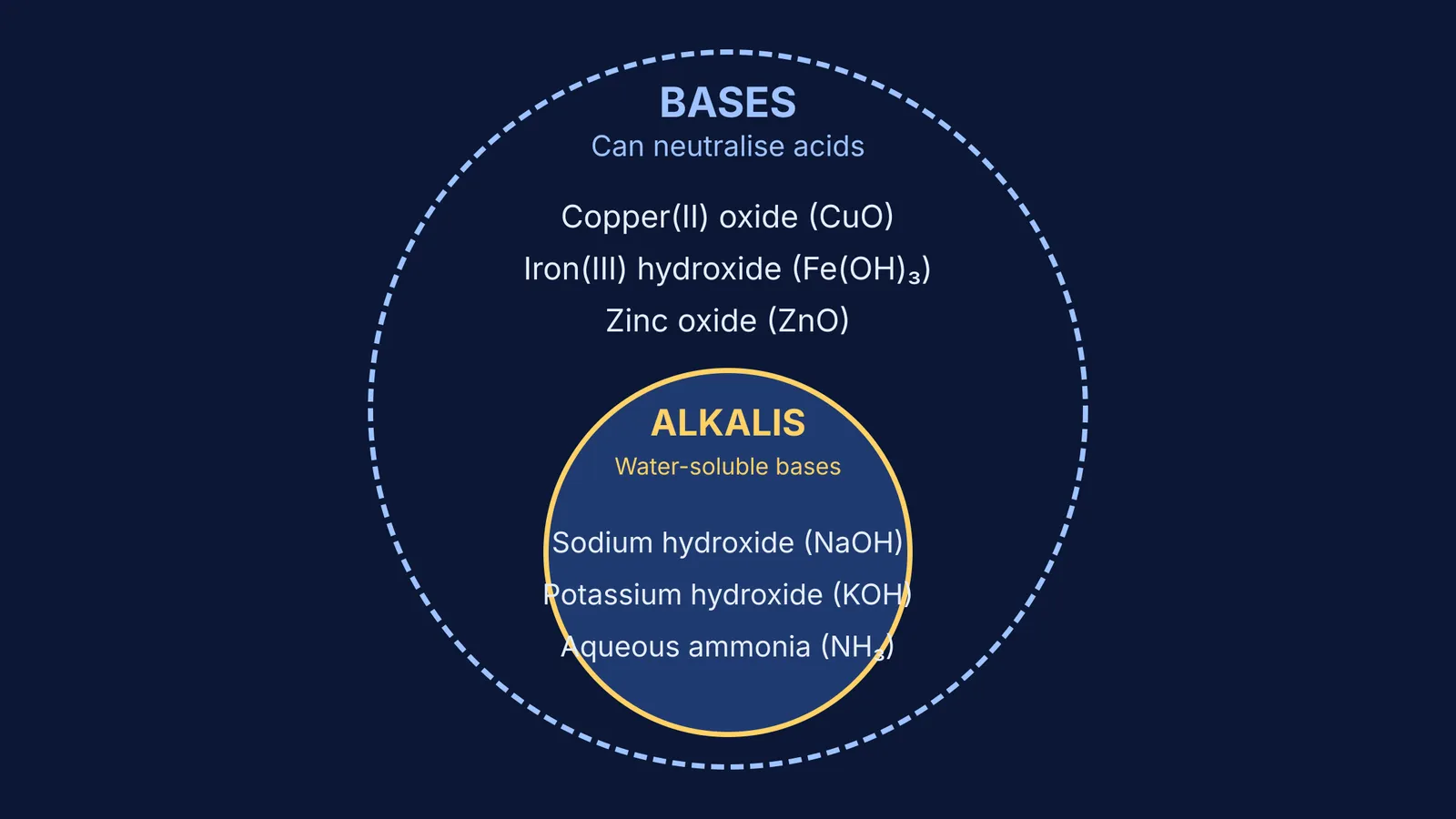
This leads to the golden rule of classifying these compounds: all alkalis are bases, but only water-soluble bases are alkalis.
Which bases are alkalis and which are not?
To see the difference in practice, we can sort common bases by their solubility.
The metals in Group 1 (the alkali metals) and Group 2 (the alkaline earth metals) of the periodic table generally form bases that dissolve in water. These are your alkalis. Some everyday examples include:
Sodium hydroxide (NaOH): A highly soluble strong alkali used to make soap.
Potassium hydroxide (KOH): Another strong alkali, often found in alkaline batteries.
Aqueous ammonia (NH₃): A weak alkali that dissolves in water to form ammonium hydroxide, common in household cleaners.
On the other hand, many transition metals form oxides and hydroxides that do not dissolve in water. These are bases, because they can still neutralise acids (for instance, if you drop them into a beaker of hydrochloric acid), but they are not alkalis. Examples of insoluble bases include:
Copper(II) oxide (CuO): A black solid that neutralises acids but sinks to the bottom of pure water.
Iron(III) hydroxide (Fe(OH)₃): A reddish-brown solid that remains insoluble.
Zinc oxide (ZnO): A white powder that reacts with acids but will not dissolve in water.
Why does solubility matter?
Solubility dictates how we use these chemicals in the laboratory and in industry. Because alkalis dissolve, they can provide a steady supply of hydroxide ions in an aqueous solution. This makes them ideal for tasks like titrations, where you need a consistent liquid solution to slowly neutralise an acid.
Insoluble bases are useful precisely because they do not dissolve. If you need to neutralise an acid spill without making the resulting mixture dangerously alkaline if you add too much, an insoluble base is safer. You can add excess copper(II) oxide to an acid, wait for the neutralisation to finish, and simply filter out the leftover solid base. (This is a common method taught in Acids, bases and salts in Class 10: indicators, pH and common salts).
If you find yourself stuck on the difference between the Arrhenius, Brønsted-Lowry and Lewis definitions of these compounds, you can read our side-by-side guide to acid-base definitions.
For students trying to master these categories for their board exams or competitive tests, memorising lists of compounds is rarely enough. The Fermi Concept Library helps you understand the underlying patterns—like why Group 1 metals form soluble hydroxides while transition metals do not—so you can predict a compound's behaviour instead of relying on memory. Fermi's AI tutor works through these ideas with you step by step, checking your understanding as it goes.
How to test for an alkali?
Because alkalis are aqueous solutions, they are easy to test with standard laboratory indicators. An alkali will turn red litmus paper blue, and it will turn phenolphthalein indicator from colourless to a bright pink.
Testing an insoluble base is less direct. Since it will not release hydroxide ions into neutral water, it will not change the colour of dry litmus paper or a water-based indicator on its own. You prove it is a base by observing its neutralisation reaction with an acid.
Understanding the difference between bases and alkalis is a foundational step in chemistry. By focusing on solubility, you can easily sort them out: alkalis are the subset of bases that dissolve and release hydroxide ions into the water around them. (And if you are curious about how we measure the strength of those solutions, read our piece on Søren Sørensen and why pH counts in powers of ten).


