

On this page
The balance of payments chapter looks like a list of definitions, but it is one idea: whatever a country spends abroad beyond what it earns has to be financed somehow. Below are NCERT's definitions, India's real numbers for April to June 2026, and a revision plan.
What is the balance of payments in Class 12 economics?
The balance of payments (BoP) records the transactions in goods, services and assets between residents of a country and the rest of the world over a period, typically a year, according to the NCERT Class 12 Introductory Macroeconomics chapter on the open economy. It has two main accounts.
Current account: trade in goods, trade in services (factor income such as wages and investment income, and non-factor income such as software, tourism and shipping), and transfer payments such as gifts, remittances and grants.
Capital account: all international transactions in assets: foreign direct investment, portfolio investment, external borrowings and external assistance.
Two current-account terms come up often. The balance of trade is exports of goods minus imports of goods. Net invisibles is the balance on services, transfers and income flows.
The same chapter gives the rule that ties everything together: a current account deficit must be financed by a capital account surplus, so current account plus capital account equals zero. If private flows fall short, the central bank fills the gap by selling foreign exchange, which NCERT calls an official reserve sale. A fall in official reserves is an overall BoP deficit.
How do the current and capital account work with real numbers?
Here is India's actual BoP for April to June 2026 from the Reserve Bank of India's press release of 1 September 2026. It uses the IMF's newer layout, splitting income into primary (mostly investment income) and secondary (mostly transfers).
Goods: a deficit of US$86.1 billion. This is the balance of trade.
Services: a surplus of US$51.6 billion, with exports up in computer, business and transport services.
Primary income: a net outflow of US$10.5 billion, mainly investment income paid abroad.
Secondary income: a net inflow of US$40.8 billion, driven by US$42.9 billion of personal transfer receipts, mainly remittances from Indians working overseas.
Add them: −86.1 + 51.6 − 10.5 + 40.8 = −4.2. That is the current account deficit of US$4.2 billion, or 0.5% of GDP, the RBI reports.
Now the other side. The capital and financial account shows a net inflow of US$2.6 billion, and errors and omissions add US$1.6 billion: −4.2 + 2.6 + 1.6 = 0. The catch is that the US$2.6 billion includes reserves falling by US$8.1 billion. Without them, the other flows come to about −US$5.5 billion (2.6 − 8.1), partly because portfolio investors took out US$9.6 billion while FDI brought in US$6.1 billion. Reserves filled the gap: in NCERT's terms, an overall BoP deficit.
Checking a sum like this is a habit worth building, as in our guide to checking a national income answer against NCERT.
What is the difference between fixed and flexible exchange rates?
The exchange rate is the price of one currency in terms of another, and the NCERT chapter describes three ways to set it.
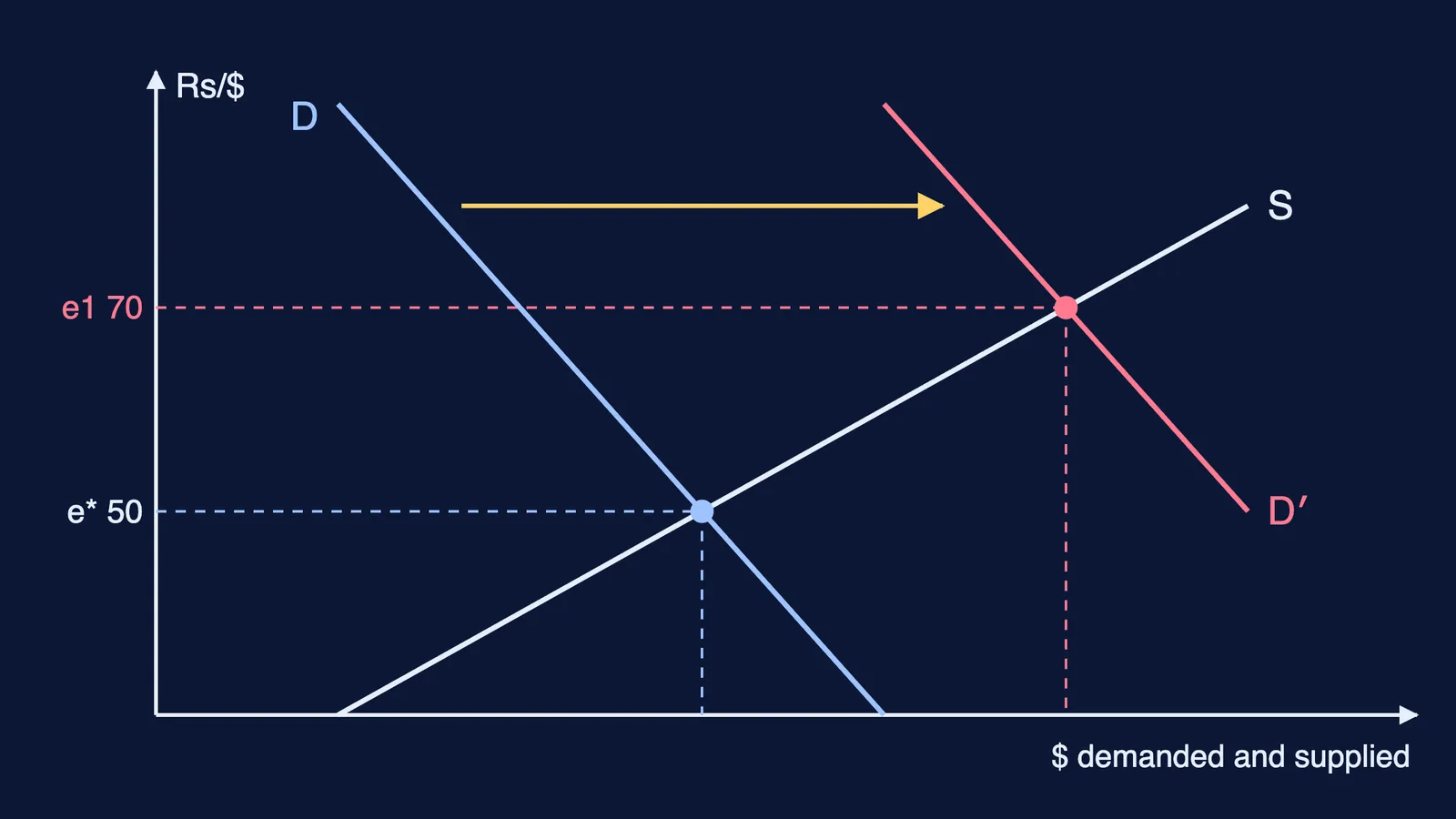
Flexible (floating): set by the demand for and supply of foreign exchange, with no central bank intervention. If Indians demand more dollars, say for foreign travel, the rate rises from Rs 50 to Rs 70 per dollar in NCERT's example. The rupee has depreciated.
Fixed: the government sets the rate and the central bank buys or sells dollars to hold it there. Raising the fixed rate (more rupees per dollar) is devaluation; lowering it is revaluation.
Managed floating ("dirty floating"): a mix of the two. The market sets the rate, but central banks buy and sell foreign currency to moderate its movements.
For the merits question: a fixed rate needs credibility and reserves; if people doubt the reserves will last, a speculative attack can force a devaluation. A flexible rate lets exchange-rate movements correct BoP surpluses and deficits automatically, needs no large reserves, and gives the country independence in its monetary policy.
How should you revise this chapter for the board exam?
Work through these in order.
Draw the current and capital account trees from memory, then check against NCERT.
Sort a list of transactions: a remittance from Dubai, an IT export, an Indian buying a US share, a World Bank loan. For each, write the account and whether it is a credit or a debit.
Redo the RBI addition above without looking.
Draw the forex diagram, shift demand right and label the depreciation. Then fix a rate above equilibrium and mark the excess supply the central bank must buy.
For background, see our notes on globalisation and the Indian economy.
If you get stuck on the diagrams, Fermi's AI tutor can take a scanned assignment, work out what you already know and build a plan for the session.


