

On this page
Baking soda and baking powder are the two most common leavening agents in any kitchen. Although they look like identical white powders, using the wrong one can leave your cake flat or give it an unpleasant, soapy taste.
The difference lies entirely in their chemical composition. One is a pure chemical compound, and the other is a carefully balanced mixture designed to react at specific times.
What is baking soda?
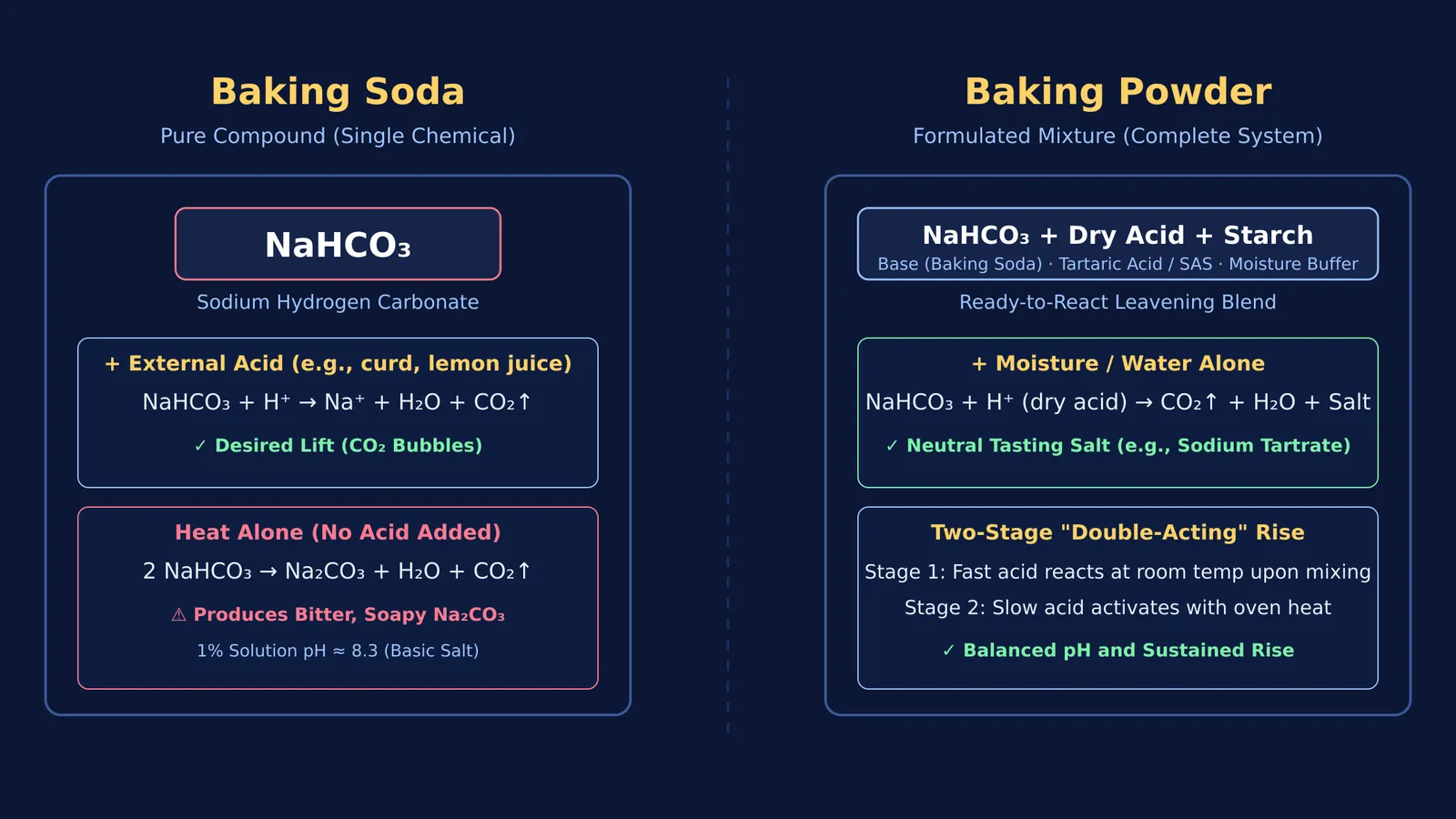
Baking soda is a pure compound known chemically as sodium hydrogen carbonate (NaHCO₃), or sodium bicarbonate. A 1% solution of baking soda in water has a pH of approximately 8.3, making it a mild, non-corrosive basic salt (Thermo Fisher Scientific).
For baking soda to produce the carbon dioxide (CO₂) gas that makes dough rise, it requires two things: moisture and an acidic ingredient. This is a classic acid-base neutralisation reaction. When you mix baking soda with acidic foods—such as curd, buttermilk, molasses, or lemon juice—the acid donates hydrogen ions (H⁺). To activate baking soda effectively, you need a sufficiently strong acid. For instance, lemon juice is highly acidic with a pH of roughly 2.25 (DOI: 10.1016/j.adaj.2015.10.019). These hydrogen ions react with the sodium hydrogen carbonate to release CO₂ gas, which gets trapped in the wet dough as bubbles, causing it to expand.
If you use baking soda in a recipe that lacks an acidic ingredient, you will encounter a problem in the oven. According to the NCERT Class 10 Science textbook, when sodium hydrogen carbonate is heated to high temperatures without an acid, it undergoes thermal decomposition. The reaction is:
2 NaHCO₃(s) + heat → Na₂CO₃(s) + H₂O(g) + CO₂(g)
This decomposition produces sodium carbonate (Na₂CO₃), water vapour, and carbon dioxide gas. While the carbon dioxide will still provide some lift, the sodium carbonate left behind is highly alkaline.
If you want to understand how acids and bases interact in general, you can read our guide to Acids, bases and salts in Class 10: indicators, pH and common salts.
What is baking powder?
Baking powder is not a single compound; it is a mixture specifically designed to solve the problem of bitter sodium carbonate.
Commercial baking powder contains baking soda (sodium hydrogen carbonate) blended with a mild, dry, edible acid—most commonly tartaric acid or sodium aluminium sulfate—and a drying agent like cornstarch. The starch absorbs moisture from the air, preventing the acid and the base from reacting prematurely while they sit in the tin.
Because baking powder already contains an acid, it does not need an acidic ingredient in the recipe to work. You only need to add water or milk. When the powder gets wet, the sodium hydrogen carbonate and the dry acid dissolve and react immediately:
NaHCO₃ + H⁺ (from dry acid) → CO₂ + H₂O + Sodium salt of acid
The carbon dioxide gas makes the bread or cake soft and spongy. Crucially, instead of forming bitter sodium carbonate, the reaction produces the sodium salt of the acid (such as sodium tartrate), which has a neutral, pleasant taste.
Furthermore, most modern baking powders are "double-acting". They contain two different acids: one that reacts quickly when mixed with liquid at room temperature, and another that only reacts when heated in the oven. This two-stage process ensures that the batter gets an initial rise while mixing, and a second, stronger lift during baking to set the structure.
Can you substitute baking soda for baking powder?
Because of their chemical differences, you cannot simply swap them without adjusting the recipe's liquid and acid balance.
Baking powder instead of baking soda: You can do this, but because baking powder is diluted with acid and starch, it is significantly weaker by volume. You typically need to use much more baking powder to get the same rising power as a given amount of baking soda. This extra powder might slightly alter the taste or texture.
Baking soda instead of baking powder: This substitution is much trickier. If you use baking soda instead of baking powder, you must also add an acid (like cream of tartar, lemon juice, or vinegar) to your recipe to neutralise the base. Furthermore, you will need to use much less baking soda, as it is highly concentrated.
Which one should you use?
Here is a quick checklist for deciding which leavening agent fits your recipe:
Does the batter contain acidic ingredients? Use baking soda. The acid (like curd, buttermilk, or molasses) will trigger the reaction and neutralise the base.
Does the batter lack acid? Use baking powder. A standard vanilla sponge or pancake batter relies on the built-in acid of the powder to provide the lift.
Does the recipe need a lot of lift but only has a little acid? Use both. The baking soda neutralises the small amount of acid for early lift, while the baking powder does the heavy lifting without upsetting the pH balance.
Understanding these reactions helps explain many everyday chemical processes. For more examples of thermal decomposition and neutralisation, explore our guide to types of chemical reactions in Class 10, or explore interactive simulations in the Fermi Simulation Lab.


