

On this page
For decades, biologists believed that all bacteria were roughly the same kind of organism. They were initially classified together, but then scientists looked closer at the microbes living in the most punishing places on Earth: boiling acid springs, salt lakes and the oxygen-starved stomachs of cows.
These organisms looked like bacteria, but their chemistry was completely different. Today, they are classified as archaebacteria (or Archaea), a distinct group of microbes that survive where almost nothing else can. Archaeal cells have unique properties separating them from the other two domains of life, Bacteria and Eukarya [[1]](https://en.wikipedia.org/wiki/Archaea).
Why can archaebacteria survive in extreme conditions?
The secret is in the boundary. The cell wall and membrane are a cell's first line of defence against the outside world. Most bacteria have a cell wall made of a mesh-like molecule called peptidoglycan. Archaebacteria completely lack peptidoglycan [[1]](https://en.wikipedia.org/wiki/Archaea).
While eubacteria (true bacteria) rely on a thick peptidoglycan layer to keep their shape and withstand osmotic pressure, archaebacteria use a completely different toolkit. Many construct an S-layer, a rigid outer shell made of interlocking protein or glycoprotein molecules [[1]](https://en.wikipedia.org/wiki/Archaea).
Beneath this wall, the lipids in their cell membranes are joined by ether bonds rather than the ester bonds found in bacteria and eukaryotes [[1]](https://en.wikipedia.org/wiki/Archaea). These ether linkages are far more chemically stable. This unique chemical structure makes their membranes highly resistant to heat, acid and salt. It allows archaebacteria to hold their shape and protect their DNA in environments that would destroy an ordinary bacterial cell.
If you are reviewing this for an exam, the Fermi Concept Library maps out every concept in biology, physics, chemistry and mathematics so you can place archaebacteria in the wider picture of taxonomy.
What are halophiles and thermoacidophiles?
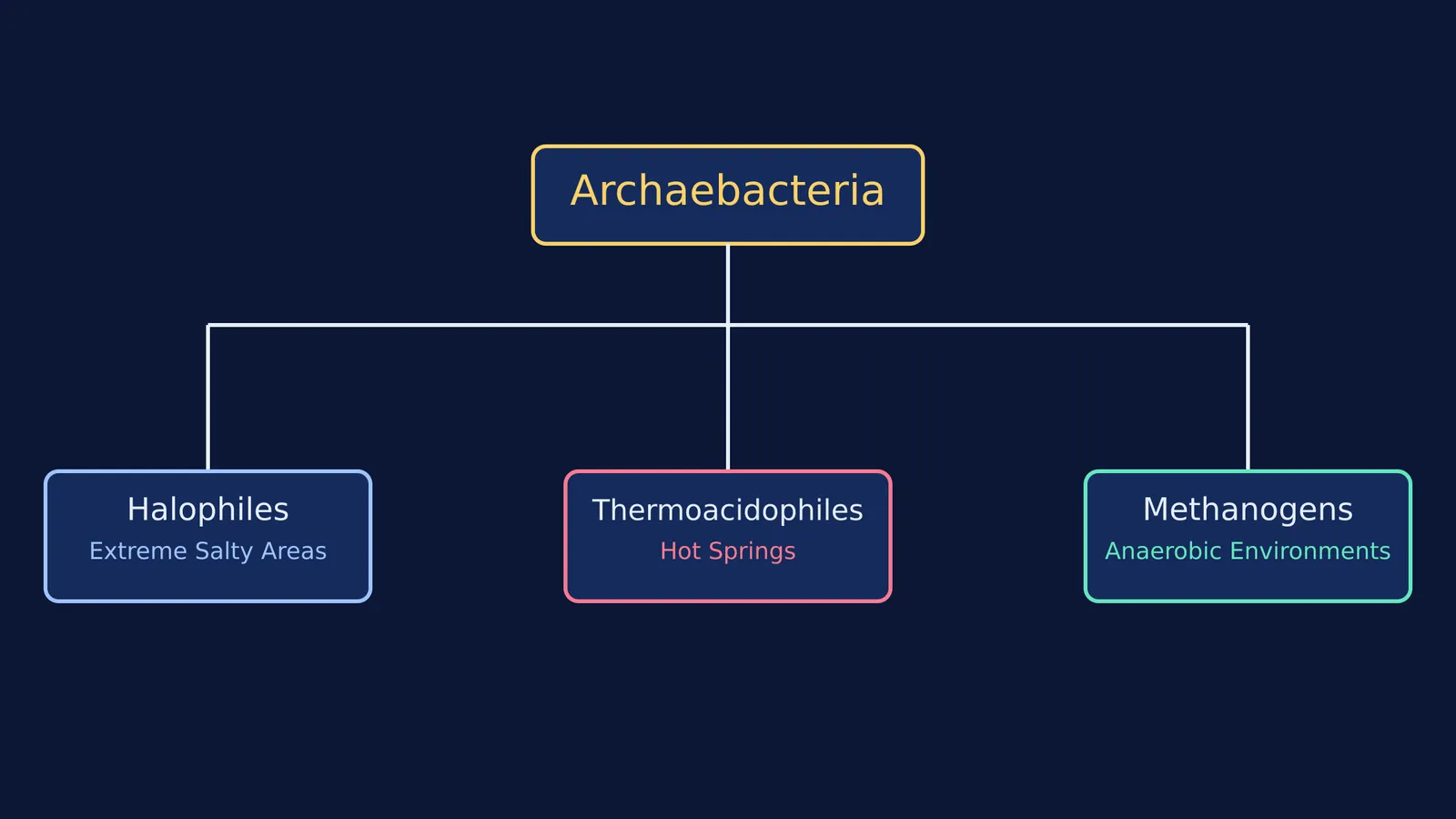
Archaebacteria are often grouped by the specific extreme habitat they prefer [[1]](https://en.wikipedia.org/wiki/Archaea). Two of the most famous groups are the halophiles and the thermoacidophiles.
Halophiles thrive in extreme salty areas [[1]](https://en.wikipedia.org/wiki/Archaea). You can find them thriving in hypersaline environments like salt lakes. In fact, some halophiles use a light-activated ion pump called bacteriorhodopsin to generate energy from sunlight [[1]](https://en.wikipedia.org/wiki/Archaea).
Thermoacidophiles live in hot springs [[1]](https://en.wikipedia.org/wiki/Archaea). As their name suggests, they are adapted to two extremes at once: high temperatures and high acidity. In environments where ordinary organisms would perish, thermoacidophiles survive because of their unique biochemistry. They are commonly found in volcanic areas and deep-sea alkaline hydrothermal vents [[1]](https://en.wikipedia.org/wiki/Archaea). The special ether-linked lipids in their membranes stop them from leaking or falling apart in the extreme heat [[1]](https://en.wikipedia.org/wiki/Archaea).
You can read more about how biologists classify these groups in our post on Biological classification for NEET, and see how this fits into the broader history in Robert Whittaker and why life was split into five kingdoms.
How do methanogens produce biogas?
Not all extreme habitats are boiling or salty. Methanogens are archaebacteria that live in strictly anaerobic conditions—places completely devoid of oxygen [[1]](https://en.wikipedia.org/wiki/Archaea). Because oxygen is toxic to them, they retreat to oxygen-free refuges such as the thick mud of swamps, marshy wetlands, and the deep layers of the ocean.
Crucially, methanogens also live in the rumen (gut) of ruminant animals such as cows and buffaloes [[1]](https://en.wikipedia.org/wiki/Archaea). Inside the cow's gut, which is essentially a massive fermentation vat devoid of oxygen, they live in a symbiotic relationship. When the cow eats grass, other microbes begin fermenting the complex plant fibres. Methanogens then use carbon dioxide as an electron acceptor to oxidize hydrogen, reducing the carbon dioxide into methane gas (CH₄) using specialised coenzymes like coenzyme M and methanofuran [[1]](https://en.wikipedia.org/wiki/Archaea). By doing this, methanogens facilitate digestion for the animal [[1]](https://en.wikipedia.org/wiki/Archaea).
Because these methane-producing microbes are abundant, they are used in biogas production and sewage treatment. When organic matter is sealed in an airtight digester tank, the methanogens continue to break it down in the absence of oxygen, releasing a steady stream of methane gas [[1]](https://en.wikipedia.org/wiki/Archaea).
For more on the different kingdoms of life and their roles, you can explore Kingdom Fungi for NEET.
A practical study technique for exam recall
When revising archaebacteria for biology exams, do not try to rote-learn the names without context. Instead, build a simple association table to lock the three main groups into your memory:
Halophiles: Associate "halo" with halogen (like chlorine in sodium chloride). Habitat: Extreme salt (e.g. salt lakes).
Thermoacidophiles: Break the word into "thermo" (heat) and "acido" (acid). Habitat: Hot springs.
Methanogens: Look for "methano" (methane gas). Habitat: No oxygen; marshy areas and the gut of ruminants (producing biogas).


