

On this page
In CBSE Class 10 English (code 184), the analytical paragraph gives you a stimulus, such as a table, a feature list or a graphic, and asks for one paragraph that examines it and reaches a judgement. The trap is describing instead of analysing. Here is the format, a structure and a marked sample.
What is the analytical paragraph format in Class 10?
The facts below come from the CBSE sample question paper for 2026-27 and its marking scheme, both listed on the CBSE Academic sample papers page.
It is Question 5 in Section B, with a choice between 5A and 5B, and it carries 5 marks.
The length asked is about 100-120 words.
The marks are split as Content 2, Organisation of ideas 2 and Accuracy 1.
It carries no title or heading.
The marking scheme states that analytical paragraph writing "should NOT be confused with writing a description of given elements or writing a summary". The sample paper notes no change in the question paper design for 2026-27.
How do you read the chart, table or list before writing?
The stimulus changes from paper to paper. The 2026-27 sample has a feature list and a SWOT table; the 2025-26 sample paper used letter excerpts and candidate profiles; the 2023-24 sample paper used a character-traits graphic. Take two minutes:
Underline the task verb (analyse, evaluate, justify) and any factors it lists: those are your content points.
Find the one big idea: the largest change in a chart, the strongest point each way in a SWOT, the deciding feature in a list.
Pick three or four details: for a chart, the highest, the lowest and the biggest change.
Decide your judgement now, so every sentence leads to it.
If reading the chart itself slows you down (percentages, scales), the Fermi Concept Library has a lesson for every mathematics concept, each with its place in the map.
What is the three-part structure for an analytical paragraph?
One paragraph, three jobs, matched to the marks: Content rewards what you notice and infer, Organisation the order and linking, Accuracy grammar and spelling.
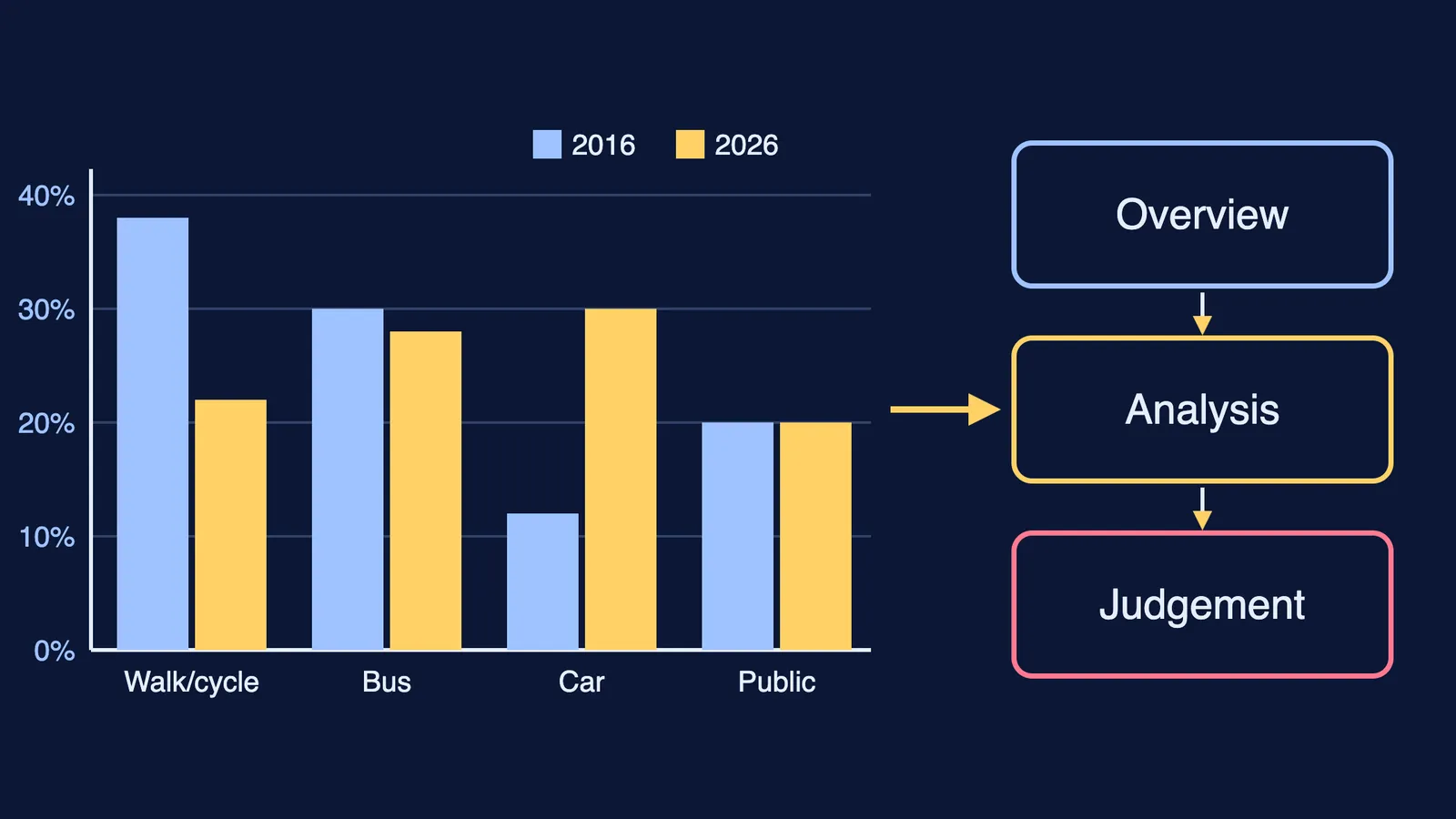
Overview (1-2 sentences, about 25 words). Say what the stimulus shows and state the main trend or verdict.
Analysis (3-4 sentences, about 70 words). Support it with grouped details and comparisons, and add one inference ("This suggests...").
Judgement (1 sentence, about 20 words). Close with a conclusion, a recommendation or a condition, with no new data.
The suggested SWOT answer in the CBSE 2026-27 marking scheme has this shape: benefits, then "However" and the challenges, then a conditional verdict that Vikram "should accept this position only if" he manages his time.
Sample: a chart question answered and marked
Like the writing questions in the CBSE sample paper, this data is imaginary.
Question. A bar chart shows how students of one school travelled to school in 2016 and 2026. Walking or cycling fell from 38% to 22%, the school bus from 30% to 28%, private cars rose from 12% to 30%, and public transport stayed at 20%. Write an analytical paragraph in about 120 words.
Answer. The bar chart compares how students of one school travelled to school in 2016 and 2026, and it reveals a clear shift from walking to cars. In 2016, walking or cycling was the most common choice at 38%, but by 2026 it had fallen to 22%. Over the same period, travel by private car rose sharply from 12% to 30%, making it the most popular mode. The school bus dipped only slightly, from 30% to 28%, while public transport held steady at 20%. This suggests that families replaced walking with car trips rather than with shared transport. Overall, students became far less active on the way to school, and the school may need to encourage safe walking and cycling.
Our marking against the CBSE split:
Content (2 of 2): names the main shift, uses the biggest fall and rise, and draws one inference.
Organisation (2 of 2): overview first, the two big shifts before the small ones, clear linkers, a judgement with no new data, no title.
Accuracy (1 of 1): past tense for past data, correct agreement.
Length: 119 words.
Compare a weak opening: "Transport Survey. In 2016, 38% walked, 30% took the bus, 12% came by car..." It has a title, lists every figure in order and reaches no judgement: the description CBSE warns against.
Which mistakes cost marks in an analytical paragraph?
Adding a title or heading.
Copying the cues in order with no comparison.
Adding facts not in the stimulus.
Running far past 120 words.
Ending without a judgement, or on a new figure.
The 2026-27 sample paper gives 3 hours for 80 marks, about 2.25 minutes a mark, so plan about 11 minutes here. Our board exam time plan by marks splits the whole paper. The other 5-mark writing question is a letter: see our line-by-line formal letter format check.
Next step: write the 2026-27 SWOT question in 11 minutes, then check it for an overview, an analysis and a judgement.


