

On this page
Your cousin wrestles at state level and has spent three years building arms like tree trunks. Will a child of theirs be born strong because of all that training? No. That one question holds the whole difference between acquired and inherited traits, and once you see why, every textbook example sorts itself.
What is the difference between acquired and inherited traits?
An inherited trait is one written in the DNA you received through your parents' egg and sperm. An acquired trait is a change your body picks up during your own life, from use, injury, diet or practice.
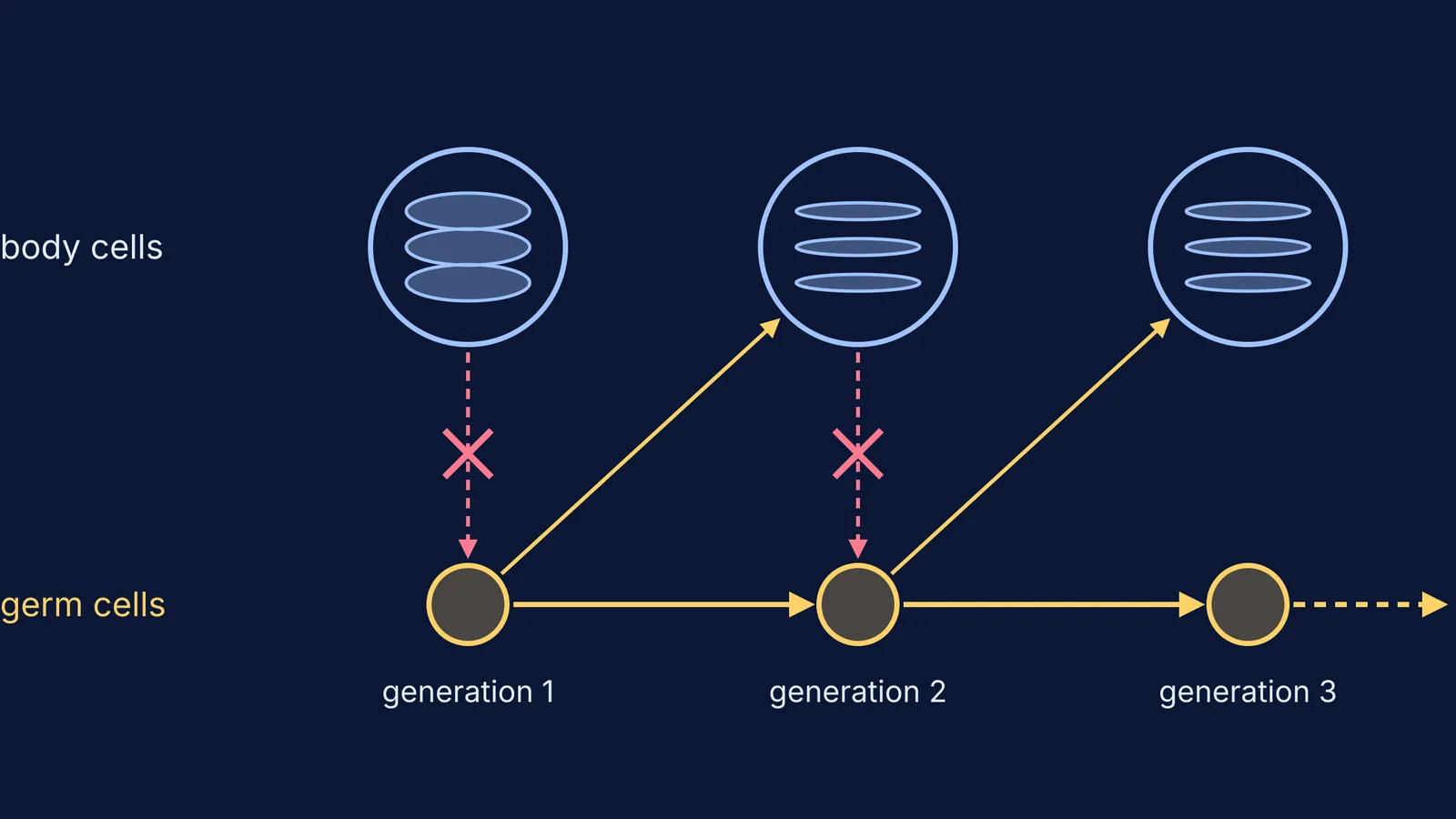
What decides it is where the change happens. The US National Human Genome Research Institute says germ line "refers to the sex cells (eggs and sperm) that sexually reproducing organisms use to pass on their genomes from one generation to the next" (NHGRI glossary: germ line). Every other cell is a somatic cell, and DNA mutations in somatic cells can affect the individual but cannot be passed on to offspring (NHGRI glossary: somatic cells).
Why are a trained athlete's muscles not passed on?
Training changes muscle cells, and muscle cells are somatic cells. No amount of squats or sprints rewrites the DNA inside the athlete's eggs or sperm. The child starts with the instructions the parent was born with, not the body the parent built.
Genes still matter for sport. A 2003 study in the American Journal of Human Genetics found that male and female elite sprint athletes have significantly higher frequencies of the 577R allele of the ACTN3 gene than controls (Yang and colleagues, 2003). A variant like that sits in germ-cell DNA, so it can be inherited. The variant is inherited; the bigger muscles are acquired.
What did Weismann's mouse experiment show?
The German biologist August Weismann proposed that only the germ plasm in germ cells, not the material in body cells, passes from parents to offspring (Embryo Project Encyclopedia, Arizona State University). To test the opposite idea, he cut off the tails of 901 mice and their offspring for five generations, and the descendants still grew normal tails. He described the results in a lecture in 1888. Read the full story in August Weismann, the germ plasm and the mice without tails.
Is acquired vs inherited traits still in the Class 10 syllabus?
Check before you revise. Careers360 reported in April 2023 that NCERT's rationalised Class 10 textbook replaces the chapter Heredity and Evolution with Heredity, and that Acquired and Inherited Traits is one of the topics dropped (Careers360, April 2023). The CBSE Class 10 Science syllabus for 2025-26 lists heredity, Mendel's laws for inheritance of traits and sex determination (CBSE Science syllabus 2025-26).
So check your own board's current syllabus. The idea is still worth ten minutes: the same CBSE document describes variation as changes in the sequence of DNA, and every Mendel cross you draw assumes traits travel in gametes. For the rest of the chapter, see our Class 10 heredity revision on Mendel's experiments and sex determination.
How do you sort the Class 10 examples correctly?
A wrestler's bigger biceps: acquired. Muscle cells changed; germ cells did not.
A beetle that loses weight in a food shortage: acquired. This example comes from the older NCERT chapter Heredity and Evolution, and Teachoo's answer to its in-text question says the change is only in the non-reproductive cells (Teachoo, in-text Q2, page 150).
Weismann's tailless mice: acquired. The cut was to body tissue.
Tall or dwarf pea plants in Mendel's crosses: inherited.
A child's ABO blood group: inherited, from alleles in each parent's egg or sperm.
Speaking Tamil or playing the tabla: acquired. Learning changes the brain, not the gametes.
A scar, a tan or a pierced ear: acquired.
A skin-cell mutation caused by sunlight: acquired. It is a DNA change, but in a somatic cell, so it is not inherited (NHGRI, above).
A green beetle born to red parents because of a DNA change in a germ cell: inherited.
If words like allele or gamete still feel shaky, the Fermi Concept Library gives every concept in biology its own lesson, so you can fill the gap first.
A three-mark answer you can adapt
Acquired traits are changes in an organism's body during its lifetime, such as larger muscles from exercise. They occur in somatic (non-reproductive) cells and do not change the DNA of germ cells. Since only germ-cell DNA passes to the offspring, acquired traits are not inherited, while traits coded in that DNA, such as blood group, are.
Doesn't epigenetics change this?
A 2014 review in Cell concluded that inheritance of epigenetic characters can occur, particularly in plants, but how much is due to the environment, and how far it happens in humans, remain unclear (Heard and Martienssen, 2014). For a school exam, the germ-cell rule is the answer.
Next time you meet an example, ask one thing: egg or sperm DNA, or just the body?


