

On this page
When table salt dissolves in water, every ionisable hydrogen from hydrochloric acid has been replaced by sodium. In school curricula and inorganic naming standards published in Pure and Applied Chemistry by the International Union of Pure and Applied Chemistry (IUPAC), salts are grouped by how completely the parent acid or base was neutralised.
What is the difference between normal, acid and basic salts?
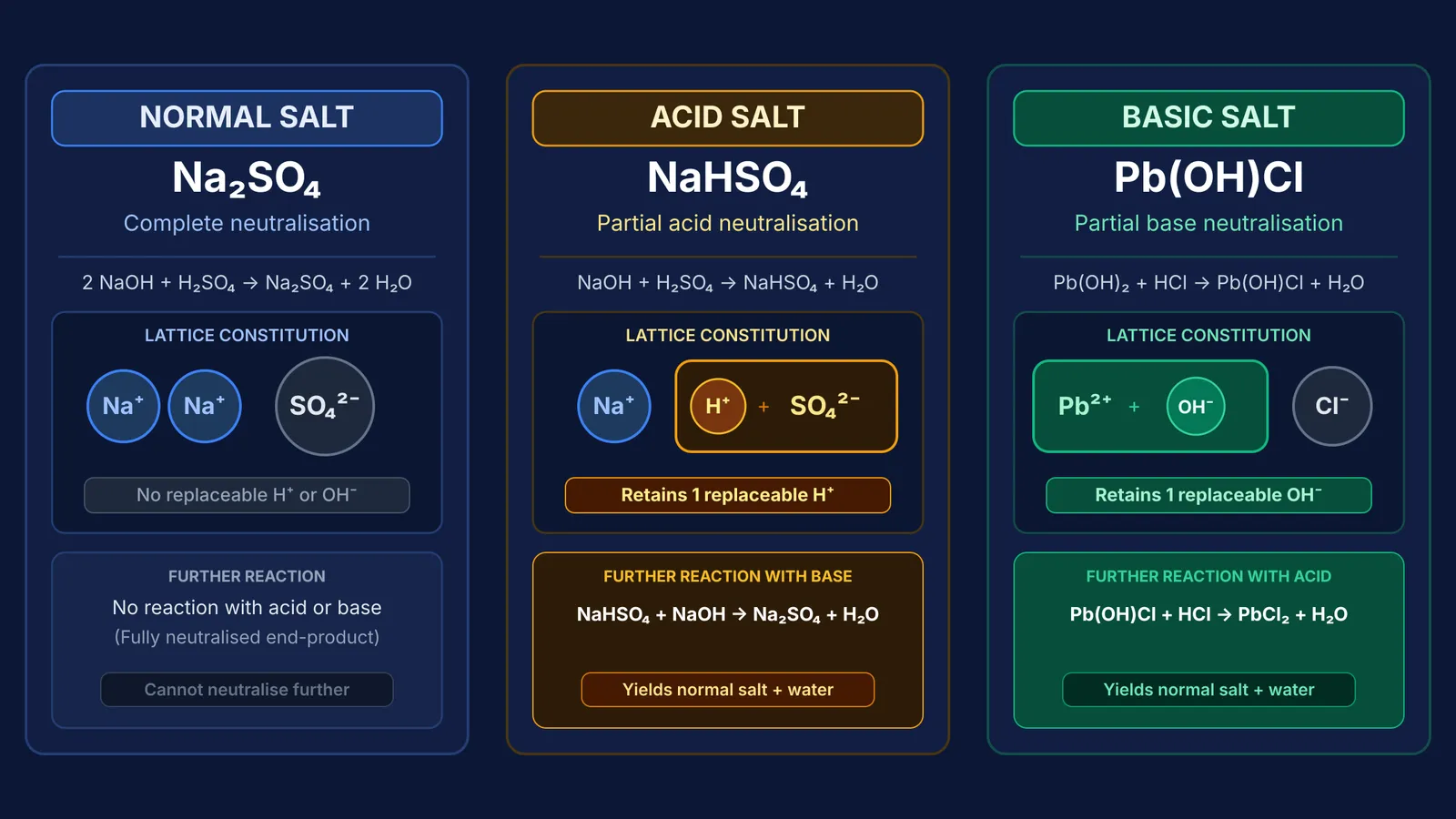
The three primary structural classes differ in their replaceable ions:
Normal salts form by the complete replacement of all ionisable hydrogen ions of an acid by metallic or ammonium ions. Examples include sodium chloride (NaCl) and sodium sulphate (Na₂SO₄). They contain no replaceable H⁺ or OH⁻ groups. You can explore how these fit into school science in our overview of acids, bases and salts in Class 10.
Acid salts form by the partial replacement of ionisable hydrogen atoms of a polybasic acid by a metal or ammonium ion. Examples include sodium hydrogen sulphate (NaHSO₄) and sodium hydrogen carbonate (NaHCO₃). Because they retain at least one replaceable proton, monobasic acids like hydrochloric acid (HCl) cannot form acid salts. Our guide to the basicity of phosphorus and sulphur oxoacids explains which acids supply multiple ionisable protons.
Basic salts form by the partial replacement of hydroxyl (OH⁻) groups of a diacidic or triacidic base by an acid radical. Examples include basic lead chloride (Pb(OH)Cl) and basic magnesium chloride (Mg(OH)Cl). Because they retain one or more hydroxyl groups attached to the metal cation, monoacidic bases such as sodium hydroxide (NaOH) cannot form basic salts.
Why is an acid salt not always acidic in water?
In an investigation of 7,500 senior high school chemistry students published in the International Journal of Science Education, researcher Hans-Jürgen Schmidt showed that chemical terminology often acts as a hidden persuader. Students frequently assume neutralisation must produce a neutral solution at pH 7, or that an acid salt always yields an acidic pH.
A salt's crystal formula and its aqueous behaviour are governed by different physical principles:
Sodium hydrogen sulphate (NaHSO₄) is an acid salt that is strongly acidic in water. According to the NIST Chemistry WebBook, the bisulfate anion (HSO₄⁻) has a second dissociation constant (pKa2) of 1.99. In 0.1 M solution, it readily releases H⁺ ions, producing a pH near 1.5.
Sodium hydrogen carbonate (NaHCO₃) is structurally an acid salt because it retains an ionisable hydrogen from carbonic acid (H₂CO₃). Yet its aqueous 0.1 M solution is mildly alkaline (pH ≈ 8.3) because bicarbonate hydrolysis generates OH⁻ far more readily than the anion dissociates.
Normal salts can also produce non-neutral solutions. Ammonium chloride (NH₄Cl) contains no replaceable protons or hydroxides, yet cation hydrolysis makes its solution acidic (pH ≈ 5.1). Sodium carbonate (Na₂CO₃) is likewise a normal salt, yet anion hydrolysis makes its solution basic (pH ≈ 11.6). Explore the mathematical proofs in our guide to salt hydrolysis and ionic equilibrium.
How do you convert acid and basic salts into normal salts?
Because acid salts retain replaceable protons and basic salts retain replaceable hydroxyl ions, each can react further to form a normal salt:
Adding a base converts an acid salt to a normal salt. Treating sodium hydrogen sulphate with sodium hydroxide neutralises the remaining proton:
NaHSO₄ + NaOH → Na₂SO₄ + H₂O
Adding an acid converts a basic salt to a normal salt. Treating basic lead chloride with hydrochloric acid neutralises the remaining hydroxyl group:
Pb(OH)Cl + HCl → PbCl₂ + H₂O
Stepwise neutralisation illustrates the sequence directly. One equivalent of base with sulphuric acid yields an acid salt:
NaOH + H₂SO₄ → NaHSO₄ + H₂O A second equivalent yields the normal salt: NaHSO₄ + NaOH → Na₂SO₄ + H₂O
When tracking multistep titrations or buffer equilibria, the Fermi Problem Library provides worked problems with a step-by-step solver that explains the reasoning rather than printing an answer.
How can you identify salt types systematically in exams?
To classify any salt quickly in an exam, use this four-step sequence:
Split the formula into cation and anion, identifying the parent base and parent acid.
Check the anion for replaceable protons. If an H is bonded to an oxygen or electronegative atom from a polybasic acid (such as HSO₄⁻ or HCO₃⁻), it is an acid salt. Note that in sodium phosphite (Na₂HPO₃), the single H is bonded directly to phosphorus in H₃PO₃ and does not ionise, making it a normal salt.
Check for unneutralised hydroxyl groups. If OH remains attached to a polyvalent metal cation alongside an acid radical (such as Pb(OH)Cl), it is a basic salt.
If neither replaceable H⁺ nor OH⁻ remains, classify the compound as a normal salt.
For students connecting acid basicity to salt structures across syllabus topics, the Fermi Concept Library covers every concept in physics, chemistry, biology, mathematics and computing, each with its own lesson and its place in the map.


