

On this page
When you first learn about acids and bases, the focus is often on pH and litmus paper. But when you write chemical equations, you need to know exactly how many ions a single molecule can release. This is where the basicity of acids and the acidity of bases come in.
In the ICSE Class 10 chemistry syllabus, these concepts are crucial for predicting what type of salt will form during a neutralization reaction. If you do not know how many replaceable hydrogen or hydroxyl ions a molecule has, you cannot balance the equation or name the resulting salt.
What is the basicity of an acid?
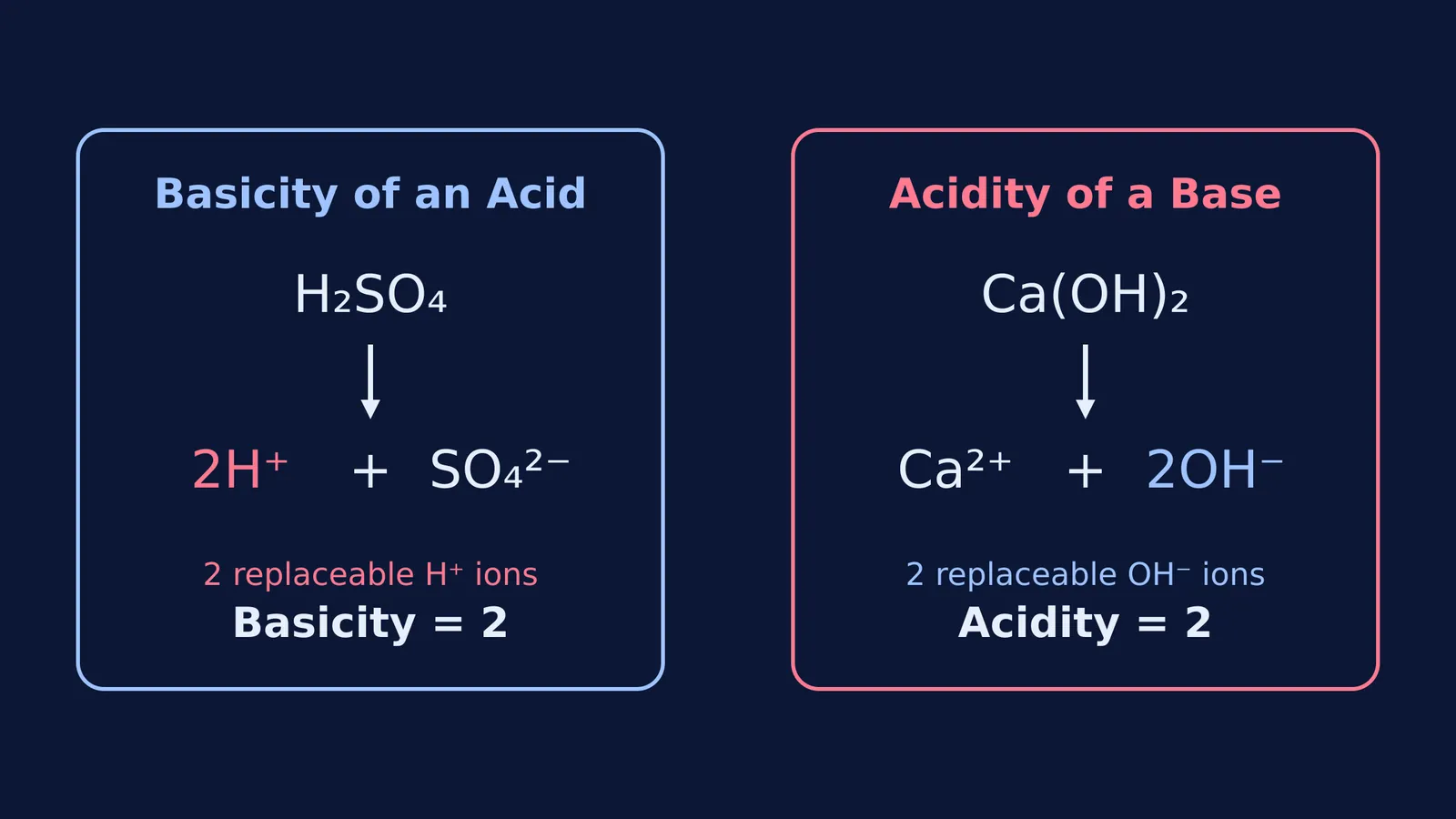
The basicity of an acid is the number of replaceable hydrogen ions (H⁺) that one molecule of the acid can produce in an aqueous solution, according to chemistry resources from Byju's. By this measure, acids are classified into three main groups:
Monobasic acids: Produce 1 hydrogen ion per molecule. Examples include hydrochloric acid (HCl) and nitric acid (HNO₃).
Dibasic acids: Produce 2 hydrogen ions per molecule, such as sulphuric acid (H₂SO₄) and carbonic acid (H₂CO₃).
Tribasic acids: Produce 3 hydrogen ions per molecule, with phosphoric acid (H₃PO₄) being the classic example.
It is important to remember that not every hydrogen atom in a molecule is replaceable. The basicity depends on the chemical structure, specifically how the hydrogen atoms are bonded. For instance, acetic acid (CH₃COOH) has four hydrogen atoms, but its basicity is only 1. Only the single hydrogen atom attached to the highly electronegative oxygen in the carboxyl group (−COOH) can break away in water.
Another classic trap in exams involves the oxoacids of phosphorus. Phosphoric acid (H₃PO₄) is tribasic because it has three −OH groups. However, phosphorous acid (H₃PO₃) only has two −OH groups, with the third hydrogen bonded directly to the central phosphorus atom. This direct P−H bond does not break in water, making H₃PO₃ a dibasic acid despite having three hydrogen atoms.
What is the acidity of a base?
Conversely, the acidity of a base is the number of replaceable hydroxyl ions (OH⁻) that one molecule of the base yields in an aqueous solution. Like acids, they are grouped by their ion count:
Monoacidic bases: Produce 1 hydroxyl ion per molecule. Sodium hydroxide (NaOH) and potassium hydroxide (KOH) fall into this category.
Diacidic bases: Produce 2 hydroxyl ions per molecule, such as calcium hydroxide (Ca(OH)₂) and magnesium hydroxide (Mg(OH)₂).
Triacidic bases: Produce 3 hydroxyl ions per molecule, like aluminium hydroxide (Al(OH)₃).
While it can feel backward to talk about the "acidity" of a base, the term simply describes its neutralizing power. A diacidic base has twice the neutralizing capacity of a monoacidic base, meaning one molecule of Ca(OH)₂ can neutralize two molecules of a monobasic acid like HCl. If you need to revise how these compounds behave in water, you can read our guide to acids, bases and salts in Class 10.
The types of salts they form
The number of replaceable ions dictates the types of salts an acid or base can produce during neutralization. As explained by Byju's, a salt is formed when the hydrogen ions of an acid are replaced by metal or ammonium ions.
Normal salts: Formed by the complete replacement of all ionizable hydrogen atoms. Monobasic acids like HCl only have one hydrogen to give, so they can only form 1 type of salt—a normal salt (like sodium chloride, NaCl).
Acid salts: Formed by the partial replacement of ionizable hydrogen atoms. Dibasic acids like H₂SO₄ can lose their hydrogen ions one at a time. If they only lose one, they form an acid salt that still contains a replaceable hydrogen (like sodium bisulphate, NaHSO₄). If they lose both, they form a normal salt (sodium sulphate, Na₂SO₄). Therefore, a dibasic acid forms 2 types of salts.
Basic salts: Formed by the partial replacement of hydroxyl groups of a diacidic or triacidic base by an acid radical. For example, when magnesium hydroxide, a diacidic base, reacts with hydrochloric acid, it can form basic magnesium chloride, Mg(OH)Cl. This salt still contains a hydroxyl group, giving it basic properties in solution.
Understanding these stages is essential when drawing acid-base titration curves, as each replaceable proton drops off at a different pH level. When an acid salt is dissolved in water, it can still act as an acid and turn blue litmus red.
Mastering equations with Fermi
When balancing neutralization reactions, the combination of basicity and acidity determines the exact molar ratios you need. If you get stuck on a tricky partial neutralization, the Fermi Concept Library holds lessons on every chemical reaction in the syllabus. Fermi's AI tutor can walk you through the transfer of ions step by step, ensuring you understand why an acid salt formed instead of a normal one, rather than just giving you the balanced equation to copy.


