

On this page
India's mains supply is nominally 50 Hz, and the grid regulator, the Central Electricity Regulatory Commission, treats 50.05 Hz as the upper edge of the permitted band (CERC order, March 2025). A sonometer lets you check it with a wire, a magnet and a scale. The mistake that costs marks is a single factor of two.
How does a sonometer measure AC mains frequency?
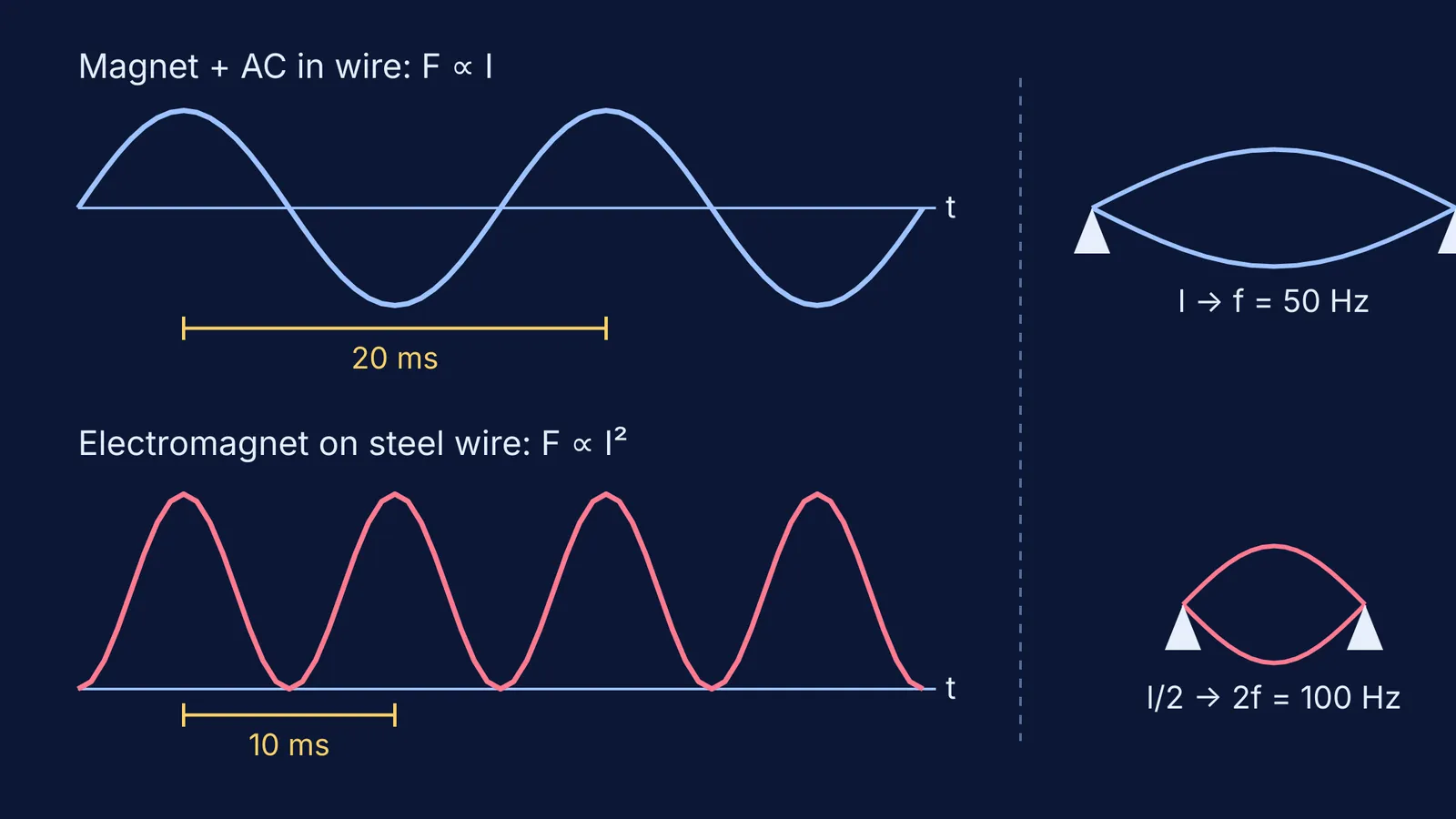
A step-down transformer sends a small alternating current through the sonometer wire, and a horseshoe magnet sits near the middle with its field at right angles to the wire (BIT Mesra physics lab manual). The Lorentz force on that stretch of wire, F = IlB, reverses every time the current reverses, so the wire is pushed up and down once per cycle of the mains.
For the fundamental mode of the wire between the bridges, f = (1/2l)√(T/μ), where l is the length between the bridges, T the tension and μ the mass per unit length (Virtual Labs, A.C. sonometer theory). You slide the bridges until this matches the driving frequency. At resonance the wire vibrates with its largest amplitude, and a small folded paper rider placed at the middle jumps or falls off (Virtual Labs, A.C. sonometer procedure).
Find μ by weighing a measured length of the same wire.
Hang a known load, so T = mg.
Move a bridge slowly until the rider flies off, and note l.
Take one reading moving the bridges apart and one moving them closer, as the BIT Mesra table does, for several loads.
Why does an electromagnet give twice the frequency?
Some set-ups instead hold an AC electromagnet under a steel wire that carries no current. Now the force is magnetic attraction, and iron is attracted whichever way the coil's field points, so the pull peaks twice every cycle. A University of California, Santa Barbara lecture-demonstration page puts it plainly: because the coil's field "has a maximum every half cycle, it drives the wire at twice the frequency of the sine wave that feeds it" (UCSB Physics lecture demonstrations).
So at resonance the wire's natural frequency is 2f, not f. The mains frequency is then f = (1/4l)√(T/μ). That 4 in place of a 2 is the factor students miss.
Worked example: from resonant length to mains frequency
The BIT Mesra manual gives real readings for the magnet method: μ = 0.015 g/cm and, with a 50 g load, a resonant length of 18.0 cm. In SI units:
μ = 0.015 g/cm = 1.5 × 10⁻³ kg/m.
T = 0.050 kg × 9.8 m/s² = 0.49 N.
Wave speed v = √(T/μ) = √(0.49 / 0.0015) ≈ 18.07 m/s.
f = v / 2l = 18.07 / (2 × 0.180) ≈ 50.2 Hz (the manual's table lists 50.1 Hz).
Across 12 readings at loads from 50 g to 300 g, the manual reports a mean of 50.3 ± 0.2 Hz. It also gives a graphical method: l grows as √T, so a plot of √T against l is a straight line and f = slope / (2√μ), averaging out single bad readings.
Now the trap. Drive the same wire, at the same tension, with an electromagnet (our calculation, not a reading from the manual). It resonates at 100 Hz, so the bridges end up about 9.0 cm apart. Put 9.0 cm into the familiar formula and you get 18.07 / 0.18 ≈ 100 Hz. The correct line is f = v / 4l ≈ 50.2 Hz. An answer near 100 Hz means the wrong formula, not a doubled grid.
Why isn't my answer exactly 50 Hz?
Partly because of the lab: judging resonance by eye and a warming wire both shift l. The BIT Mesra manual has you set a rheostat so the wire does not overheat, noting that even mild heating affects the results.
Partly because the grid itself drifts. CERC's order, drawing on a Grid-India report, says that on 25 August 2024 the all-India frequency peaked at 50.377 Hz and averaged 50.065 Hz for the day (CERC order, March 2025). A result like 50.3 Hz is reasonable; 100 Hz or 25 Hz points to a formula error.
What should you say in the viva?
Name the force: the Lorentz force on a current (magnet method) or magnetic attraction on iron (electromagnet method).
Say how many pushes per cycle: one for the magnet, two for the electromagnet.
Explain the rider: it falls off at maximum amplitude, which marks resonance.
Give the check: the answer should be close to 50 Hz.
For the length and tension laws, read our sonometer experiment on frequency, length and tension and Marin Mersenne's laws of vibrating strings; for exams, see experimental skills in the JEE Main physics syllabus.
To practise the arithmetic, the Fermi Problem Library has worked problems with a step-by-step solver that explains the reasoning rather than printing an answer, so you can check where a 2 should become a 4. If standing waves themselves are the gap, the Fermi Concept Library gives each physics concept its own lesson.


