

On this page
In short In ordinary algebra, if the product of two numbers is zero, one of them must be zero. However, the NCERT Class 12 mathematics textbook notes that if the product of two matrices is a zero matrix, it is not necessary that one of the matrices is a zero matrix. Because of this rule, you cannot cancel a common matrix from both sides of an equation.
If you solve ab = 0 in ordinary mathematics, you know immediately that either a = 0 or b = 0. This is called the zero-product property. But matrices behave differently.
Why does the zero-product rule fail for matrices?
In matrix algebra, if the product of two matrices is a zero matrix, it is not necessary that one of the matrices is a zero matrix. When two non-zero matrices multiply to give a zero matrix, they are known as zero divisors.
This happens because matrix multiplication combines rows and columns in a way that allows positive and negative terms (or simply zeros) to cancel each other out perfectly across every element of the resulting matrix.
If you are struggling to picture how these rows and columns interact, the Fermi Concept Library holds interactive lessons that let you trace each step of matrix multiplication visually.
A 2×2 example of zero divisors
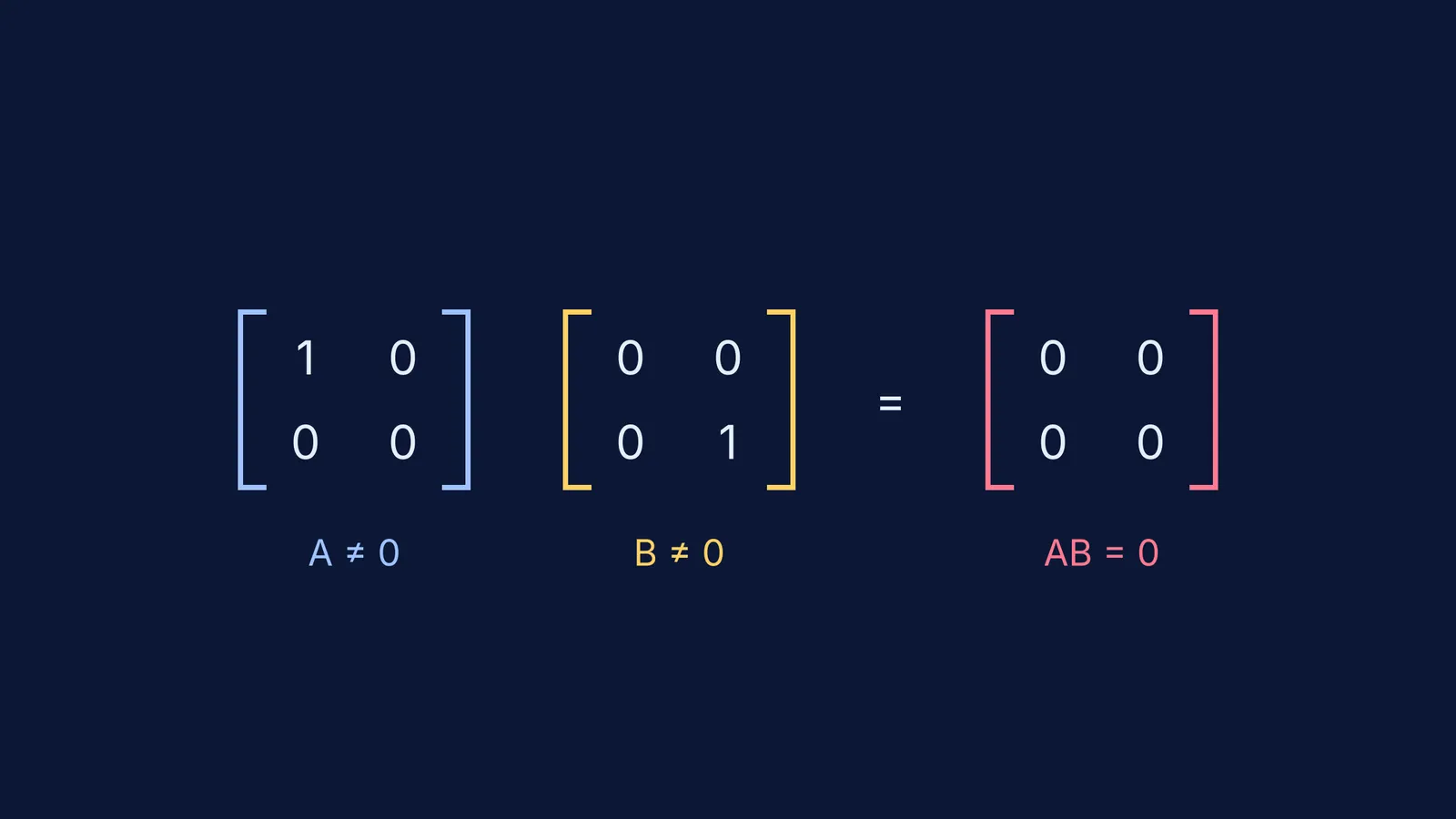
To see how this works, take two 2×2 matrices, A and B:
A = [1 0] [0 0]
B = [0 0] [0 1]
Neither A nor B is a zero matrix. But if you multiply them:
AB = [(1×0 + 0×0) (1×0 + 0×1)] [(0×0 + 0×0) (0×0 + 0×1)]
AB = [0 0] [0 0]
The result is the zero matrix.
Why can you not cancel A from AB = AC?
In normal algebra, if ax = ay and a is not zero, you divide by a to get x = y.
If you have the matrix equation AB = AC, you might be tempted to cancel A from both sides to get B = C. You cannot do this.
When you rearrange AB = AC, you get AB − AC = 0, which factors out to A(B − C) = 0.
Because of the zero divisor rule, the product of A and (B − C) can be zero even if neither A nor (B − C) is zero. Therefore, B − C does not have to be the zero matrix, which means B does not have to equal C.
You can only cancel A if you know it has an inverse. If the inverse exists, you can multiply both sides by it: A⁻¹AB = A⁻¹AC, which correctly leaves B = C. If you get stuck on whether a matrix can be cancelled during an exam problem, Fermi's AI tutor can work out what you already know and build a plan for the session, so you sit down to a clear next step in your matrix calculations.
How to test for cancellation safely
Before you cancel a matrix from an equation, run a quick checklist:
Find the determinant: calculate the determinant of the matrix you want to cancel.
Check for zero: if the determinant is zero, the matrix is singular and you cannot cancel it. It might be a zero divisor.
Multiply by the inverse: if the determinant is non-zero, find the inverse and multiply both sides of the equation by it.
Understanding this limit to matrix algebra will save you from losing marks on simple algebraic mistakes. For more on how matrices behave under multiplication, read about Finding Aⁿ for a matrix by spotting the pattern or explore the rules of the Adjoint and inverse of a matrix: the properties JEE tests.


