

On this page
For admissions to premier Indian institutes like the IITs, IISERs, and IISc, the Statement of Purpose (SOP) is evaluated differently than in the US or UK. Admissions committees for MS (Research) and PhD programmes prioritize technical depth and alignment with faculty research over personal narratives.
If you are applying while finishing your undergraduate degree, building a study routine that lasts will help you balance your final-year project with these application demands. You must treat the application process itself as a rigorous academic exercise.
How long should an SOP for Indian programmes be?
Every institute has its own constraints, and exceeding them is a quick way to be disqualified. A recent guide to graduate school applications notes that writing a statement of purpose requires understanding its specific conventions and expectations (Todey, 2025). Indian institutes value brevity and precision.
You must convey your academic background, research interests, and future goals concisely. Many online application portals restrict the research statement to a strict character limit. This means you often have very little space to make your case.
What structure do Indian universities expect in an SOP?
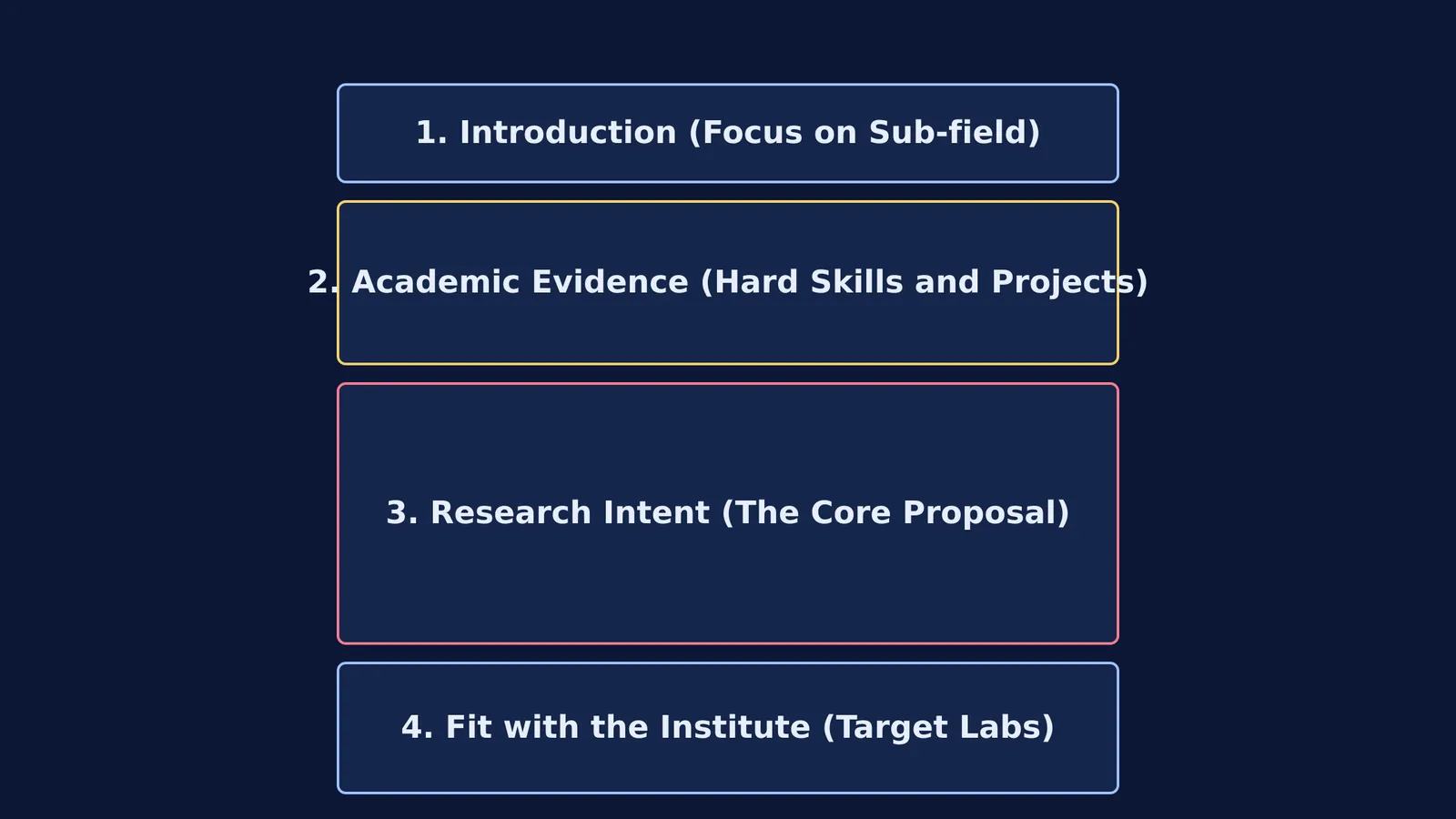
With tight limits, you must avoid generic openings like "Since childhood, I have been fascinated by science." These clichés waste valuable space and do not demonstrate your competence. Instead, break your document into four clear parts:
Introduction: Name the specific sub-field you intend to study immediately. Do not bury the lede.
Academic Evidence: Detail the coursework and projects that prepare you for this field. Focus on the hard skills and methodologies you have mastered.
Research Intent: Propose a problem you want to investigate. This is the core of the document. Show that you have read recent literature and understand the open questions in the domain.
Fit with the Institute: Name a few professors whose current research aligns with yours. Explain exactly why their lab is the right place for your proposed work.
How do you show evidence of research skills?
Admissions committees want proof that you can handle independent, unstructured work. You must show evidence of pushing past a plateau. Just as students plateau despite studying every day, researchers often get stuck; your SOP should show how you evaluate and fix your methods when that happens.
Instead of writing "I did a project on machine learning," be specific: "I implemented a random forest model to predict crop yields, but when the accuracy stalled, I applied principal component analysis to reduce noise and improved the performance significantly." This shows that you understand the mechanics behind the tools you use.
If you are shortlisted based on your SOP, you will face a technical interview where professors test your fundamentals to see if you can back up your claims. If you are preparing for this and not knowing where to start, Fermi works out what you already know, builds a plan for the session, and teaches through it. When revising the mathematical models or physics fundamentals behind your undergraduate projects, you can use the Fermi Problem Library, which provides worked problems with a step-by-step solver that explains the reasoning rather than printing an answer.
How do you structure a character-limited SOP?
For portals with strict limits, ruthless editing is required. You do not have room for a narrative arc. Use this structural framework to draft your statement effectively:
Introduction: State the specific problem area immediately (e.g., "My research interest is in computational fluid dynamics, specifically modelling turbulent flow in microchannels").
Evidence: Describe your strongest piece of evidence. Name the tool, the method, and the result of your final-year project. Do not list every project you have ever done; pick the most relevant one and explain your exact contribution.
The Gap: Identify the gap you want to explore in their programme. What is the specific question you want to answer during your MS or PhD?
The Target: Name the specific laboratory or faculty member whose recent papers you have read and want to contribute to, showing that your application is highly targeted.
Write your draft in a plain text editor to avoid copying hidden formatting characters into the portal, and verify the character count—including spaces—before you submit. A common mistake is submitting a first draft without peer review. You should always ask a mentor or a current graduate student to read your SOP and point out any vague claims before you finalize it. Doing this carefully ensures your application is not rejected on a technicality.


