

On this page
The first hurdle most graduates worry about is whether an Indian degree is valid overseas. On June 13, 2014, India's National Board of Accreditation (NBA) became a permanent signatory of the Washington Accord 1. This international agreement ensures that engineering degrees from member nations are treated as substantially equivalent. However, this only applies if you graduated after that date from a Tier-1 institution with an NBA-accredited program.
If your degree meets these criteria, you do not have to prove its equivalency when applying for jobs or higher studies in signatory countries like the U.S., the U.K., and Australia. If you graduated from a Tier-2 or non-accredited college, your degree is still a valid bachelor's, but some employers or universities may require a third-party credential evaluation.
Can I get a job abroad directly after B.Tech?
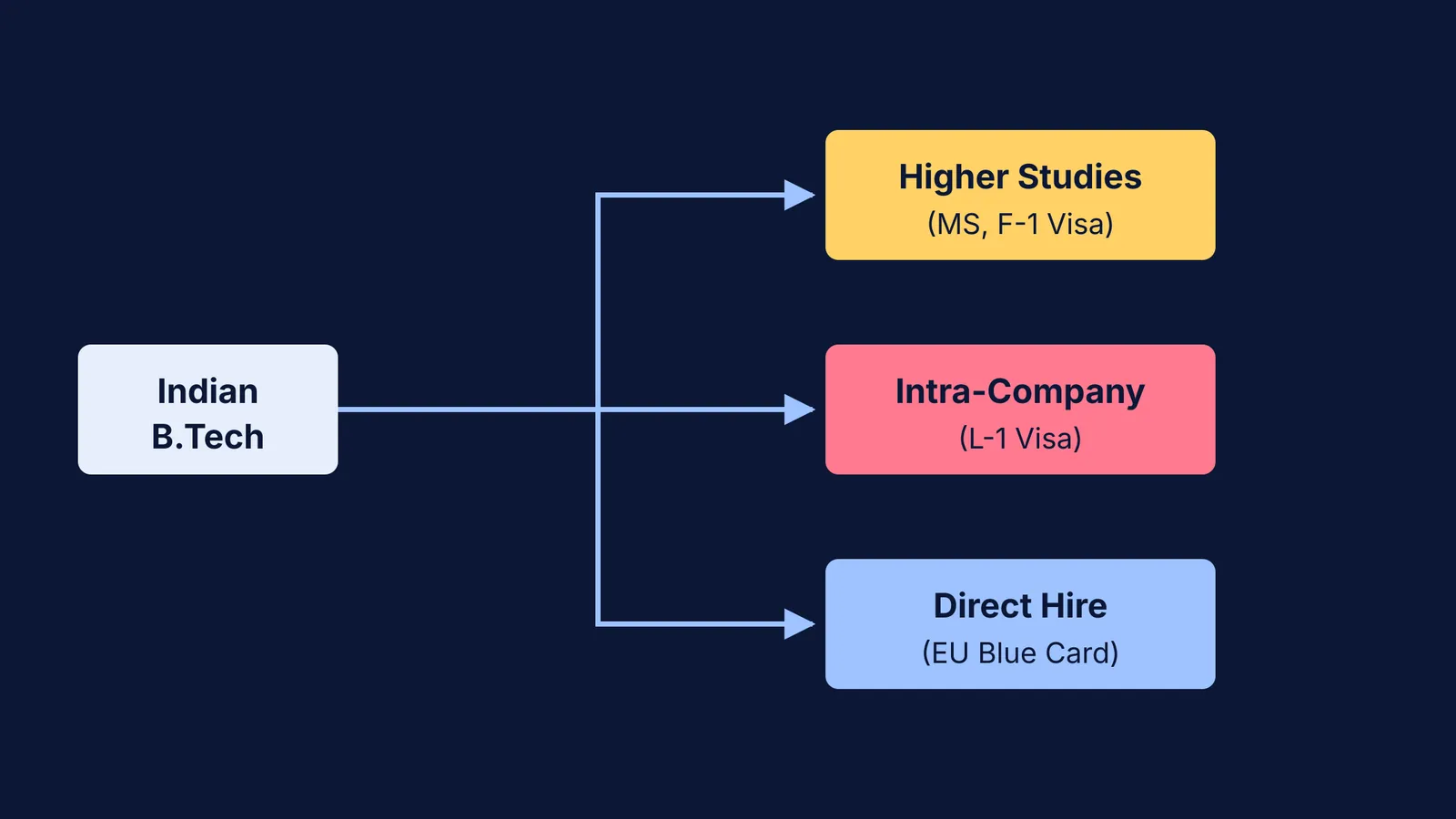
Getting hired directly from India by a foreign company is possible but highly competitive. In the U.S., direct hires typically require an H-1B visa, which is subject to a strict annual cap and awarded through a lottery system. Because of this uncertainty, U.S. employers are often reluctant to sponsor fresh graduates directly unless they have highly specialised skills.
The European Union offers a more straightforward path through the EU Blue Card. Germany, for example, has streamlined its immigration laws for skilled workers. For 2026, the EU Blue Card salary threshold in Germany for shortage occupations like IT and engineering is set at €45,934.20 per year 2. If you secure a job offer meeting this salary, you can obtain the visa without facing a lottery.
Building the niche tech skills required for these direct roles takes a deep understanding of core subjects. Fermi's AI tutor can work out what you already know and build a plan for the session, helping you master complex engineering concepts step by step.
What is the intra-company transfer route?
If applying directly feels too daunting, the intra-company transfer is a reliable alternative. You start by joining a multinational company (MNC) with offices in India, such as a major tech firm or a global consultancy.
After working there for at least one continuous year, you can request a transfer to an overseas branch 3. In the U.S., this is done via the L-1 visa. Unlike the H-1B, the L-1 visa has no annual cap and no lottery, making it a highly predictable route if your employer is willing to sponsor you. The catch is that you are tied to that specific employer; you cannot switch companies once abroad without changing your visa status.
Why do most students choose the higher studies route?
Because direct employment is difficult and internal transfers take time, pursuing a master's degree remains the most popular pathway. The Open Doors 2024 report states that 331,602 Indian students were enrolled in the U.S. during the 2023-24 academic year, making India the leading source of international students 4.
Studying abroad grants you a post-study work visa—such as the Optional Practical Training (OPT) period in the U.S. or the Graduate Route in the U.K. This gives you an extended period to work locally without needing employer sponsorship upfront, allowing you to build a local network and prove your value to a company before they enter you into the work visa lottery.
If you are considering this path during your first semester at science or engineering college, keeping your CGPA high is essential. When talking about STEM careers with your family, it helps to present a clear timeline of the exams and finances required for a master's degree.
A checklist for planning your route
If you want to work abroad, decide on your primary path early:
Intra-company transfer: Join a multinational firm in India, perform well for at least one continuous year, and apply for internal global mobility roles 3.
Higher studies: Maintain a strong academic record, prepare for entrance exams like the GRE or TOEFL, and plan your finances.
Direct hire: Master a niche technical skill, build a public portfolio of projects, and apply to EU companies that actively sponsor visas.
When preparing for technical interviews or entrance exams along the way, the Fermi Problem Library has worked problems with a step-by-step solver that explains the reasoning rather than printing an answer, ensuring your foundational knowledge is solid.


