

On this page
Wikipedia is not just a place to look up facts; it is a live encyclopedia built by volunteers, and you can be one of them. Many students use it daily for exam prep or homework. However, contributing to it requires learning a specific set of academic skills.
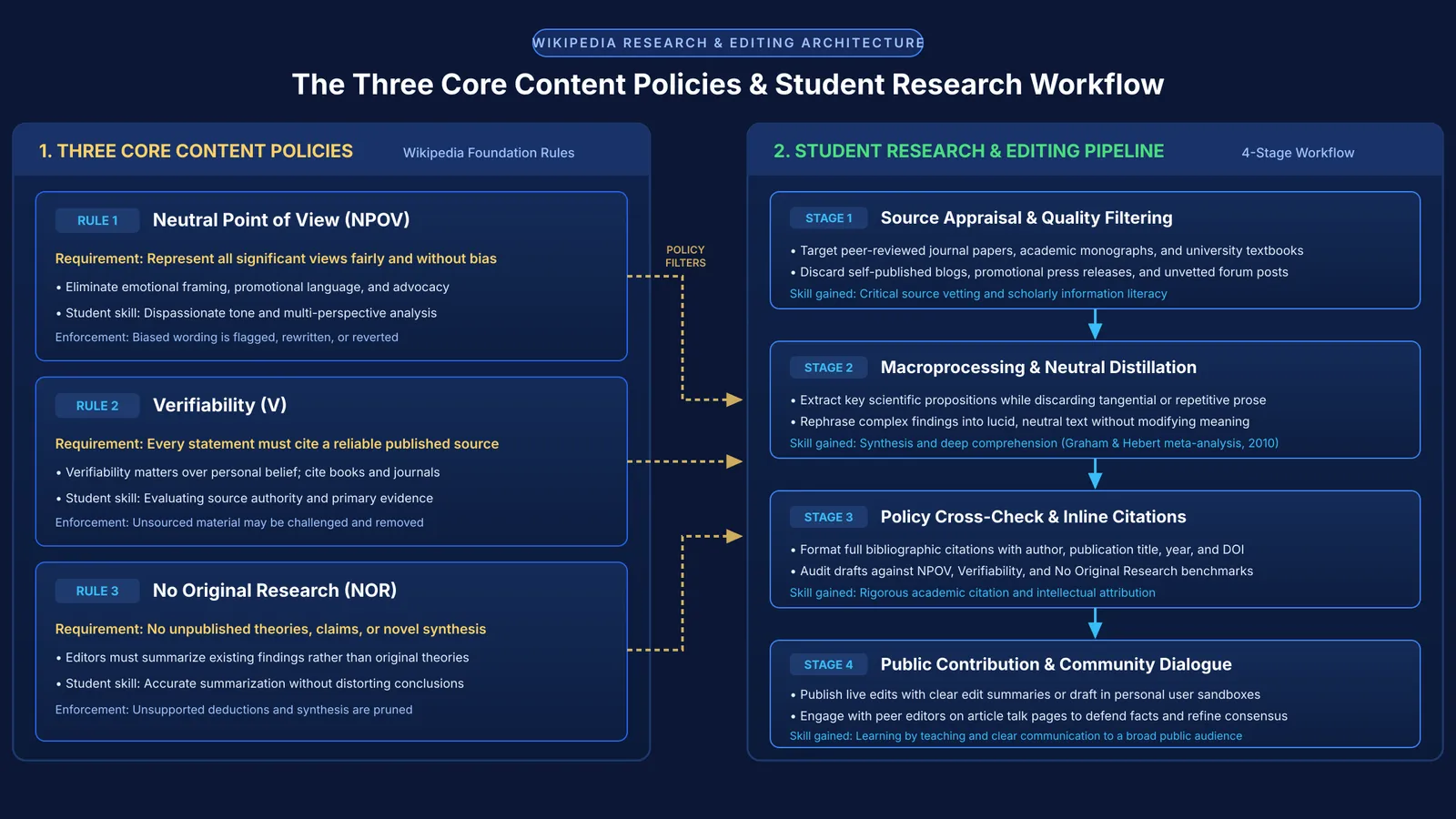
To make an edit that "sticks" and does not get reversed or removed by other editors, you must follow three core content policies. These rules are designed to keep the platform reliable, but they also happen to be excellent training for your own school research projects.
How do you edit Wikipedia articles?
First, your writing must have a neutral point of view. You cannot take sides or use emotional language. Instead of saying a scientist made a "brilliant discovery", you state what they discovered and who praised it.
Second, the rule of verifiability means every claim you make must be backed by a published, reliable source.
Finally, Wikipedia has a strict no original research rule. You cannot publish your own theories, personal experiences, or a new conclusion you reached by combining different facts. Your job is simply to summarize what experts have already published.
Why does writing summaries improve learning?
Editing Wikipedia is essentially an exercise in strict, accurate summarization. But why should you spend your study time doing this? A 2010 meta-analysis by Steve Graham and Michael Hebert, published by the Carnegie Corporation, found that writing about a text—such as summarizing it—is more effective for improving reading comprehension than simply reading and rereading it.
When you summarize a complex topic for Wikipedia, you engage in a cognitive process called macroprocessing. You have to separate the main ideas from the minor details, organize them logically, and put them into your own words without changing the original meaning. This effort creates a permanent record of your understanding, which helps you retain the information longer.
It also reduces your cognitive load. By condensing a long chapter into its absolute essence, you create a more manageable mental model of the subject in your head. It is a form of learning by teaching, because you are explaining the concept to a general audience.
What counts as a reliable source?
Under Wikipedia's reliable sources guideline, understanding how to read a scientific paper becomes useful. You cannot cite a personal blog, a social media post, or a self-published website. Instead, you need to rely on established textbooks, peer-reviewed scientific journals, and reputable news outlets.
Finding and citing these high-quality sources trains you to evaluate evidence critically. You learn to ask exactly where a fact came from and whether the author had the expertise to make the claim.
How can you practice summarizing safely?
If you are nervous about editing live Wikipedia pages immediately, you can practice the same skills in your own study notebook. Take a textbook chapter you just finished reading. Try to write a concise one-paragraph summary of the entire chapter, ensuring you cover only the most critical ideas without adding your own opinion. Then, try to condense that down to a single sentence. This scaling exercise forces your brain to prioritize information.
Just as Wikipedia requires strict sourcing to solve disagreements, tackling complex physics and maths problems requires a structured approach to evidence and formulas. To study worked problems with a step-by-step solver that explains the reasoning, you can explore the Fermi Problem Library. You can also test your own knowledge by writing your own practice questions.
A checklist for your first edit
To get started, try making small improvements to existing articles before writing a whole new page. Use this checklist before you hit publish on your first edit:
Did I read the existing paragraph carefully to ensure my addition fits naturally?
Is my language completely neutral, without any hype words or personal opinions?
Did I avoid adding my own original thoughts or new conclusions?
Is there an inline citation for the fact I just added?
Does the source I cited actually support the claim, and is it from a reliable publisher?
By practising these steps, you are not just helping to build a free encyclopedia. You are training your brain to read actively, evaluate evidence, and write clearly—skills that will help you in every exam and research project you face.


