

On this page
If you want to become a veterinarian in India, admission to recognized veterinary colleges is anchored by national entrance merit. Under regulations from the Department of Animal Husbandry and Dairying and the Veterinary Council of India, admission to the 15% All India Quota seats in the 5.5-year Bachelor of Veterinary Science and Animal Husbandry (B.V.Sc. & A.H.) degree relies exclusively on your NEET-UG rank, while the majority of state veterinary authorities also use NEET-UG scores to fill their 85% state quota seats.
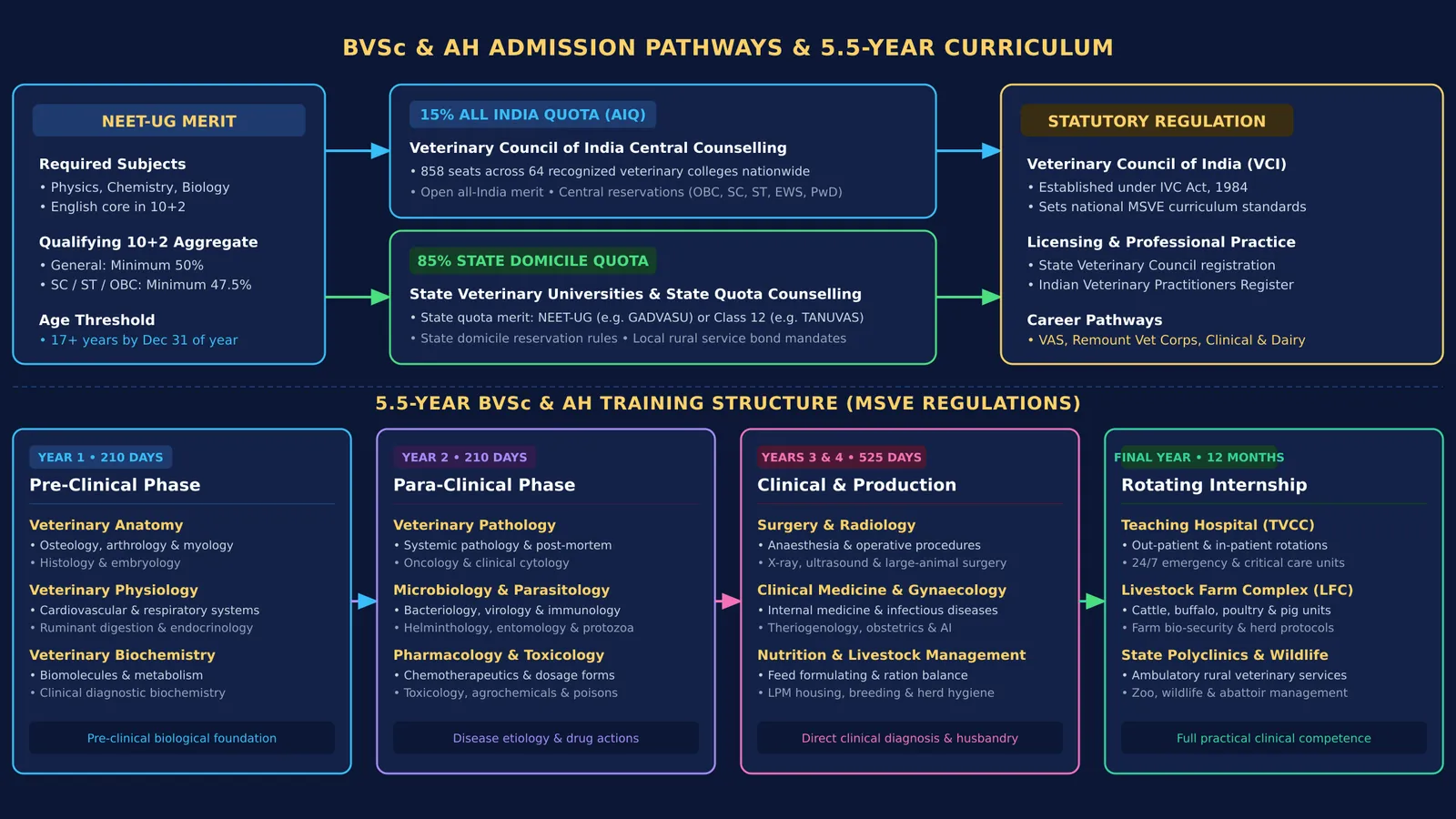
Every recognized veterinary college divides its seats into two streams: the 15% All India Quota (AIQ), administered centrally by the Veterinary Council of India (VCI), and the remaining 85% state quota seats filled by individual state veterinary authorities. Understanding how both tracks operate ensures you do not miss simultaneous counselling windows.
For students reviewing pre-clinical foundations like animal organ systems and biological classification, the Fermi Concept Library covers every concept in physics, chemistry, biology, mathematics and computing, each with its own lesson and its place in the map.
How does veterinary admission through NEET work?
The admission process begins right after the National Testing Agency declares NEET-UG results. Instead of sitting for a standalone pre-veterinary test, your all-India merit rank serves as the primary qualifying metric across both central and state counselling authorities. Candidates must register on respective portals once registration windows open, as seat allocation does not happen automatically.
State veterinary authorities and the central council publish distinct merit lists based on candidate applications. If your score sits slightly below the cutoff for government MBBS seats, veterinary medicine represents an intellectually rich alternative with direct clinical practice and research opportunities.
What is the difference between VCI 15% AIQ and state quota seats?
The two admission pathways differ in jurisdiction, registration portals, and seat matrices:
15% All India Quota (VCI): Centralized counselling takes place on the VCI admissions portal, allocating 858 seats across 64 recognized veterinary colleges nationwide. Candidates compete on all-India merit without state domicile barriers. Central reservations apply: 15% for SC, 7.5% for ST, 27% for OBC-NCL, 10% for EWS, and 5% horizontal reservation for PwD.
85% State Quota: The remaining 85% of seats are reserved for state domicile holders. State universities conduct separate counselling rounds under state reservation rules and local service bond mandates: universities like GADVASU in Punjab use NEET-UG scores for state quota selection, whereas institutions such as TANUVAS in Tamil Nadu evaluate candidates based on Class 12 board marks.
Our guide to NEET UG counselling rounds and quota structures explains how All India Quota and state counselling schedules interact across successive rounds.
What are the eligibility criteria and documents required?
The Minimum Standards of Veterinary Education (MSVE) Regulations set clear baseline criteria under the Department of Animal Husbandry and Dairying:
Age: You must be at least 17 years old on or before December 31 of the admission year.
Subjects: You must have passed 10+2 with Physics, Chemistry, Biology or Biotechnology, and English.
Qualifying marks: General candidates need at least 50% aggregate marks in these four subjects, while SC, ST, and OBC candidates require 47.5%.
Entrance merit: You must obtain a qualifying rank in NEET-UG for the current session.
Check our overview of NEET UG eligibility rules on subjects and qualifying marks for board equivalencies. When numerical problem-solving in physics or physical chemistry slows your revision, the Fermi Problem Library offers worked problems with a step-by-step solver that explains the reasoning rather than printing an answer.
What does the 5.5-year BVSc and AH curriculum actually involve?
Governed by MSVE Regulations from the Veterinary Council of India, the B.V.Sc. & A.H. course spans 5.5 years. The academic curriculum covers 4.5 professional years—comprising three 1-year phases of at least 210 instructional days each and a fourth 1.5-year phase of at least 315 instructional days—followed by a mandatory 12-month rotating internship.
The curriculum progresses through distinct training phases:
Professional Year 1 (Pre-Clinical): Veterinary Anatomy, Veterinary Physiology, and Veterinary Biochemistry.
Professional Year 2 (Para-Clinical): Veterinary Pathology, Microbiology, Parasitology, and Pharmacology and Toxicology.
Professional Years 3 and 4 (Clinical and Production): Surgery and Radiology, Clinical Medicine, Gynaecology and Obstetrics, alongside Animal Nutrition and Livestock Production Management.
During the final 12-month internship, students rotate through the Teaching Veterinary Clinical Complex, Livestock Farm Complex, state polyclinics, and wildlife facilities. Training demands physical stamina: treating non-verbal patients requires sharp observational skills, large-animal restraint (such as handling mature cattle and buffaloes), and field biosafety.
What career paths open after graduating in veterinary science?
Graduating with a B.V.Sc. & A.H. degree and registering with a State Veterinary Council or the Veterinary Council of India opens varied career options:
State Animal Husbandry: Serving as a Gazetted Veterinary Assistant Surgeon (VAS) managing rural dispensaries and disease eradication.
Armed Forces: Commissioning into the Remount Veterinary Corps (RVC) of the Indian Army to manage military canines and horses.
Clinical Practice: Running private companion-animal clinics or working in urban multispeciality veterinary hospitals.
Livestock and Dairy Industry: Overseeing animal health, nutrition, and biosecurity with cooperative dairy federations and commercial poultry enterprises.
Research: Pursuing master's degrees (M.V.Sc.) in animal genetics, epidemiology, or vaccine development.
Our guide on broader conversations about STEM careers beyond clinical human medicine helps families evaluate diverse life science trajectories. When organizing your study routine, Fermi's AI tutor can work out what you already know and build a plan for the session, keeping your prep on track.


