On this page
An internship is meant to be a bridge between academic theory and workplace reality. But as demand for experience grows, many students find themselves caught in a cycle of unpaid labour.
While working for free can sometimes offer genuine learning, it often crosses the line into exploitation. Knowing the difference protects both your time and your career.
Is an unpaid internship worth it for students?
For short-term projects that focus heavily on teaching you a new skill, an unpaid role might be worthwhile. The AICTE Internship Policy explicitly notes that technical internships—which are mandatory for many students—can be "non-compensated". However, these roles are meant to be strictly educational, translating to academic credits.
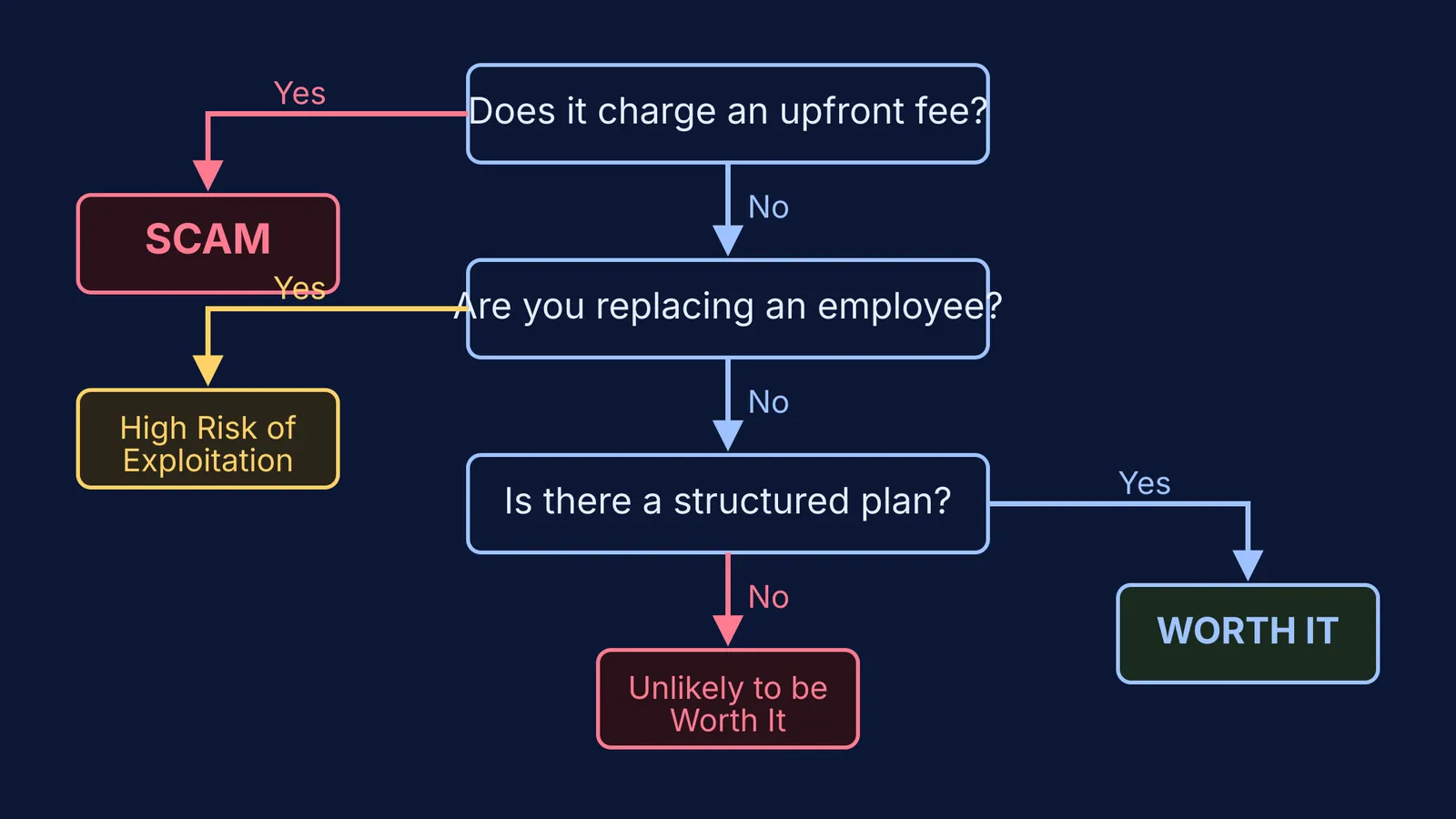
An unpaid internship is only worth it if the mentorship is structured, the tasks are challenging, and the duration is brief. If you are learning the nuances of industrial software from an experienced engineer, the educational value may outweigh the lack of a stipend. It helps you explore your options before committing to a full career, much like talking about STEM careers beyond the most common choices. But if you are simply formatting spreadsheets full-time, you are providing free labour, not gaining experience.
What are the warning signs of a pay-to-work scam?
The most blatant red flag is any request for money. Fraudulent companies often disguise these charges as "onboarding fees," "laptop security deposits," or mandatory "training modules" you must pass before starting the work.
Under formal schemes like the Apprentices Act, 1961, it is illegal for employers to charge trainees; in fact, the act mandates a stipend. Similarly, the AICTE strictly forbids companies from charging students application or placement fees on its national portal. If an employer asks you to pay to work, it is a scam, not an internship.
Instead of paying a dubious company for an internship certificate, you can build verifiable skills that employers actually test for. Focusing on deep, conceptual mastery using Fermi's AI tutor—which holds a line of reasoning across a session and notices where a student is stuck—helps you develop real problem-solving abilities. Gaining these foundational competencies is much closer to building skills that matter with AI than paying for a meaningless line on your resume.
How does the Code on Wages treat unpaid interns?
India's labour laws make the situation complicated. Under the Code on Wages, 2019, an "employee" is defined as someone hired for "hire or reward." Because unpaid interns do not receive wages, they technically fall outside the definition of an employee and are not legally entitled to the minimum wage.
However, this is a grey area. Legal experts warn that if an intern performs regular commercial duties without an educational component, they could be misclassified. If a company treats you like a full-time staff member but uses the label "intern" to avoid paying you, they are taking advantage of this loophole.
The unpaid internship decision checklist
Before accepting an unpaid offer, run it through this five-point check:
Is there any fee? If they ask for payment for training, software, or onboarding, decline the offer immediately.
Who is the mentor? Ask for the name and designation of the person who will be reviewing your work.
What is the learning plan? A legitimate internship will have a clear syllabus or project scope, not just a list of daily chores.
Does the company exist? Check their LinkedIn page. If they have zero employees or no physical address, it might be a data-harvesting shell company.
How long does it last? Unpaid internships should be short. Anything longer without a path to a stipend is exploitative.
If you suspect you have encountered a pay-to-work scam, you can report it to the National Cyber Crime Helpline by dialling 1930.