

On this page
You open the chapter on laws of motion. Do you read the NCERT text first, or jump straight to the exercise at the back? Most students pick one habit and use it for every chapter. The research says the better choice depends on the kind of topic and on how much you already know about it.
Should you study theory first or solve questions first?
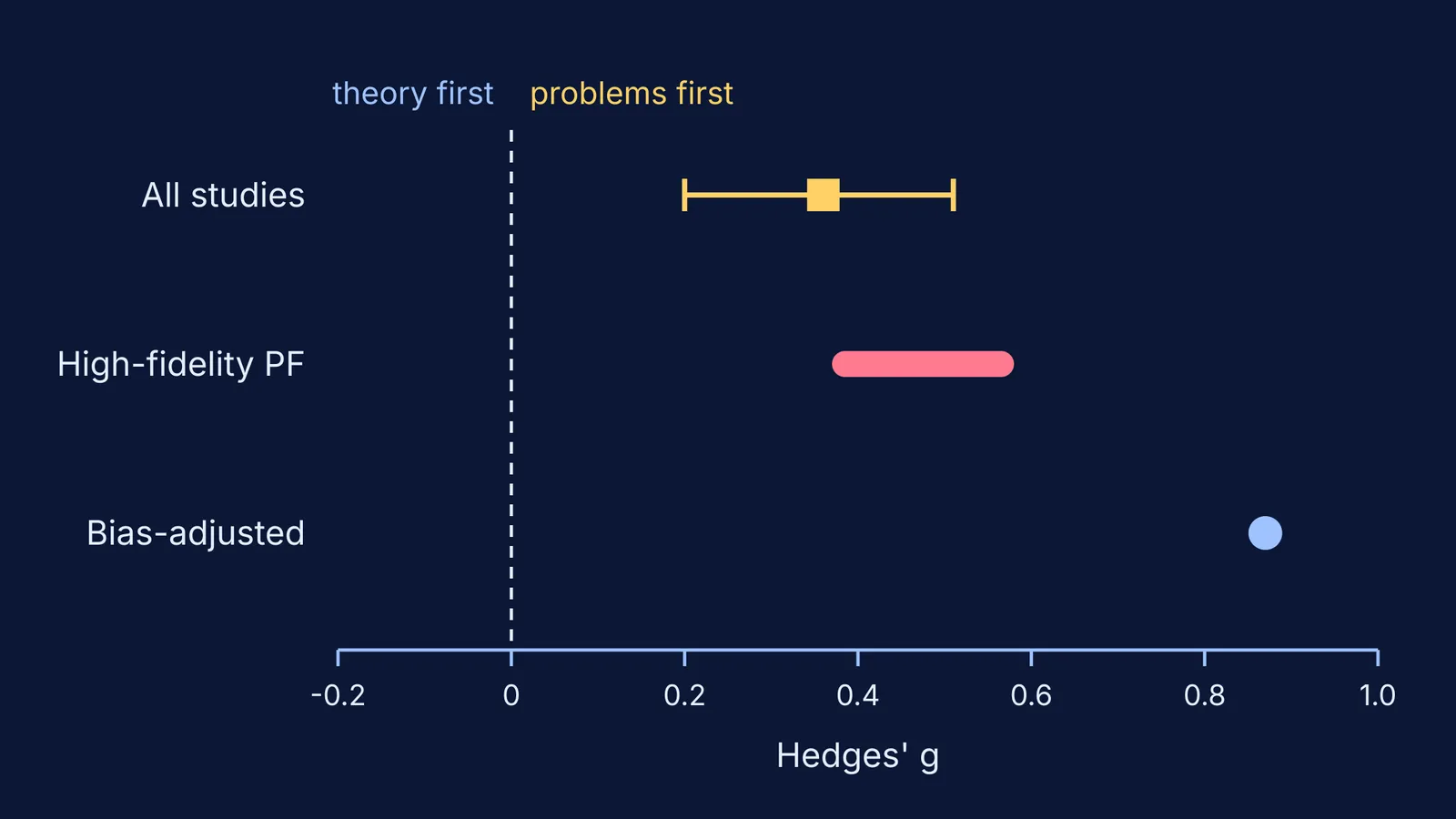
Researchers have tested this directly. In a 2021 meta-analysis in Review of Educational Research, Tanmay Sinha and Manu Kapur pooled 53 studies with 166 comparisons of problem solving followed by instruction against instruction followed by problem solving (Sinha and Kapur, 2021). Problems first came out ahead, with a moderate effect of Hedges' g 0.36. The effect was larger (g 0.37 to 0.58) when the problem-solving phase closely followed the principles of Productive Failure, a carefully designed version of problems first. The same paper found the opposite trend for second to fifth graders and for domain-general skills, where effect sizes favoured instruction first.
There is evidence on the other side too. In a series of algebra experiments, John Sweller and Graham Cooper found that worked examples took much less time to study than conventional problems, and students who studied them then solved problems of the same structure faster and with fewer errors (Sweller and Cooper, 1985). The expertise reversal effect is the finding that teaching methods that work well for inexperienced learners can lose their benefit, or even backfire, for more experienced ones (Kalyuga, Ayres, Chandler and Sweller, 2003).
One way to read these together: struggling with a question helps when you have something to grab onto. When you have nothing at all, a short explanation or one worked example should come first.
When should you start with theory?
The topic is mostly new words. Biological classification, IUPAC naming in organic chemistry, parts of a flower. A question cannot teach you vocabulary you have never seen.
It is a procedure you have never met. Integration by parts, balancing redox equations by the ion-electron method. Read one worked example line by line, then try a similar question.
You cannot write a single line. If you stare at a question and nothing comes, you have no foothold yet. Struggle without a foothold is just waiting.
When should you start with questions?
You already have an everyday sense of it. Friction, motion, heat, current in a circuit. Your first guess, even a wrong one, shows you exactly what the theory needs to fix.
It is your second pass. On revision, questions first tell you which pages you actually need to reread.
The test is coming. Dunlosky and colleagues rated practice testing as one of only two high-utility techniques out of 10 they reviewed, while rereading and highlighting were rated low (Dunlosky et al., 2013).
If you notice you can recite a formula but cannot use it, that is a sign you went theory-only for too long; we explain why in why memorising physics formulas fails.
How do you switch between theory and questions?
Use this four-step loop for one topic in about an hour. These timings are our suggestion, not from a study; adjust them to your chapter.
Try (10 minutes). Attempt two or three questions from the exercise before reading. Write down what you would do, even if you are unsure.
Read (20 minutes). Now read the theory, looking for the exact thing you were missing.
Retry (15 minutes). Redo the same questions without looking at the book.
Mix (15 minutes). Do four or five new questions, some from earlier chapters. Our interleaved practice plan shows how to build that mixed set.
Here is the loop on friction in Class 11 physics. In Try, you meet a block resting on a rough slope and write friction = μN, because that is the formula you remember. In Read, you find that static friction only rises as high as it needs to, up to a maximum of μsN, so your answer was probably too big. In Retry, you work out the friction from the forces along the slope instead. In Mix, you add a question from kinematics so the new idea sits next to old ones.
What if you get stuck in the loop?
A blank page in Try usually means a concept gap. The Fermi Concept Library has a lesson for every concept in physics, chemistry, biology, mathematics and computing, so you can read just the piece you are missing instead of the whole chapter.
A wrong answer in Retry usually means a wrong method. The Fermi Problem Library has worked problems with a step-by-step solver that explains the reasoning rather than printing an answer, so you can see which step went wrong.
For a deeper look at building understanding from the ground up, read how to learn physics from first principles. Then pick tonight's chapter and start with Try.


