On this page
Many engineering students enjoy technology but prefer communication and structure over full-time coding. Technical writing offers a career path that uses your engineering background while focusing on explanation rather than implementation.
What do technical writers do?
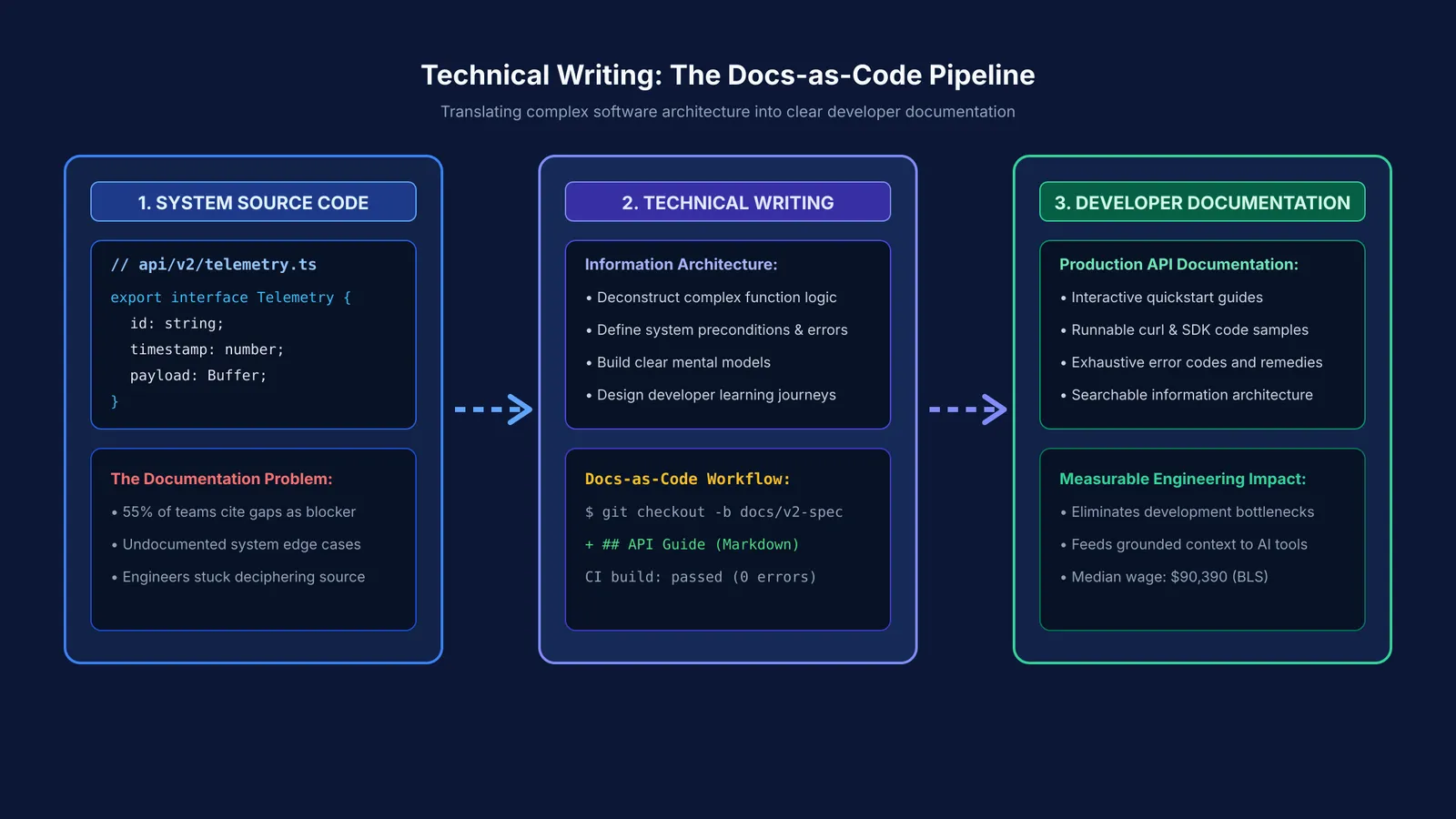
Technical writers create the documentation that allows other people to use a product. In the software industry, this often means writing API documentation, developer guides, system architecture overviews, and tutorials. Modern technical writing is moving toward "Docs-as-Code," where writers use Git, Markdown, and the same continuous integration tools that developers use.
When you are studying for your own exams, you might turn to the Fermi Concept Library to fill gaps in your understanding of physics or chemistry. In the software industry, developers turn to technical writers to fill gaps in their understanding of a codebase. You act as the bridge between the people who built the system and the people who need to use it, translating dense logic into clear instructions.
Why do companies need engineers as writers?
The demand for specialized technical writers is driven by the complexity of modern software. If documentation is missing or inconsistent, development slows down because engineers spend hours reading source code to figure out how a function works. According to Postman's 2025 State of the API Report, 55% of development teams cite inconsistent documentation as a primary blocker in their workflow (Postman).
Engineers have a significant advantage in this field because they can understand complex code, system architectures, and APIs. A writer who can read Python or C++ and understand RESTful principles can immediately start improving developer experience. This technical depth is why companies actively hire writers with engineering backgrounds over those with just a background in English or journalism.
Is technical writing a good career for engineering students?
Technical writing is a stable and lucrative career, especially when you specialize in software and APIs. The U.S. Bureau of Labor Statistics projects 3,200 annual openings for technical writers over the next decade, with a median annual wage of $90,390 (BLS).
In India, the growth of SaaS companies and global capability centres has created a strong market for writers who understand code. While the role is distinct from a software developer, it offers a similar trajectory, often leading to senior roles like Documentation Architect, Developer Advocate, or Product Manager. As explored in our discussion of STEM careers beyond engineering and medicine, roles that combine domain knowledge with clear communication offer resilient career alternatives for science and engineering graduates.
How is AI changing technical writing?
With the rise of large language models, you might wonder if AI will replace technical writers. While AI tools are excellent at drafting initial text or checking grammar, they struggle with system architecture and undocumented edge cases. Postman's 2025 State of the API Report notes that while 41% of developers use AI to generate API documentation, these tools still require human oversight to ensure accuracy (Postman).
In fact, AI has made good technical writing more valuable. Documentation is now the foundation that AI agents use to understand software. If the documentation is ambiguous, the AI will make mistakes. As the World Economic Forum highlighted in our analysis of skills that matter alongside AI, analytical thinking, information architecture, and precise technical communication become more critical when automated tools handle boilerplate text. Technical writers are transitioning into roles where they manage information architecture, ensuring that both human developers and AI assistants have accurate, structured data to work from.
How do you build a technical writing portfolio?
You do not need a specific degree in English to become a technical writer, but you do need a portfolio that proves you can explain complex topics clearly.
Contribute to open source: Find an open-source project and improve its README or contribution guidelines. GitHub's Octoverse 2024 report notes that there are over 17 million developers on GitHub in India, making it a highly active space for open-source contributions (GitHub).
Write tutorials: Build a small project or API, and then write a comprehensive guide on how to use it.
Explain your reasoning: Writing about technical concepts deepens your own understanding. As demonstrated in research on learning by teaching, explaining a mechanism or algorithm step-by-step forces you to confront hidden assumptions. If you are preparing for technical interviews, you can write detailed walkthroughs of problems you solve in the Fermi Problem Library, where worked solutions model step-by-step explanation.
Learn the tools: Familiarize yourself with Markdown, Git, and static site generators. Host your writing samples in a version-controlled repository to demonstrate that you understand developer workflows.
If you enjoy breaking down complex systems into clear, readable steps, technical writing is a career path worth exploring.