

On this page
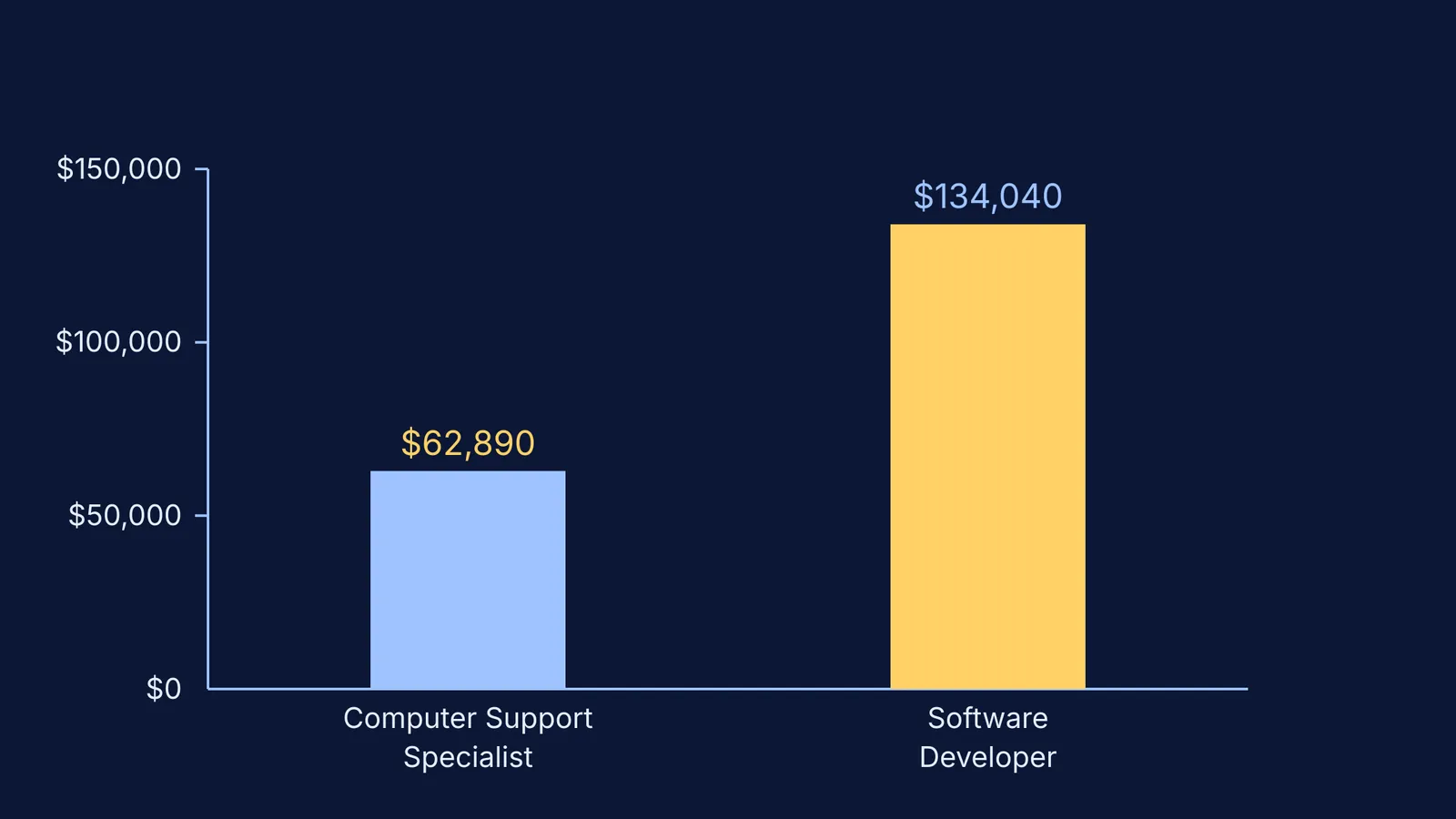
In short Moving from technical support to software engineering is an established path built on debugging skills and user empathy. The U.S. Bureau of Labor Statistics expects software developer jobs to grow 10% from 2025 to 2035, paying a median of USD 134,040 compared to USD 62,890 for support roles.
If you work in technical support, you already spend your day diagnosing problems, reading logs, and dealing with edge cases. These are the same skills that senior engineers use every day.
While learning to write code takes time, your support background gives you a head start. You already know how systems break in production, which is something many junior developers only learn through painful experience. Because of this, transitioning from technical support to software engineering is widely recognised as a viable career change in the technology industry.
Can a technical support job lead to a software engineer?
The leap from support to development is less about starting over and more about pivoting your existing skills. Rather than competing against thousands of computer science graduates for an entry-level position, you can use your internal track record.
In IT support, you develop deep product knowledge and user empathy. You know exactly what confuses customers, where the software fails, and what features cause the most frustration. Engineers with a support background are more likely to write software that accounts for real-world user behaviour because they have dealt with the consequences of poor design.
You also have strong debugging instincts. A developer spends a large portion of their time maintaining and fixing code rather than writing new features from scratch. If you can trace a user's complaint down to a specific error message, database inconsistency, or log entry, you are already doing the diagnostic work of an engineer.
How to transition from IT support to a software developer?
The most successful transitions often happen within the company you already work for. Internal engineering teams value your product knowledge and the context you have built up, making them much more willing to hire a known colleague over an external candidate.
Automate your own tasks: This is an effective first step. Write a script to automate report generation, account resets, or log analysis. This proves you can create solutions, not just troubleshoot them. When you build a tool that saves your team ten hours a week, you have created a tangible engineering portfolio.
Escalate with evidence: When you pass a bug to the engineering team, include a technical hypothesis. Do not just report that "the login page is broken." Query the database or read the application logs to find the exact database exception, showing you are thinking like an engineer.
Look for hybrid roles: Positions like Support Engineer, Solutions Architect, or Tools Engineer sit perfectly between support and development. They require you to read code, write scripts, and fix minor bugs without the pressure of building full-scale features from scratch.
What should you learn first?
To prove you can create software, you need to build a core set of technical skills. Do not try to learn every new framework that appears online. Instead, focus on a solid and enduring foundation:
One programming language: Python or JavaScript are excellent starting points for automation and web development. Understanding mathematical fundamentals, such as the analysis of algorithms or how memory works in languages like Fortran, will give you a stronger grasp of how software runs under the hood.
Databases: Learn SQL to query databases directly. This is an immediate asset in any support role, allowing you to bypass graphical interfaces and investigate data directly.
Version control: Understand how to use Git to track changes and collaborate on code. Every modern engineering team relies on Git.
If you are not sure where to begin, Fermi's AI tutor can work out what you already know and build a plan for your learning sessions, so you sit down to a clear next step instead of feeling overwhelmed. When you need to grasp core programming ideas like loops, functions, or data structures, the Fermi Concept Library maps out every concept with its own lesson.
A plan for your first 30 days
To turn this into a reality, here is a practical checklist for the next month:
Week 1: Choose one repetitive support task and find out if a script can do it faster. Write a simple Python or Bash script to automate it, and test it thoroughly.
Week 2: The next time you escalate a ticket, spend an extra 15 minutes finding the relevant log entry or database row. Add this to your bug report to help the engineers.
Week 3: Ask an engineer on your team to review your automation script. Getting code review feedback is how developers learn best.
Week 4: Start working through small, isolated coding problems. The Fermi Problem Library has worked problems with a step-by-step solver that explains the reasoning rather than printing an answer, which is crucial when learning to debug.
Every line of code you write to solve a real support problem is a portfolio piece. You are not just studying to be an engineer; you are already doing the work.


