

On this page
Online certification courses are no longer just extra lines on your resume. If you navigate the system correctly, they can actually count towards your degree and lighten your course load on campus.
Through the SWAYAM platform, the Indian government offers university-level courses taught by professors from IITs, IISc and other top institutions. If your college agrees, passing these courses means you can skip taking equivalent electives on campus. This gives you the flexibility to learn from experts across the country and choose subjects your local college might not offer.
Here is how the credit transfer system works and what you need to do before signing up.
Can I get credits for NPTEL courses in college?
Yes. In 2021, the University Grants Commission (UGC) updated the "Credit Framework for Online Learning Courses through SWAYAM" Regulations. These guidelines allow Higher Education Institutions to formally recognise online learning.
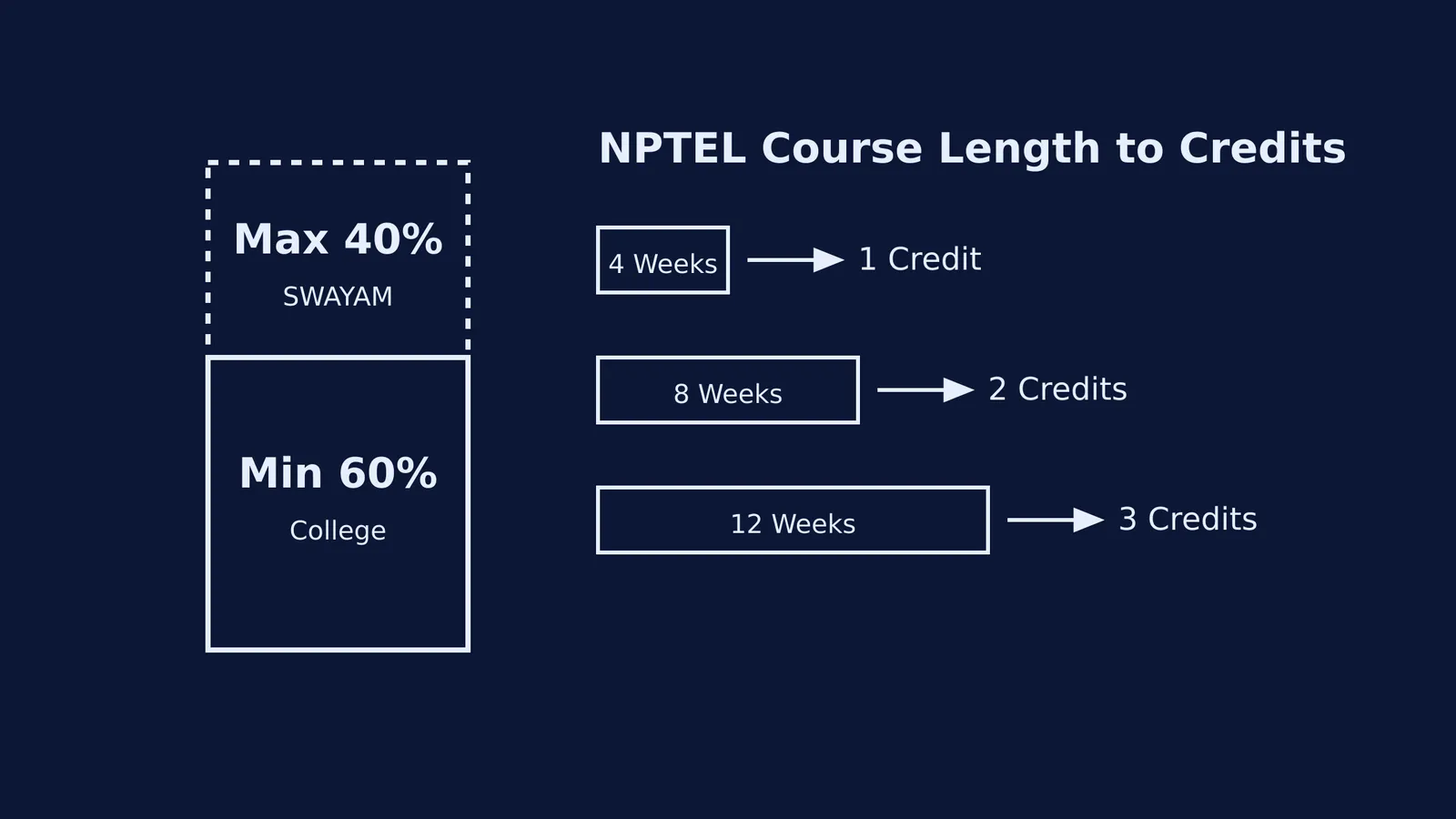
Under this framework, universities can allow students to earn up to 40% of their total credits in a semester through SWAYAM courses.
This means if your semester requires 20 credits, up to 8 of them could theoretically come from online courses. However, the 40% rule is a ceiling, not a mandate. Each individual college must amend its own rules to accept these credits. Many institutions set lower limits or restrict SWAYAM credits to specific categories, such as open electives or minor specialisations, rather than core engineering subjects.
How does the NPTEL credit transfer work?
For engineering and science students, the National Programme on Technology Enhanced Learning (NPTEL) is the main provider of courses on SWAYAM. These courses run on a strict schedule with weekly video lectures, reading materials and assignments. The number of credits you earn depends directly on the length of the course.
According to NPTEL's official guidelines, a 4-week course is equivalent to 1 credit. An 8-week course counts as 2 credits, and a full 12-week course is mapped to 3 credits.
To actually claim these credits, you must pass the course. Registration for the course is free, but you must pay a fee to register for the final proctored exam. Your final score is split into two parts: 25% from your weekly online assignments and 75% from the in-person final exam.
To pass, you must score at least 40 out of 100 on the assignments (which means a minimum of 10/25) and at least 40 out of 100 on the final exam (which means a minimum of 30/75) independently.
Steps to claim your SWAYAM credits
Do not assume a course will count just because it looks related to your major. Follow this checklist before you invest 12 weeks of effort:
Check the approved list: Your college's Board of Studies must officially approve a SWAYAM course for it to map to your curriculum. Ask your Head of Department or the college's SWAYAM Nodal Officer for the current semester's approved list.
Get written permission: Obtain formal consent from your department before registering if you intend to substitute a core or elective subject. If you do not follow the exact administrative process, the university may refuse to add the credits to your transcript.
Link your ABC ID: The Academic Bank of Credits (ABC) stores your earned credits digitally. Ensure your SWAYAM account is linked to your ABC ID so your university can pull your records directly.
Keep up with deadlines: Submit your weekly assignments on time. If you do not meet the 10/25 threshold on assignments, you will not receive a certificate even if you ace the final exam.
Preparing for the rigorous proctored exam
Passing the final exam is often the hardest part of the credit transfer process. Because NPTEL courses are taught by leading researchers, the questions test deep conceptual understanding rather than simple recall.
If you find yourself stuck on the complex assignments or struggling to follow the professor's derivations, consider a structured approach. Using Fermi's AI tutor can help bridge the gap between watching a lecture and solving a hard problem. When you do not know where to start, the tutor works out what you already know and builds a plan for the session. Rather than just printing an answer, it notices where you are stuck and holds a line of reasoning until you master the idea yourself.
You might also find it helpful to look into evidence-based study methods, such as those covered in the 2013 Dunlosky review of study techniques, to make your revision more effective. Additionally, creating a structured schedule, like using an AI tutor in the week before an exam, can keep you on track.
Remember, your college makes the final call on credit transfers. Always communicate with your professors early in the semester, and you can successfully turn your online learning into progress toward your degree.


