

On this page
The transition from Class 11 to Class 12 is a critical pivot in a student's academic journey. Class 11 often feels rushed, leaving students with a backlog of difficult chapters in mechanics or organic chemistry. The summer break offers a rare window of unstructured time before the final school year begins. The competition for engineering and medical seats is intense: in 2024, a record-breaking 14,15,110 unique candidates appeared for the JEE Main exam NTA. For medical aspirants, 2,333,297 candidates appeared for the NEET UG exam in 2024 NTA. Using these weeks well can fundamentally change your trajectory.
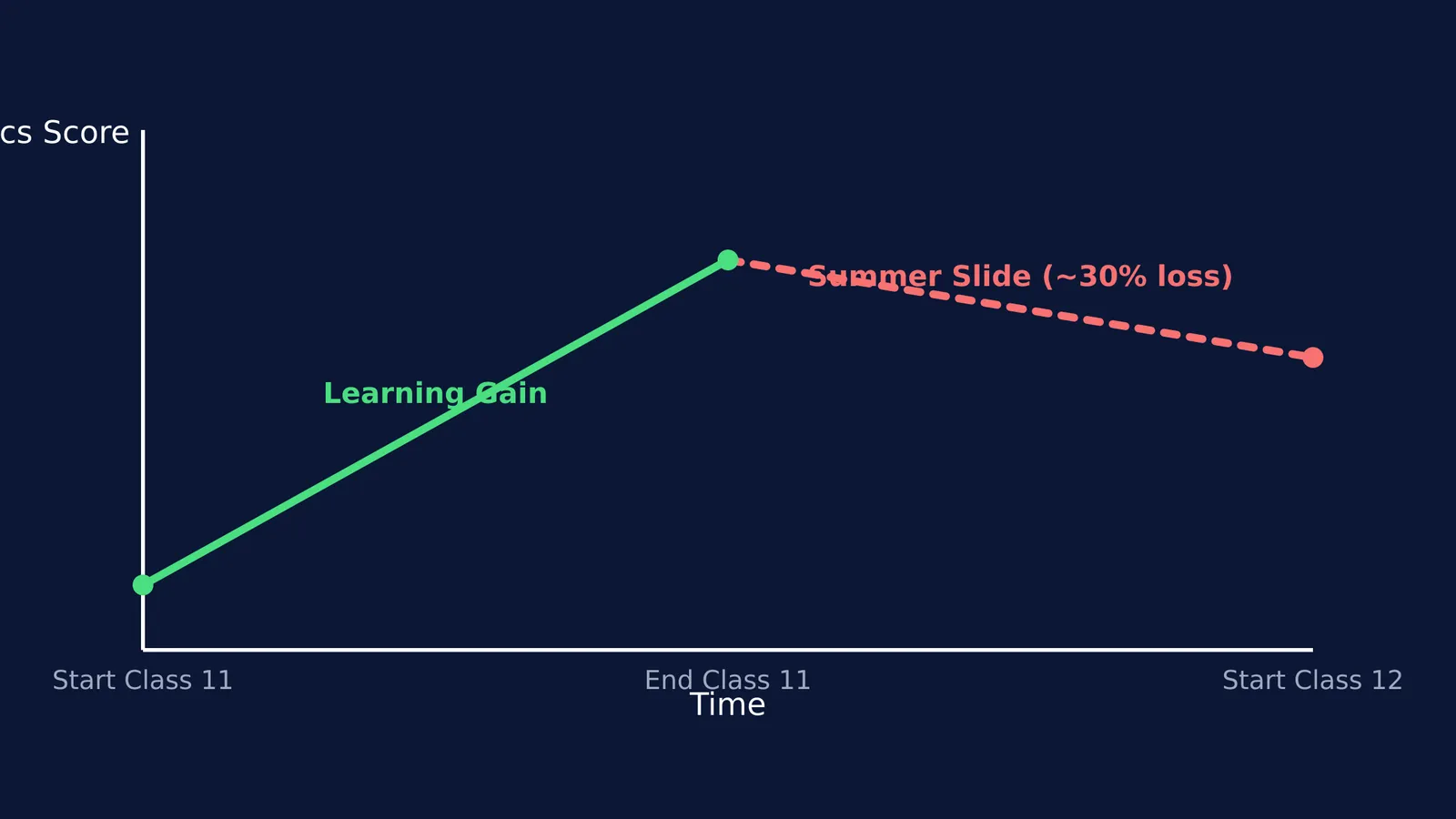
However, taking a complete break from academics carries a measurable cost. According to the NWEA MAP Growth Norms, students lose an average of 2 to 7 RIT points in mathematics over the summer NWEA. This decline represents 10% to 30% of the total learning gains made during the preceding school year. The skills most vulnerable to this "summer slide" are procedural computation and multi-step tasks—exactly what physics and physical chemistry demand.
Why do you need a summer plan?
A blank calendar can lead to either burnout or procrastination. Without a structured school timetable, students often over-commit. They plan to study from dawn to dusk, only to give up completely by the second week. A structured, realistic plan keeps you moving forward without exhausting your motivation before Class 12 even begins.
The goal is to maintain a steady pace. You need to repair the gaps in your existing knowledge while preparing for the heavier workload of the coming year. If you struggle to know where to begin, Fermi's AI tutor can work out what you already know and build a plan for the session, so you sit down to a clear next step instead of a blank page.
How to clear your Class 11 backlog?
Before starting Class 12 chapters, identify the Class 11 topics that slow you down. The syllabus is interconnected. A gap in Class 11 rotational mechanics will make Class 12 electrostatics significantly harder, and weak chemical bonding will stall your progress in coordination compounds.
Audit your syllabus: Make a comprehensive list of all Class 11 chapters. Be honest with yourself and mark them as strong, average, or weak.
Target the prerequisites: Prioritise weak chapters that form the foundation for Class 12. For JEE, focus on coordinate geometry, basic calculus, and general organic chemistry. For NEET, ensure human physiology, cell biology, and plant diversity are completely solid.
Fix wrong methods: If you understand the theory but get stuck on problems, your application needs work. The Fermi Problem Library has worked problems with a step-by-step solver that explains the reasoning rather than printing an answer.
How to build an effective summer routine?
Consistency matters much more than total hours spent at a desk. Shorter sessions of highly focused, active learning always beat long periods of passive reading, as highlighted in the Dunlosky review of learning techniques.
Set daily non-negotiables: Pick a couple of subjects to tackle each day. Do not try to study physics, chemistry, mathematics and biology all in one sitting, as context-switching drains your focus.
Use active recall: Test yourself immediately after reading a concept. Close the book and try to write down the key formulas or draw the biological pathway strictly from memory.
Visualize hard ideas: Some concepts in physics and chemistry are notoriously hard to picture from a flat textbook diagram. Use the Fermi Simulation Lab to play with interactive simulations for ideas easier to see than read.
Take weekly tests: Start giving part-syllabus tests every Sunday to build your exam temperament early. Analysing your mistakes is where the real learning happens. If you need a strategy for managing these tests, try an approach for the JEE Main mathematics paper.
What does a summer study framework look like?
If you have a summer break of roughly four weeks, use this framework to structure your time practically and avoid feeling overwhelmed:
Week 1: Diagnosis and repair. Take a full Class 11 mock test under timed conditions. Identify your weakest subjects and spend the week revising those specific theories and fundamental formulas.
Week 2: Heavy problem solving. Move from theoretical revision to active application. Solve a solid block of questions per day strictly on the weak topics you revised in the first week. Focus on accuracy over speed.
Week 3: The Class 12 head start. Pick the first chapters of your Class 12 syllabus for each subject. Read the standard course materials and work through the basic introductory examples to get comfortable with the new material.
Week 4: Integration. Combine your Class 11 revision with your new Class 12 preparation. Take a comprehensive test covering both the Class 11 topics you fixed and the Class 12 topics you just started.
By the time school reopens, you will have protected your Class 11 gains from the summer slide and built a solid, confident foundation for the intense year ahead.


