

On this page
After a seven-hour school day followed by evening coaching or commuting, sitting down to study can feel overwhelming. Many students try to force four or five hours of late-night study, only to find themselves staring at the same page, highlighting random lines, or scrolling on their phones.
When your energy is depleted, adding more hours does not produce more learning. A structured two-hour weekday routine—combining one focused practice block, one spaced revision block, and a short mental reset—outperforms long, unfocused evening marathons.
Why is two hours of active study enough?
The value of a study session depends on the cognitive effort you invest, not the time you spend sitting at a desk. When students have limited time, they often default to re-reading textbooks or copying class notes, assuming that seeing the material again will reinforce memory.
Cognitive science shows that passive repetition is among the least effective ways to learn. In a comprehensive 2013 review published in *Psychological Science in the Public Interest*, John Dunlosky and colleagues evaluated ten common learning techniques across hundreds of empirical trials. The researchers classified passive re-reading and text highlighting as "low utility" because they produce familiarity rather than true comprehension. In contrast, practice testing and distributed (spaced) practice received the highest utility ratings for durable learning. You can explore how these methods compare in our breakdown of the 2013 Dunlosky learning review.
Active retrieval forces your brain to reconstruct knowledge, creating stronger neural pathways. In a landmark study published in *Psychological Science*, Henry Roediger and Jeffrey Karpicke demonstrated that after one week, students who practised retrieval recalled 61% of material, whereas those who repeatedly re-read remembered only 40%. Two hours spent actively testing yourself yields significantly greater retention than five hours of passive reading.
How should you split a two-hour weekday study session?
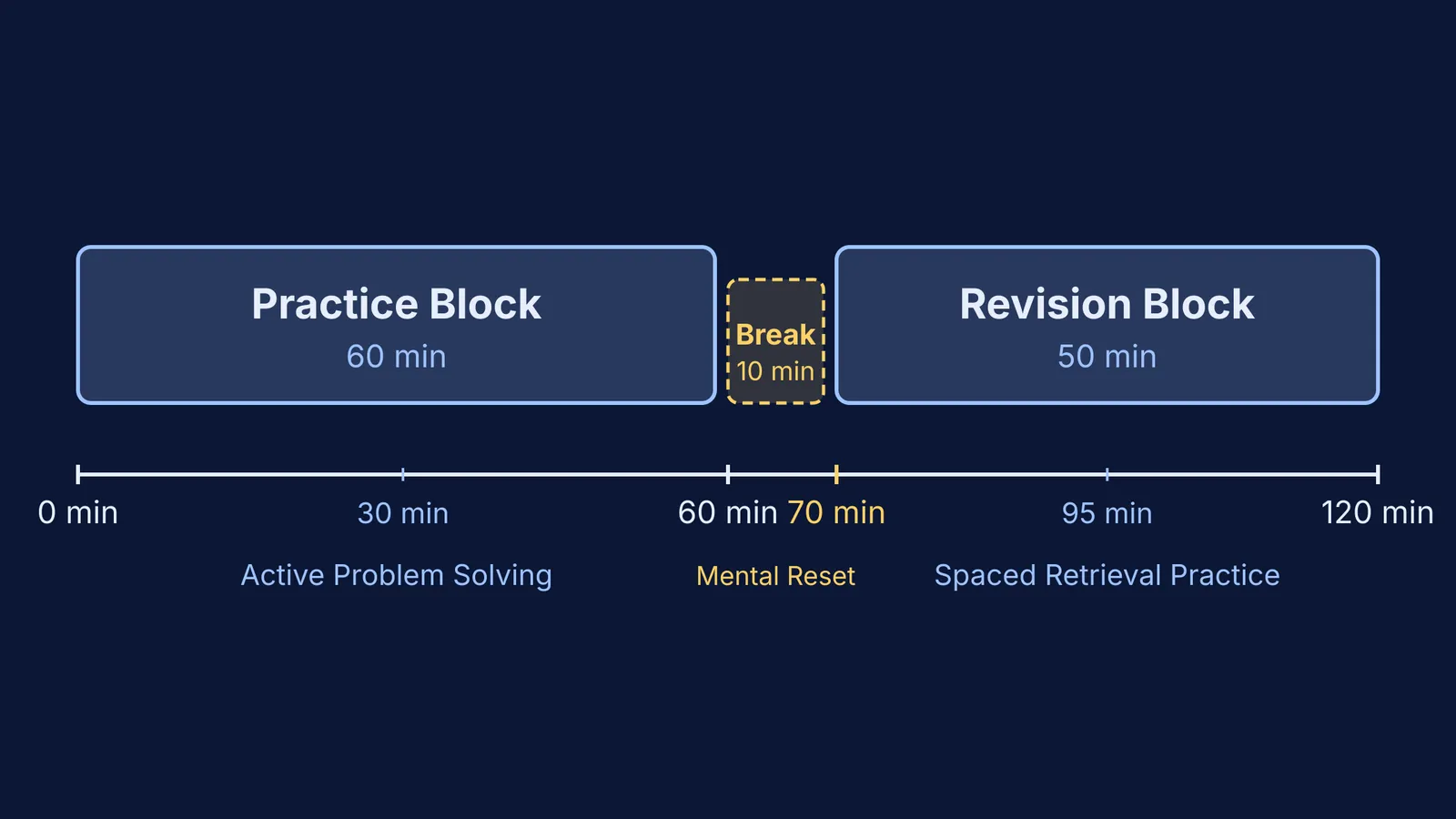
To get the most out of two hours, divide your 120 minutes into two distinct working blocks separated by a brief cognitive reset.
The Practice Block (60 minutes): Focus entirely on today's coursework. Rather than reading the textbook chapter from start to finish, go directly to the assigned problem sets, numerical exercises, or past paper questions. Attempt every problem without looking at the answer key first. When you hit a roadblock on a tricky numerical, rather than peeking at a full solution, the Fermi Problem Library breaks down problems step-by-step, asking guiding questions instead of just giving you the final answer.
The Mental Reset (10 minutes): Step away from your desk completely. Drink water, do light stretches, or walk around the room. Avoid checking social media feeds or messaging apps during this interval, as digital switching adds cognitive friction and makes returning to deep focus difficult.
The Spaced Revision Block (50 minutes): Never spend this second block on today's material. Instead, retrieve concepts studied two to seven days ago.
Spacing your reviews prevents rapid forgetting. In a study of over 1,350 individuals published in *Psychological Science*, Nicholas Cepeda and colleagues showed that for a one-week retention interval, the optimal study gap between sessions is 1 to 2 days, representing 20% to 40% of the retention delay. Reviewing topics from earlier in the week locks them into long-term memory before the traces fade.
If you sit down unsure of which older topics need urgent review, Fermi's AI tutor adapts to how you learn, identifying where you are stuck and checking your understanding along the way. For more guidance on sustaining this structure over a term, read our guide on how to build a study routine that lasts.
How do you handle syllabus backlogs on weekends?
A common fear among students is that two hours a day will not cover heavy board or entrance exam syllabi. Weekdays are designed for maintenance and consolidation, not for swallowing massive new chapters. Trying to cram new foundational theory into an exhausted weekday evening leads to frustration and unfinished tasks.
Use Saturday and Sunday mornings to handle deep backlogs and comprehensive topic reviews:
Schedule dedicated morning blocks: On weekend mornings, your mind is rested. Use an early block for difficult, pending theory and a subsequent block for mixed problem-solving.
Visualise difficult mechanisms: When abstract physical or biological concepts stall your progress, using interactive simulations in the Fermi Simulation Lab explains the core concepts using interactive visualisations.
Simulate exam conditions on Sunday: Spend an uninterrupted morning working through a timed mock section. In a 2018 meta-analysis published in *Psychological Bulletin*, Steven Pan and Timothy Rickard found that practice testing significantly transfers to novel questions and unfamiliar problem formats. Explore the details of how practice tests transfer to new questions.
What common mistakes ruin a short study routine?
When you only have two hours, small inefficiencies can derail your entire evening. Avoid these three common traps:
Treating homework as passive copying: Copying solved examples from reference books into homework notebooks consumes valuable evening time without requiring active thought. Solve each problem on rough paper first, then write down the final derivation.
Fragmenting your study time: Splitting your study hours into short, scattered intervals between meals, phone calls, and chores multiplies switching costs. Keep your two-hour study session continuous.
Starting without a clear target: Sitting at your desk wondering what to study wastes valuable willpower. Write down the exact problem set and revision topic you will tackle the night before.


