

On this page
A week at your grandparents' house in Kerala, a cousin's wedding in Jaipur, a Diwali trip to the hills: none of these needs to be a choice between your family and your syllabus. On a trip, the aim is not to cover new chapters. It is to keep what you have already learnt from fading, so you come home to a short catch-up instead of a backlog.
What kind of studying works on a holiday?
The methods that suit a trip are the ones that need no textbook. In a 2013 review of 10 common study techniques, Dunlosky and colleagues rated practice testing and distributed (spaced) practice as high utility, and rereading and highlighting as low utility.
Practice testing just means pulling ideas out of memory. In Roediger and Karpicke's 2006 experiments, students who recalled a passage from memory remembered more of it two days and one week later than students who reread it, even though the rereaders felt more confident.
So you don't need the heavy books, just a way to quiz yourself a little most days.
What should you carry on a family trip?
Pack light enough that you will actually use it:
A list of chapters you have finished in the last month or so. This is your menu for recall.
Question cards you write before leaving: a question on the front, the answer on the back. One evening of card-writing the week before is enough.
One formula or key-facts sheet per subject, a single page each, for checking yourself after recall.
A thin notebook for writing out everything you remember on a topic.
Earphones, if you have recorded voice notes explaining topics in your own words.
Leave the full textbooks and coaching modules at home. For more on writing good cards, see our guide to flashcards that work for physics and chemistry.
How much should you study each day on a trip?
A short daily session is enough to keep chapters fresh. Spacing research also suggests reviews can be further apart when the exam is further away. In a 2008 study of more than 1,350 people, the best gap between learning and review was about 20 to 40% of the delay for a test one week away, and about 5 to 10% for a test one year away.
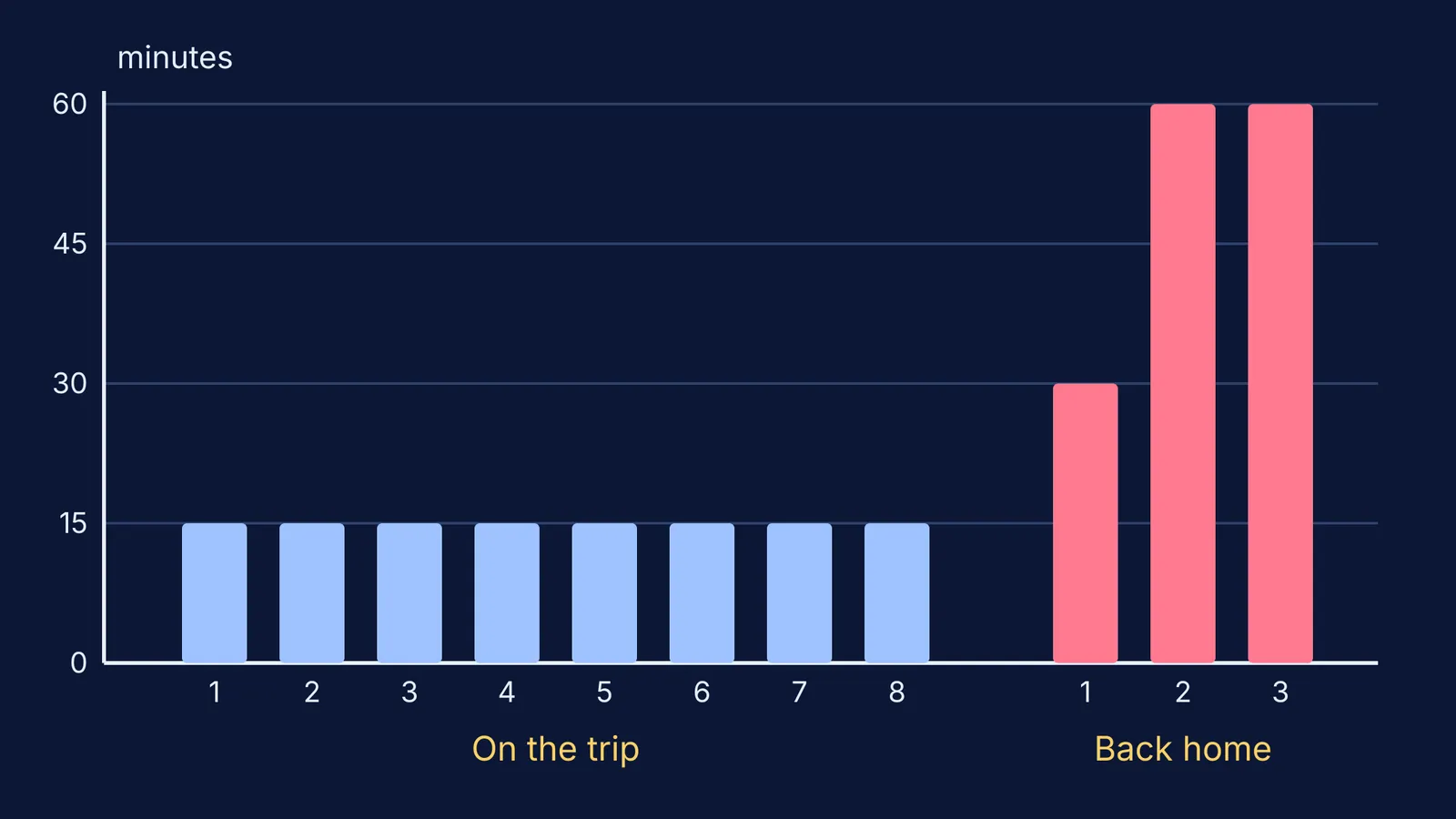
For an exam months away, a few days off is not a disaster; if a unit test falls the week you return, keep the daily session. Here is a 15-minute session that works in a guest room before breakfast:
Minutes 0 to 5: pick one chapter from your list and write everything you remember, without looking.
Minutes 5 to 10: answer 10 cards from that chapter. Put the ones you miss in a "back home" pile.
Minutes 10 to 15: check your notes against the formula sheet. Circle what you forgot and add it to your "back home" list.
Worked example: a Class 11 student on an eight-day trip with six chapters on the list does a different chapter each morning and repeats the two weakest ones on days seven and eight.
What can you do during a train, car or flight journey?
The NHS advises people prone to motion sickness not to read, watch films or use electronic devices while travelling, and to look at a fixed point such as the horizon. So plan travel tasks you can do with your eyes up:
Explain one concept aloud to a parent or sibling, start to finish.
Recite a sequence: the steps of a process, a reaction series, the order of a derivation.
Do mental maths: unit conversions, rough estimates, squares and cubes.
Listen to your own voice notes and pause to predict the next point.
How do you catch up after a family trip?
Your "back home" list is the plan. Since practice testing is one of the two high-utility methods in the Dunlosky review, test yourself first and reread only what you got wrong. Spread it over three days:
Day 1, 30 minutes: sort the list into forgotten facts (back into cards), shaky concepts (to relearn) and class work you missed (get notes from a friend).
Day 2, 60 minutes: relearn the shaky concepts, oldest first.
Day 3, 60 minutes: work through missed class topics. Try the practice questions before reading the solutions.
For a concept that slipped, the Fermi Concept Library has its own lesson for every concept in physics, chemistry, biology, mathematics and computing. If you sit down and don't know where to begin, Fermi's AI tutor can work out what you already know and build a plan for the session.
After day 3, fold your cards into a 4-week spaced revision schedule. If the trip was long and the list keeps growing, use this triage plan to clear a chapter backlog.


