

On this page
The most common mistake students make when studying for board exams is treating mathematics and physics proofs like a storybook. You read through the derivation of the Lens Maker's formula in your textbook, nodding along with each step. It makes perfect sense, so you assume you know it.
But in the exam hall, faced with a blank answer sheet, you freeze at step three. This happens because reading builds an illusion of competence. Exams do not test your ability to understand a derivation when it is presented to you; they test your ability to retrieve that information from memory.
Why do I forget proofs during exams?
When you read a textbook, the author has already done the hard work of organizing the logic. You are simply verifying their algebra line by line. To actually remember a theorem, you need to reconstruct the logical path yourself.
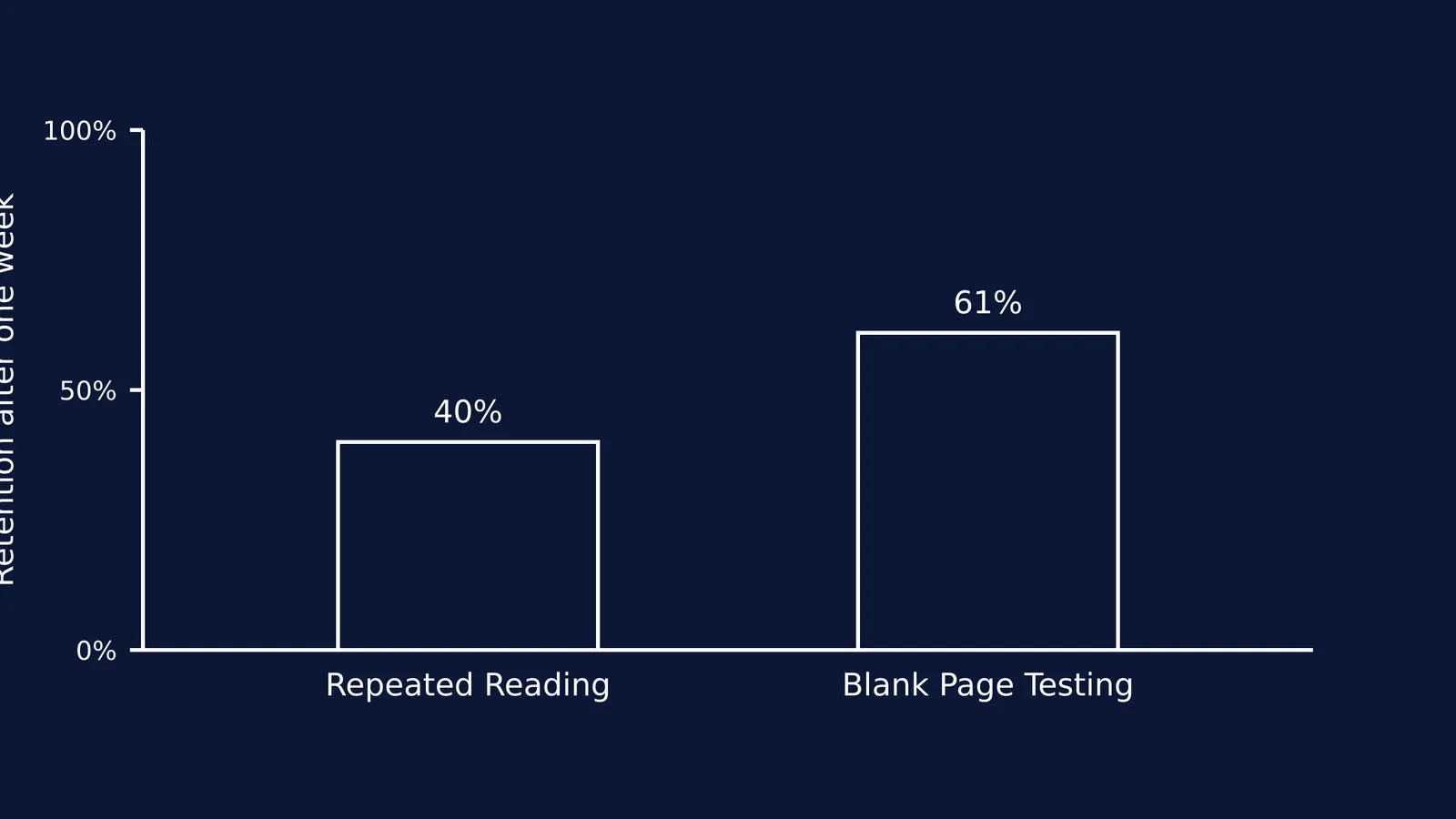
A 2006 study in *Psychological Science* quantified how effective this is: students who tested themselves from memory retained 61% of the material after one week, whereas students who spent the exact same amount of time repeatedly reading the text retained only 40%. The mental effort of pulling the information out of your brain is what makes the memory stick.
How do you find the key idea of a proof?
Every proof or derivation rests on one or two pivotal tricks or starting assumptions. Do not try to memorize lines of algebra. Instead, identify the key idea that reveals the rest of the problem.
For example, when deriving the magnetic field on the axis of a circular current loop, the key idea is resolving the magnetic field vectors into sine and cosine components and realizing that the perpendicular components cancel out due to symmetry. Once you remember that trick, the rest of the derivation is standard integration.
In mathematics, proving the properties of definite integrals often relies on a single clever substitution, such as setting x = a − t. When studying Gauss's law for a sphere, the key idea is defining the correct Gaussian surface and evaluating the dot product between the electric field and the area vector.
Write down a one-sentence summary of the strategy for each proof before you look at the math.
What is the blank page method?
This is the gold standard for mastering derivations. It forces you into active recall and exposes exactly where your understanding is weak.
Study the proof in your notes until you understand the logic.
Close the book and put away all reference materials.
Reconstruct the entire derivation on a blank sheet of paper.
If you get stuck, do not read the rest of the proof. Look at your notes *only* for the specific step you missed, then close the book again and continue. If you had to peek at the textbook, start over from the beginning on a fresh page until you can write it flawlessly from start to finish.
If you find yourself repeatedly stuck on the underlying concepts rather than the steps, Fermi's AI tutor teaches rather than answers. It works out what you know and builds a plan for the session, checking your understanding as it goes instead of just printing the final derivation.
Which derivations are important for Class 12 boards?
In the CBSE Class 12 syllabus, derivations make up a significant chunk of the Physics paper, and theorem proofs frequently appear in Mathematics. Use the blank page method to map out the key steps for these common questions:
Electrostatics: Practice finding the electric field due to an infinitely long straight wire and a charged plane sheet. You should also be comfortable deriving the energy density in an electric field. Always explicitly state your assumptions and the direction of the area vector.
Optics: The Lens Maker's formula and refraction through a prism are exam favourites. Be careful with your sign conventions here. You should also practice drawing the ray diagrams and tracing the image through a lens and mirror.
Electromagnetism: Master the motional EMF in a conductor and the impedance of a series LCR circuit using phasor diagrams.
Mathematics: Focus on the properties of definite integrals and the derivation of the Bayes' theorem formula.
Master the core strategy of the proof, practice retrieving it on a blank page, and the algebra will take care of itself.


