

On this page
Singapore is home to globally recognised institutions such as the National University of Singapore (NUS) and Nanyang Technological University (NTU). For Indian students looking to pursue an undergraduate degree abroad, these universities offer rigorous academics, proximity to home, and a unique fee subsidy scheme.
The application process relies heavily on academic merit rather than the holistic profiles favoured by US colleges. Here is what you need to know about the requirements, the entrance tests, and the tuition grant.
Which are the top universities in Singapore?
Most international applicants target the government-funded autonomous universities. The most competitive are NUS and NTU, both consistently ranked among the top globally for engineering, computing and the sciences (National University of Singapore Admissions).
Singapore Management University (SMU) is highly regarded for business, economics and law, while the Singapore University of Technology and Design (SUTD) focuses on design-led engineering. Applications for the August intake generally open between October and November of the previous year and close by February.
What are the academic requirements for Indian boards?
Singaporean universities recognise the CBSE, ISC and state board qualifications. The selection is fiercely competitive. While the universities do not publish official cut-offs, successful applicants to STEM and computing courses at NUS or NTU typically score above 95% in their Class 12 board exams (NUS Indian Standard 12 Requirements).
Students applying while still in Class 12 must submit their predicted grades or Class 11 transcripts, and update the university portals with their final board marks within days of the results being declared.
If your board marks are hovering near the cut-off or you are tackling weak spots in your preparation, Fermi's AI tutor can work out what you already know and build a plan for the session, so you sit down to a clear next step.
Do Singapore universities require SAT or JEE?
Your requirement for standardised tests depends entirely on your Class 12 board:
CBSE and ISC: Students from these central boards are generally not required to submit SAT, ACT or Advanced Placement (AP) scores to apply to NUS or NTU. However, SMU often requires the SAT from all international applicants.
State Boards: Applicants from Indian state boards must submit scores from the SAT, ACT (with Writing) or AP exams to be eligible for admission at NUS.
While not strictly required for central board students, a competitive SAT score or a strong rank in JEE Advanced is viewed very favourably and can strengthen an application for competitive majors (NTU International Qualifications). If you are preparing for these rigorous exams, the Fermi Problem Library has worked problems with a step-by-step solver that explains the reasoning rather than printing an answer.
For English proficiency, students who studied in English-medium schools and scored well in Class 12 English are usually exempt from taking the IELTS or TOEFL.
What is the MOE Tuition Grant Scheme for international students?
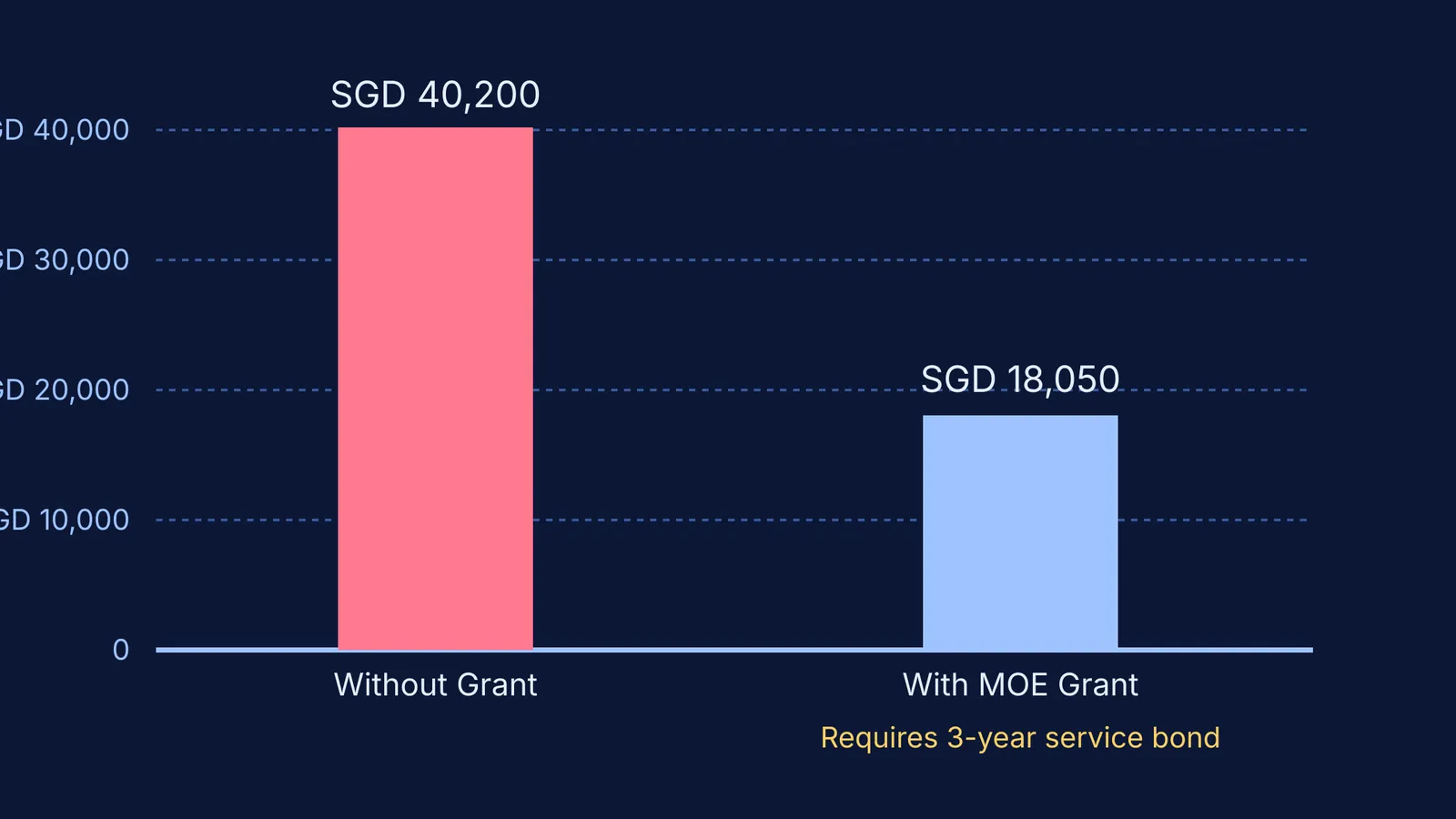
The cost of studying in Singapore is offset by the Ministry of Education (MOE) Tuition Grant Scheme, which is offered to eligible international students based on merit (MOE Tuition Grant).
The grant is substantial: it reduces annual tuition fees by more than 50%. For example, an international student studying computing at NUS might see their fee drop from SGD 40,200 to SGD 18,050 per year (NUS Undergraduate Fees).
In exchange for this subsidy, you must sign a bond committing to work for a Singapore-registered company for three years immediately after graduation. If you break the bond—by leaving the country or dropping out—you must repay the grant with 10% compound interest.
What is the checklist for Indian applicants?
To keep your application on track, ensure you have the following ready by November:
Academic records: Attested copies of your Class 10 board marks and Class 11 final transcripts.
Predicted grades: Your school's official estimate of your Class 12 board marks.
Test scores: SAT, ACT or AP scorecards (if you are from a state board or wish to strengthen a central board application).
Achievements: Certificates for Olympiads, national-level sports or major science fairs (crucial for Aptitude-Based Admissions).
Passport: Ensure it is valid for your student pass application.
Are there interviews for Indian applicants?
Most standard undergraduate applications (like a B.Sc. in Physics or B.Eng. in Mechanical Engineering at NUS or NTU) do not require an interview if your grades are exceptional.
However, interviews and aptitude tests are mandatory if you apply for professional degrees such as medicine, dentistry, law or architecture. They are also required for university-wide undergraduate scholarships or admissions through the Aptitude-Based Admissions (ABA) route, where universities consider your extra-curricular achievements because your grades fall just below the standard cut-off.
Universities like SMU and SUTD follow a more holistic admissions model and tend to interview a larger proportion of their shortlisted applicants.
For more on what to expect once you secure admission, read our guide on your first semester at science or engineering college. Or, if you are balancing Indian entrance exams alongside your applications abroad, see our breakdown of BITSAT basics for JEE aspirants. For families navigating the application process together, learn how parents can help children learn without adding pressure.


