

On this page
Applying to undergraduate programs in Canada requires planning nearly a year in advance of your first class. While Indian students made up approximately 41% of international students in 2023, recent shifts in Canadian study permit rules mean the process now involves more steps and higher financial thresholds.
If you are aiming for the September (Fall) intake, you need to navigate provincial application portals, gather specific documents, and secure provincial approval before you can even apply for a visa. Here is the step-by-step process.
Where do I submit my application?
Unlike the Indian entrance exam system, where you write tests like JEE or NEET, Canadian admissions are based on your school grades, essays, and sometimes video interviews. To submit these, you use one of three main routes:
OUAC (Ontario): If you are applying to the University of Toronto, Waterloo, or McMaster, you will use the Ontario Universities' Application Centre (OUAC). You fill out one central application and choose the specific programs you want to be considered for.
EducationPlannerBC (British Columbia): To apply to the University of British Columbia (UBC) or Simon Fraser University, you submit your details and essays (such as UBC's Personal Profile) through this provincial portal.
Direct applications: Universities in other provinces, like McGill in Quebec or the University of Alberta, often accept applications directly through their own websites.
What documents do I need to apply?
Canadian universities look for consistent academic performance over your high school years. You will need:
Transcripts: Your final marks for Class 10 and Class 11, plus predicted marks for Class 12 (usually provided by your school).
English proficiency proof: A test score like IELTS or TOEFL.
Supplemental essays: Many competitive engineering or commerce programs ask for short essays detailing your extracurricular activities and leadership experience.
If you are preparing for these transitions, learning how to read a scientific paper as a school or college student can be a useful skill to build before you arrive on campus.
When are the application deadlines?
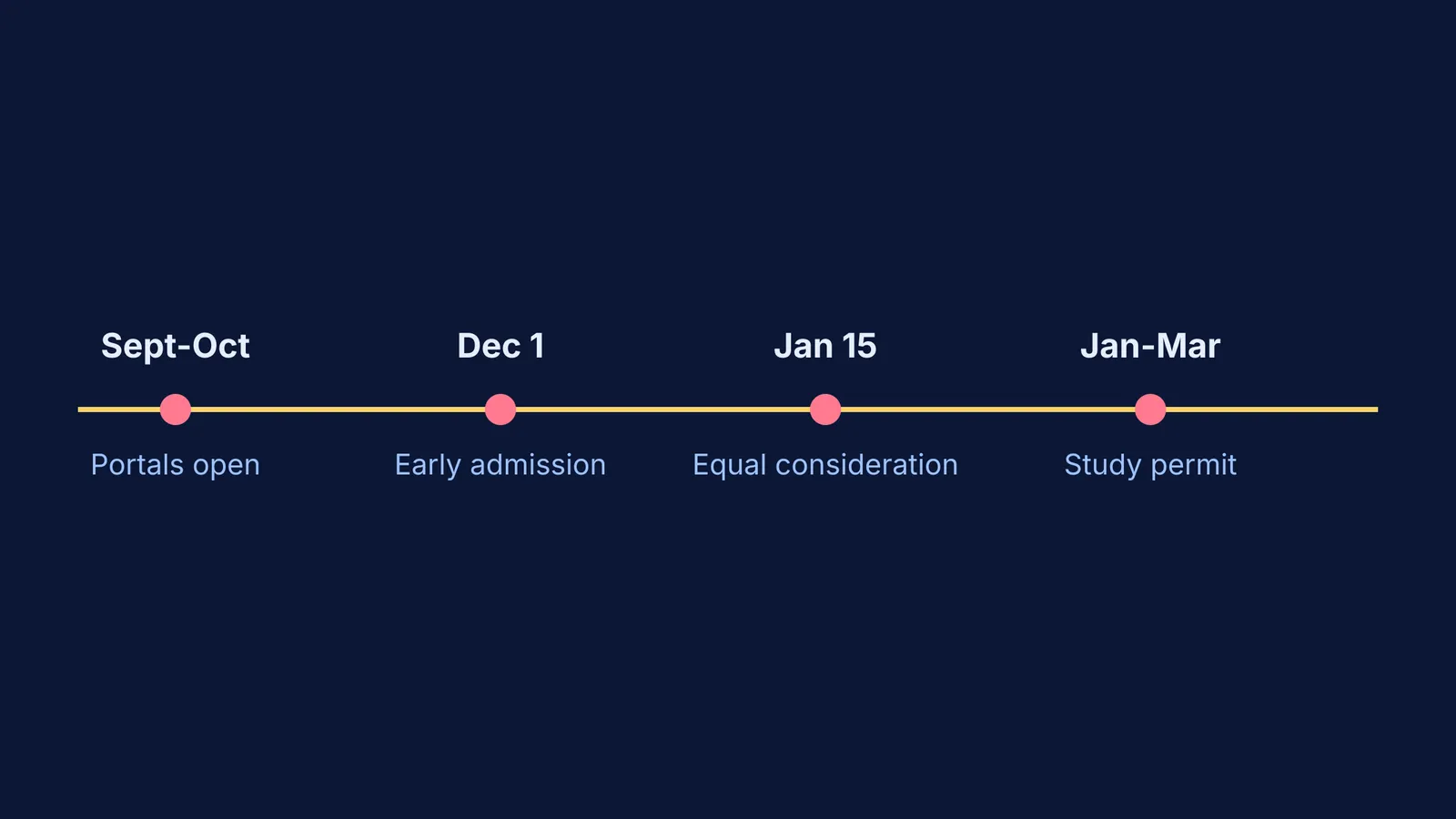
For the Fall 2025 intake, portals opened in late September 2024. While international deadlines vary, these are the critical dates to watch:
December 1, 2024: The deadline for early admission and entrance awards at universities like UBC.
January 15, 2025: The "equal consideration" deadline for most OUAC programs, and the final regular deadline for UBC.
June 30 to July 15, 2025: The window to submit your final official Class 12 board results.
While some universities have rolling admissions through the spring, highly competitive computer science and engineering programs often close by mid-January. If you are struggling to balance board exam preparation with application essays, Fermi's AI tutor can work out what you already know and build a plan for the session, so you can make steady progress on both fronts.
How much proof of funds is required in 2024?
In 2024, the Canadian government introduced significant changes to the study permit process. The minimum financial requirement has increased significantly. To secure a study permit, a single applicant must now show proof of C$20,635 for living expenses, in addition to the first year of tuition and travel costs. This is often demonstrated by purchasing a Guaranteed Investment Certificate (GIC) from a Canadian bank.
Most undergraduate applicants now also require a Provincial Attestation Letter (PAL). This document proves that the province has space for you under the national cap on international students. You do not apply for a PAL yourself; once you accept a university offer and pay a tuition deposit, the institution requests the PAL from the province on your behalf. Only after receiving this letter can you apply for your study permit.
Once the paperwork is filed, you can shift your focus to finishing Class 12 strongly and preparing for your first semester at science or engineering college: what changes.


