

On this page
Most students use one study habit for every subject: read the chapter, highlight it, read it again. A 2013 review of ten study techniques rated rereading and highlighting as low utility, noting that these techniques "do not consistently boost students' performance". The same review rated practice testing and spreading practice over time as high utility. What changes from subject to subject is what a "test" looks like.
Do you study biology and physics the same way?
Not quite. School biology asks you to hold a lot in memory: named structures, processes in order, labelled diagrams. The main risk is forgetting. Physics and maths need fewer facts, but each chapter gives you tools, and the main risk is picking the wrong one.
A classic study by Michelene Chi, Paul Feltovich and Robert Glaser found that experts approach physics problems through the principle underneath, while novices go by the problem's surface features. So biology practice should train recall, and physics practice should train you to spot the principle.
Why does biology need recall practice, not rereading?
In a study by Henry Roediger and Jeffrey Karpicke, students either reread prose passages or took recall tests on them. Rereading did better on a test five minutes later, but on tests two days or a week later, the students who had practised recall remembered substantially more, even though rereading made students feel more confident. Rereading an NCERT biology chapter can feel like learning in the same way.
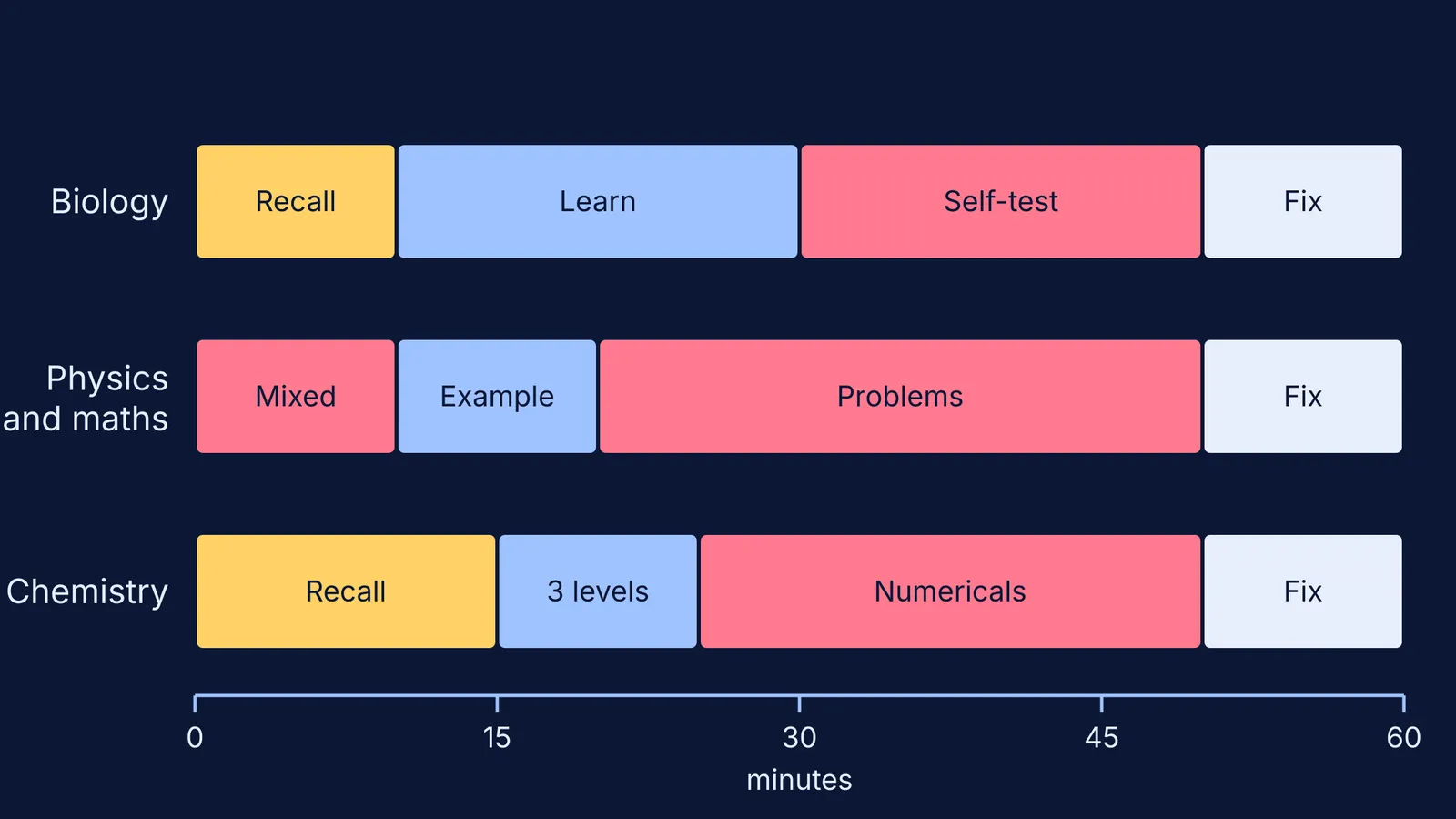
A 60-minute biology session:
10 minutes, blank-page recall: with the book closed, write or draw everything you remember from your last topic, such as a labelled nephron.
20 minutes, new material: read one section; after each subheading, close the book and say the key points aloud.
20 minutes, self-test: answer questions, redraw diagrams and explain processes step by step without looking.
10 minutes, fix: open the book and mark what you missed in a different colour.
Revisit each topic over several days, not in one long sitting.
How should you study physics and maths?
In an experiment by Doug Rohrer and Kelli Taylor, 18 college students learned to find the volumes of four kinds of solids. One group practised the problems in blocks of one type; the other practised them mixed. During practice, the blocked group scored 89% and the mixed group 60%, but on a test a week later the mixed group scored 63% and the blocked group 20%. Almost every test error came from choosing the wrong formula. The authors note limits: college students, procedural maths tasks, a lab setting.
A 60-minute physics or maths session:
10 minutes, mixed warm-up: three unlabelled problems from older chapters.
10 minutes, one worked example from the new topic: cover the solution and predict each step before you uncover it.
30 minutes, problems: a few on the new topic, then mix in older chapters. Before each, write one line naming the principle, such as "Newton's second law on each block".
10 minutes, error log: for every wrong answer, note whether it was the wrong principle, a wrong setup or a calculation slip.
When your error log keeps saying "wrong method", the Fermi Problem Library has worked problems with a step-by-step solver that explains the reasoning rather than printing an answer, so you can see where your approach went off track.
What makes chemistry different?
Chemistry mixes both jobs. Inorganic trends and organic reactions are recall work; mole concept and equilibrium are numerical work. It also asks you to think on three levels at once, which the chemist Alex Johnstone described, as summarised by the Royal Society of Chemistry: the macroscopic (what you can observe), the submicroscopic (particles too small to see) and the symbolic (formulas, equations and diagrams).
A 60-minute chemistry session:
15 minutes, recall: write reactions, trends and exceptions from memory, then check.
10 minutes, three levels: for one new idea, describe what you would see in the beaker, what the particles are doing and the equation.
25 minutes, numericals: mixed problems from this chapter and older ones.
10 minutes, fix: errors go into the same log you use for physics.
If you can balance an equation but cannot picture what the particles are doing, the Fermi Concept Library has a lesson for every concept in physics, chemistry, biology, mathematics and computing, each with its place in the map.
How do you fit all three into a week?
Rotate subjects instead of giving each one a whole day. A NEET-UG aspirant with two free hours each evening could do one biology session plus one physics or chemistry session. Because every session opens with recall or mixed problems, old chapters keep coming back without a separate revision week.
Pick one subject tonight, try its template, and keep the error log going for two weeks before you judge it.


