

On this page
College is often the first time you manage your own money, and deciding how to pay for things is your first major financial test. In India, the choice is shifting fast. According to the Reserve Bank of India, debit card transactions plunged from 4.08 billion in 2021 to 1.33 billion in 2025, largely because students now use the Unified Payments Interface (UPI) for daily expenses. At the same time, credit card volumes more than doubled to 5.7 billion. With outstanding credit card debt hitting ₹2.7 lakh crore in June 2024 according to India Today, deciding whether to get a credit card requires understanding exactly what you are signing up for.
What is the difference between a debit card and a credit card?
The main difference lies in whose money you are spending.
Debit card: You spend your own money. When you buy a coffee, the money moves straight from your bank account to the shop. You cannot spend more than you have, and you pay no interest. For budgeting daily expenses, it is the safest choice.
Credit card: You borrow the bank's money. The bank pays the shop, and you owe the bank. You receive a bill at the end of the month. If you pay the full balance by the due date, you pay no interest. If you leave a balance, the bank charges you to borrow that money.
Because students rarely have a steady income, banks in India usually do not issue them regular unsecured credit cards. Instead, you can get an add-on card linked to your parent's account or a secured credit card backed by a fixed deposit (FD).
How does the minimum amount due trap work?
The biggest risk of a credit card is the interest rate, which in India averages between 36% and 48% per annum (about 3% to 4% per month), according to India Today. This is much higher than most personal loans.
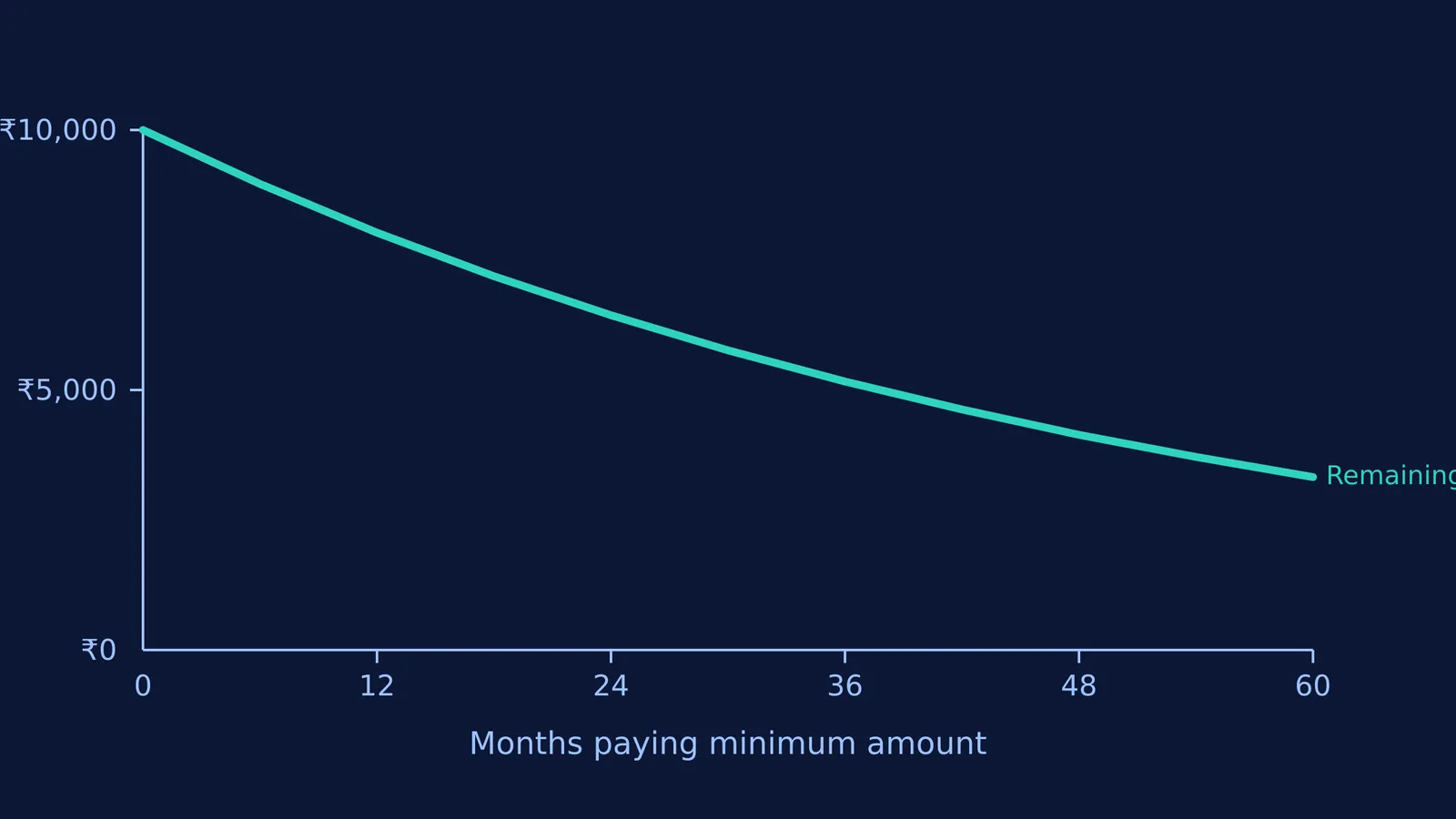
When your bill arrives, it shows a "Total Amount Due" and a "Minimum Amount Due" (MAD). The minimum is usually just 5% of your outstanding balance, as noted by India Today. Paying only the MAD stops late fees but traps you in debt. The bank begins charging interest on the remaining 95% of your balance immediately, and you lose your interest-free grace period for all new purchases.
A 2019 study by Gupta and Verma found that individuals with low financial literacy are significantly more likely to revolve credit card balances and fall into this trap (Gupta and Verma, 2019). Understanding the mathematics of exponential growth can help you see why. Just as we use differential equations to model populations in Population growth and cooling: exponential models via dy/dt = ky, compound interest grows your debt faster than a small minimum payment can shrink it.
Should college students get a credit card?
If you have the discipline to use it correctly, yes. A credit card is a powerful tool for building a good CIBIL score early. A strong credit history will make it much easier to get education loans for higher studies, car loans, or a home loan later on.
To build credit safely, you need the same discipline you use to prepare for exams. When you sit down to study, Fermi's AI tutor can work out what you already know and build a plan for the session, so you sit down to a clear next step. You need a similarly deliberate plan for your finances.
How can students build good credit habits?
Building sound financial habits now will protect you from debt later.
Treat it like a debit card. Never buy something on a credit card unless you already have the money in your bank account.
Set up auto-pay for the full amount. Do not rely on your memory to pay the bill. Set your bank account to automatically pay the "Total Amount Due" (never the minimum) three days before the deadline.
Use UPI for small daily habits. Keep your credit card for planned purchases and use UPI for daily tea and snacks. This makes tracking your remaining cash easier.
Keep your limit low. If you get an FD-backed card, keep the limit small (for example, ₹10,000). A low limit naturally prevents impulsive lifestyle spending.
Planning your finances takes practice. Just as you might Set study goals you actually hit with WOOP and if-then plans, write an if-then rule for your spending: "If I want to buy something over ₹1,000, then I will wait 48 hours before using my credit card."


