

On this page
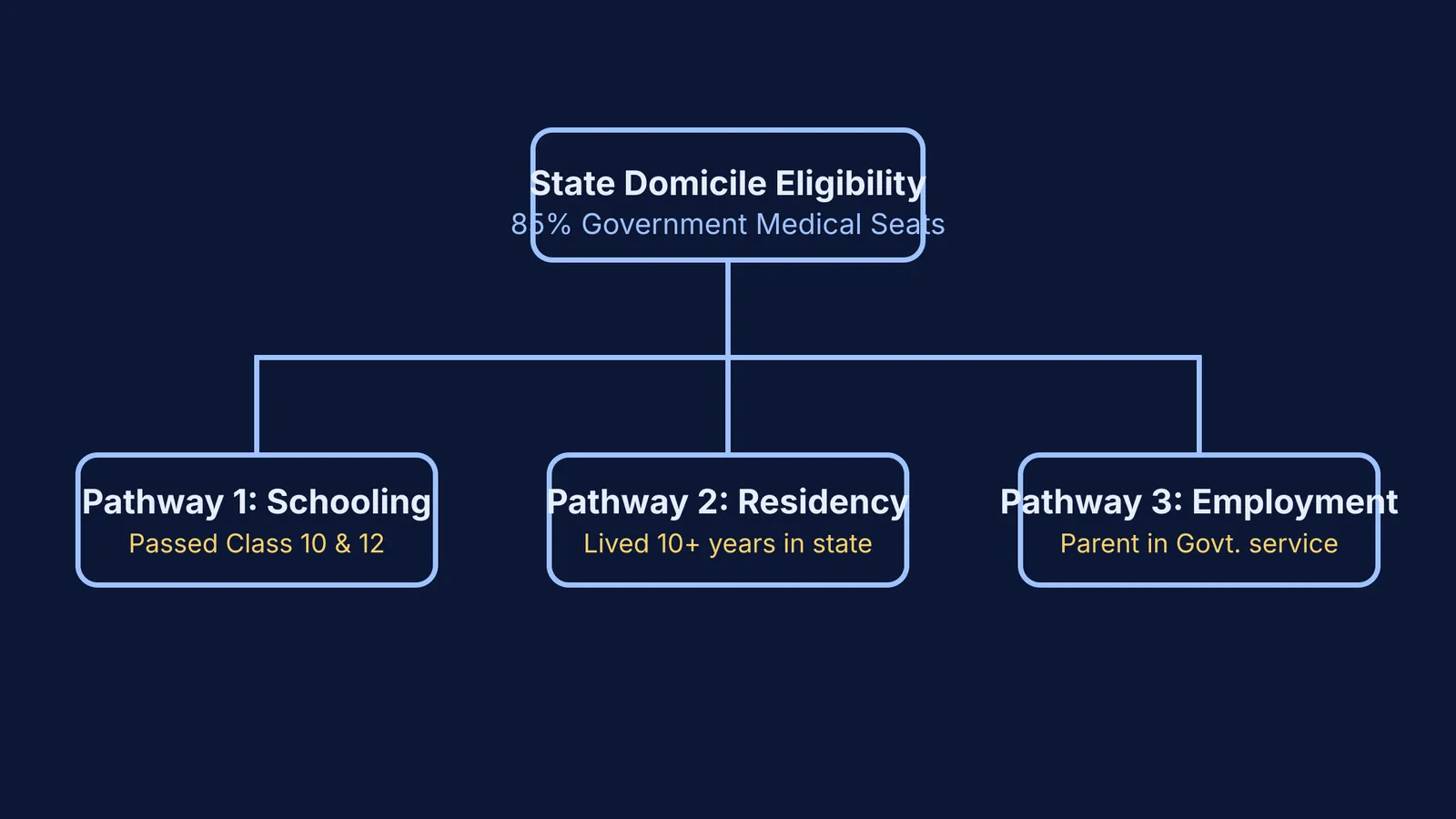
If you are preparing for medical entrance exams, your home state gives you a massive mathematical advantage. Under the current system, 85% of the seats in government medical and dental colleges are reserved for candidates who hold the domicile of that specific state. The remaining 15% are pooled into the All India Quota (AIQ).
However, determining your "home state" for this quota is not as simple as showing an Aadhaar card. Because state governments heavily subsidise these medical colleges, they set strict and highly variable rules to ensure seats go to local students.
What are the common domicile criteria?
While the exact clauses depend on the state's Directorate of Medical Education, most states determine eligibility through one of three main pathways.
The schooling pathway
Many states grant domicile status if you completed your crucial secondary education within their borders. For example, in Uttar Pradesh, you automatically qualify for the state quota if you have passed both Class 10 and Class 12 from a recognized institution located within the state, regardless of where you were born.
The long-term residency pathway
If you did not complete your schooling in the state, you must usually prove long-term residency. In Maharashtra, candidates under "Type A" candidature must hold a state domicile certificate proving they have resided for 10 years in Maharashtra, along with passing Class 10 and 12 there.
The parental employment pathway
Most states offer a route for the children of state or central government employees. If your parent is a Government of India employee currently posted in a state, you are often eligible for that state's quota even if your permanent home is elsewhere.
There are also special provisions for specific regions and edge cases. For instance, Maharashtra allows certain students who studied in the Maharashtra-Karnataka border region and speak Marathi as their mother tongue to claim domicile under its "Type E" candidature. Other states allow you to claim domicile if your parents hold it, which provides a backup if you do not meet the strict schooling rule yourself.
Why do domicile rules differ by state?
Since health and state-funded education are managed at the state level, each government tailors its admissions policy to its own population dynamics and educational infrastructure. States with many medical colleges and lower populations might have relaxed criteria, while states with fewer colleges enforce stringent long-term residency proofs to protect their local students.
Central institutes, however, bypass this system entirely. Institutions such as AIIMS and JIPMER fill their seats at the national level through NEET UG counselling, with no state-based reservations.
Navigating these rules is stressful enough without worrying about whether your physics concepts are solid enough for the state cut-off. If you need help structuring your revision, Fermi's AI tutor can work out what you already know and build a plan for the session, so you sit down to a clear next step.
How do you read the state information brochure?
Every year, ahead of counseling, state authorities release an information brochure. Do not assume last year's rules still apply. When you download your state's brochure, read it with this checklist:
Check the exact certificate issuing authority. A letter from a local politician or a simple utility bill is never enough; states usually demand a domicile certificate signed by a competent state authority, such as a District Magistrate or Sub-Divisional Magistrate.
Look at the difference between "Nativity" and "Residence". While they sound similar, some counseling authorities treat a nativity certificate as proof of birth or ancestral roots in the state, whereas a residence certificate only proves you live there currently. Handing over the wrong document on verification day can lead to instant disqualification.
Verify the dates. Ensure your residency duration (e.g., 5, 7, or 10 years) meets the state's cut-off date, which is often the last date of online registration.
Review language requirements. A few states require proof that you studied the local language up to a certain grade.
If you are a repeater who moved states for coaching, you might be confused about your primary domicile. You can legally claim the state quota in only one state. If you are attempting the exam again and need to clear out pending topics, a triage plan to clear your NEET backlog can help you stay on track.
When you are aiming for top government medical colleges under your state quota, you cannot afford to skip the tough topics. You can use the Fermi Problem Library to work through difficult chemistry or physics questions with a step-by-step solver that explains the reasoning.


